

Dow Jones Industrial Average advances as earnings beat expectations, Fed decision in focus
Bởi Joshua Gibson
Ngày xuất bản: 27 Jan 2026 | Ngày chỉnh sửa: 27 Jan 2026


BÀI VIẾT PHỔ BIẾN

US equities opened the week on a positive note, with the S&P 500 rising 0.5 percent as investors balanced political uncertainty against a heavy slate of earnings and an upcoming Federal Reserve (Fed) decision.
- Stocks rise as earnings and Fed decision offset political uncertainty
- Gold hits record above $5,100 as investors hedge fiscal and trade risks
- Earnings mostly beat, guidance cautious, focus turns to Fed rate outlook
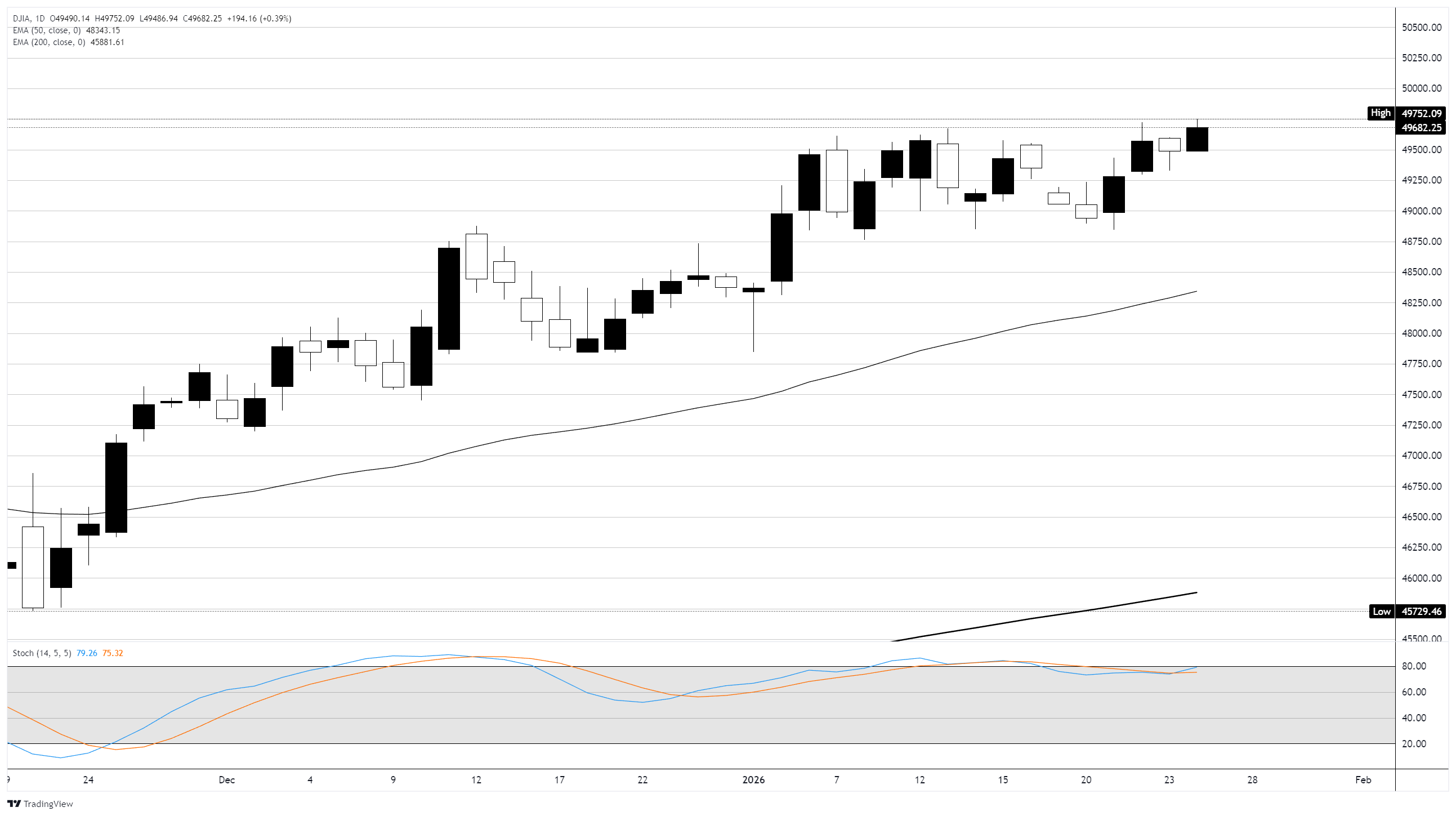
US equities opened the week on a positive note, with the S&P 500 rising 0.5 percent as investors balanced political uncertainty against a heavy slate of earnings and an upcoming Federal Reserve (Fed) decision. The Dow Jones Industrial Average (DJIA) added 0.3 percent, while the Nasdaq Composite gained 0.6 percent, supported by strength in large technology names such as Apple (AAPL) and Meta (META) ahead of their earnings results. The advance followed a volatile prior week, during which the S&P 500 fell about 0.4 percent for a second straight weekly decline amid geopolitical tensions that later eased.
Political risk remained a key backdrop. Markets digested President Trump’s renewed tariff threats toward Canada tied to a possible expansive trade agreement with China, although Canadian officials pushed back strongly, reducing fears of immediate escalation. At the same time, tensions in Washington over federal funding and immigration policy raised concerns about a possible government shutdown, though Senate leadership signaled that a resolution may still be reached. While these issues have not yet triggered a sharp market reaction, the repeated use of trade and fiscal pressure tactics continues to weigh gradually on sentiment.
Political uncertainty and acquisitions lift Gold, economic backdrop holds firm
Safe-haven demand was evident on Monday, as Gold surged to a new all-time high above $5,100 per ounce, reflecting investor caution over political and fiscal risks. Despite this, broader economic signals remain relatively positive. Consumer spending appears resilient, and corporate profitability remains solid, with companies continuing to invest heavily in areas such as artificial intelligence and productivity tools.
Novo Nordisk (NOVO) shares improved, bolstered by bank analysts suggesting the launch of oral Wegovy is expanding the obesity treatment market rather than cannibalizing injectable products. Novo Nordisk shares are up sharply this month, while competitor Eli Lilly (LLY) has lagged. In the commodities and materials sector, Gold miners benefited from the bullion rally, with Newmont (NEM) posting strong gains. Corporate activity also drove individual stocks, including USA Rare Earth (USAR), which jumped after the US government took a stake, and Allied Gold, which rose following a takeover agreement with Zijin Gold, which offered to buy out Allied at $44 per share in an all-cash offer, valuing the deal at $5.5 billion.
Earnings season is moving into a critical phase, with more than 90 S&P 500 companies reporting this week, including several megacap technology firms. Results have been broadly positive thus far, though not as strong as last quarter. About three-quarters of reporting companies have beaten earnings expectations, but again, revenue beats have moderated compared with the prior quarter. Guidance has been conservative, as is typical at this point in the season, and companies that beat both revenue and earnings have not been rewarded immediately in share price performance. Regardless, markets expect the overall earnings picture to remain decent as results broaden beyond financials and early reporters.
On the policy front, the Fed is set to announce its first rate decision of the year, with no change expected. Investor focus will be on forward guidance, particularly signals around the timing of potential rate cuts. Futures markets currently price in two quarter-point cuts by the end of 2026.
Dow Jones daily chart
Dow Jones FAQs
The Dow Jones Industrial Average, one of the oldest stock market indices in the world, is compiled of the 30 most traded stocks in the US. The index is price-weighted rather than weighted by capitalization. It is calculated by summing the prices of the constituent stocks and dividing them by a factor, currently 0.152. The index was founded by Charles Dow, who also founded the Wall Street Journal. In later years it has been criticized for not being broadly representative enough because it only tracks 30 conglomerates, unlike broader indices such as the S&P 500.
Many different factors drive the Dow Jones Industrial Average (DJIA). The aggregate performance of the component companies revealed in quarterly company earnings reports is the main one. US and global macroeconomic data also contributes as it impacts on investor sentiment. The level of interest rates, set by the Federal Reserve (Fed), also influences the DJIA as it affects the cost of credit, on which many corporations are heavily reliant. Therefore, inflation can be a major driver as well as other metrics which impact the Fed decisions.
Dow Theory is a method for identifying the primary trend of the stock market developed by Charles Dow. A key step is to compare the direction of the Dow Jones Industrial Average (DJIA) and the Dow Jones Transportation Average (DJTA) and only follow trends where both are moving in the same direction. Volume is a confirmatory criteria. The theory uses elements of peak and trough analysis. Dow’s theory posits three trend phases: accumulation, when smart money starts buying or selling; public participation, when the wider public joins in; and distribution, when the smart money exits.
There are a number of ways to trade the DJIA. One is to use ETFs which allow investors to trade the DJIA as a single security, rather than having to buy shares in all 30 constituent companies. A leading example is the SPDR Dow Jones Industrial Average ETF (DIA). DJIA futures contracts enable traders to speculate on the future value of the index and Options provide the right, but not the obligation, to buy or sell the index at a predetermined price in the future. Mutual funds enable investors to buy a share of a diversified portfolio of DJIA stocks thus providing exposure to the overall index.

Hơn một triệu người dùng dựa vào FXStreet để có dữ liệu thị trường thời gian thực, công cụ biểu đồ, góc nhìn chuyên gia và tin tức Forex. Lịch kinh tế toàn diện và các hội thảo web giáo dục giúp nhà giao dịch luôn cập nhật và đưa ra quyết định có tính toán. FXStreet có khoảng 60 nhân sự, chia giữa trụ sở Barcelona và nhiều khu vực toàn cầu.
Đọc thêm








