

GBP/USD tests 1.37 as market trepidation keeps Greenback on the defensive
Bởi Joshua Gibson
Ngày xuất bản: 27 Jan 2026 | Ngày chỉnh sửa: 27 Jan 2026


BÀI VIẾT PHỔ BIẾN

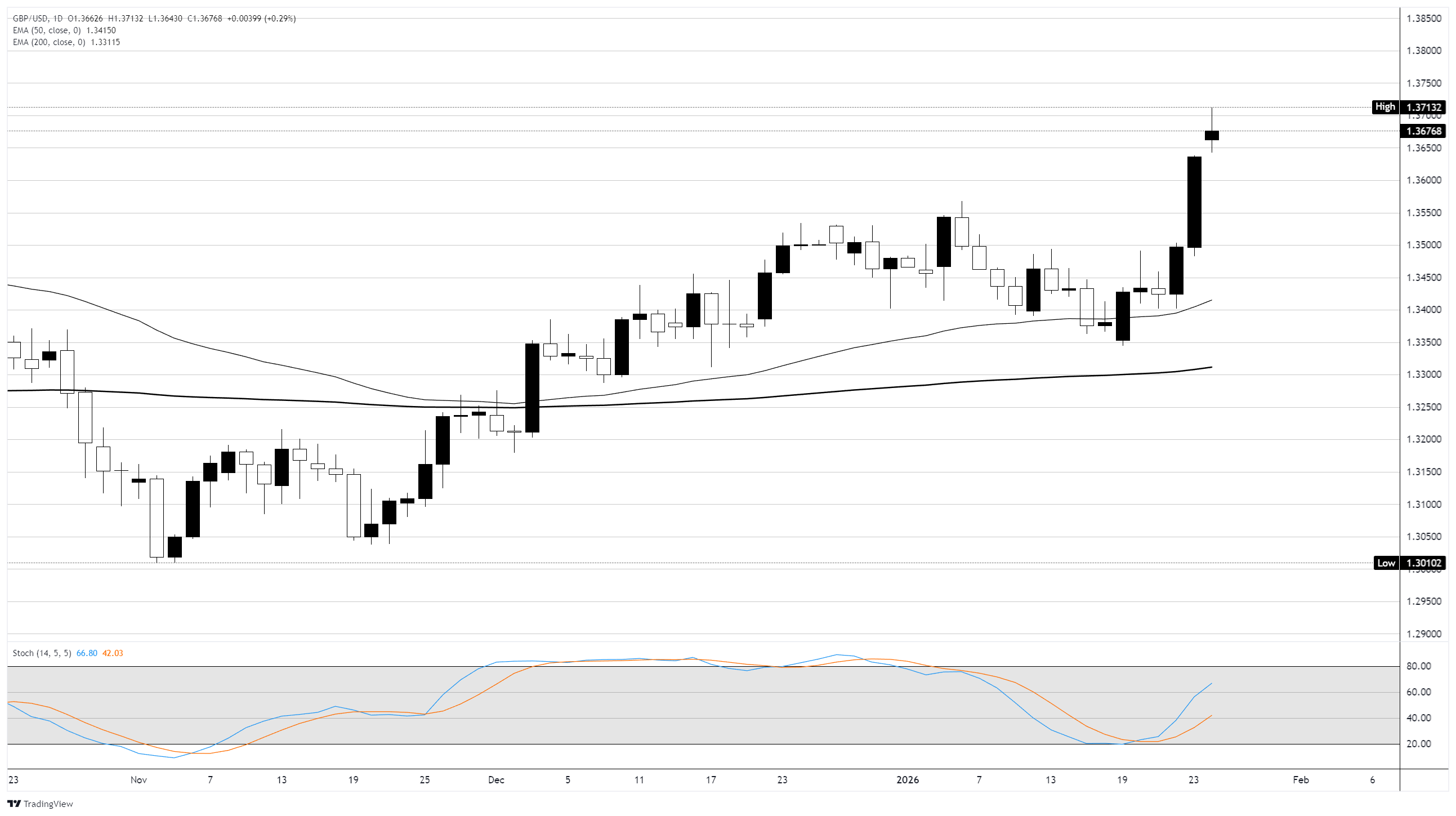
GBP/USD caught a halting bullish step higher to open the new trading week, knocking on the 1.3700 handle for the first time since September.
- GBP/USD caught a limited bullish extension on Monday, testing 1.3700.
- Market sentiment is broadly tilted against the US Dollar, keeping Cable well-bid.
- Investors continue to bank on a renege of fresh tariff threats and are on the lookout for Fed policy tone shifts.
GBP/USD caught a halting bullish step higher to open the new trading week, knocking on the 1.3700 handle for the first time since September. The Trump administration threatened additional tariffs on a number of European nations if they don’t give over control of Greenland to the US, but markets continue to bank on the usual turnaround on trade war rhetoric from the White House.
UK data remains strictly low-tier this week, with the Federal Reserve’s (Fed) latest interest rate decision standing as the week’s key event. The Fed is broadly expected to stand pat on interest rates, but investors will be looking for any meaningful tonal shifts on policy. The Trump administration is also expected to announce Trump’s upcoming pick to replace Fed Chair Jerome Powell as head of the Fed when Powell’s term ends in May.
At the current cut, interest rate futures markets are pricing in at least two quarter-point interest rate cuts before the end of the year. This runs a little faster than the Fed’s own projections, which see one cut per year over the next two years on the outside. Trump’s upcoming pick for Fed Chair will likely be friendly to a more accommodative policy stance, and could swing the needle steeply toward further rate cuts.
GBP/USD price forecast
GBP/USD is well on its way into overbought territory, tapping a four-month high on Monday at the 1.3700 handle and marking in a strong January performance as the US Dollar continues to weaken. It will take a long drop to push Cable bids back into the middle range, with the 50-day Exponential Moving Average (EMA) languishing near the 1.3400 region.
GBP/USD daily chart
Pound Sterling FAQs
The Pound Sterling (GBP) is the oldest currency in the world (886 AD) and the official currency of the United Kingdom. It is the fourth most traded unit for foreign exchange (FX) in the world, accounting for 12% of all transactions, averaging $630 billion a day, according to 2022 data. Its key trading pairs are GBP/USD, also known as ‘Cable’, which accounts for 11% of FX, GBP/JPY, or the ‘Dragon’ as it is known by traders (3%), and EUR/GBP (2%). The Pound Sterling is issued by the Bank of England (BoE).
The single most important factor influencing the value of the Pound Sterling is monetary policy decided by the Bank of England. The BoE bases its decisions on whether it has achieved its primary goal of “price stability” – a steady inflation rate of around 2%. Its primary tool for achieving this is the adjustment of interest rates. When inflation is too high, the BoE will try to rein it in by raising interest rates, making it more expensive for people and businesses to access credit. This is generally positive for GBP, as higher interest rates make the UK a more attractive place for global investors to park their money. When inflation falls too low it is a sign economic growth is slowing. In this scenario, the BoE will consider lowering interest rates to cheapen credit so businesses will borrow more to invest in growth-generating projects.
Data releases gauge the health of the economy and can impact the value of the Pound Sterling. Indicators such as GDP, Manufacturing and Services PMIs, and employment can all influence the direction of the GBP. A strong economy is good for Sterling. Not only does it attract more foreign investment but it may encourage the BoE to put up interest rates, which will directly strengthen GBP. Otherwise, if economic data is weak, the Pound Sterling is likely to fall.
Another significant data release for the Pound Sterling is the Trade Balance. This indicator measures the difference between what a country earns from its exports and what it spends on imports over a given period. If a country produces highly sought-after exports, its currency will benefit purely from the extra demand created from foreign buyers seeking to purchase these goods. Therefore, a positive net Trade Balance strengthens a currency and vice versa for a negative balance.

Hơn một triệu người dùng dựa vào FXStreet để có dữ liệu thị trường thời gian thực, công cụ biểu đồ, góc nhìn chuyên gia và tin tức Forex. Lịch kinh tế toàn diện và các hội thảo web giáo dục giúp nhà giao dịch luôn cập nhật và đưa ra quyết định có tính toán. FXStreet có khoảng 60 nhân sự, chia giữa trụ sở Barcelona và nhiều khu vực toàn cầu.
Đọc thêm








