

Gold slips as easing Mideast risks boost US Dollar, curb haven bids
- Gold edges lower as improving risk sentiment reduces haven demand.
- A firmer US Dollar and lower geopolitical anxiety pressured bullion prices.
- Markets now weigh softer conflict risks against the Fed’s policy outlook.
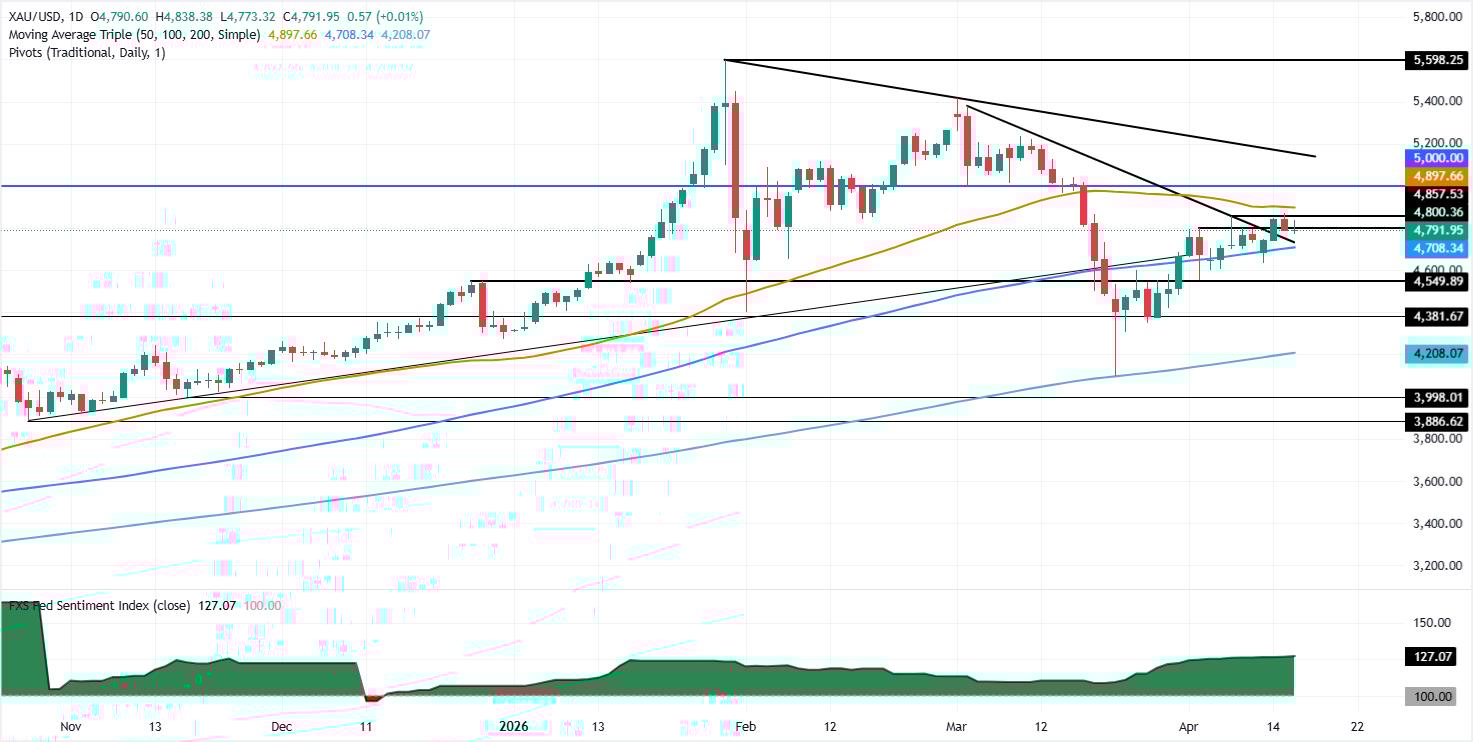
Gold (XAU/USD) price edges lower on Thursday during the American session as geopolitical tensions are tempered amid negotiations to resume US-Iran talks and a likely ceasefire between Israel and Lebanon, brokered by US President Donald Trump. At the time of writing, XAU/USD trades at $4,784, down 0.13%.

Bullion eases as truce hopes dent safe-haven appeal
The yellow metal is pressured by the US Dollar’s recovery, which is erasing some of its Wednesday losses, as shown by the US Dollar Index (DXY). The DXY, which measures the US Dollar’s value against six currencies, is up 0.21% at 98.25.
Speculation for a deal between Washington and Tehran was cheered by Wall Street, with its three largest indices posting gains. However, negotiations seem stuck as negotiators on both sides are eying a memorandum to prevent a resumption of the conflict.
Sources revealed that the US and Iran are narrowing some gaps, including the Strait of Hormuz. However, Tehran wants Washington to unfreeze Iranian funds in exchange for allowing ships to sail through the strait via Omani waters.
In the meantime, a Western diplomat said the nuclear issue “remains a core obstacle.”
US President Donald Trump announced Thursday that Israel and Lebanon agreed to start a 10-day ceasefire at 5:00 PM EST (21:00 GMT), pausing the conflict between Israel and Hezbollah amid the ongoing war with Iran.
Fed to focus on inflation; US labor market remains healthy
Data-wise, US Initial Jobless Claims fell to 207K for the week ending April 11, under the expected 215K, and below the prior week’s 218K. Despite this, recent employment and JOLTS data suggest a period of both low hiring and low layoffs.
In the meantime, US Industrial Production decreased from 0.7% to -0.5% MoM in March, with the largest declines in motor vehicles, parts, and utilities, suggesting an economic slowdown.
Federal Reserve (Fed) officials reinforced the central bank’s current policy path. New York Fed President John Williams noted that the conflict in Iran is exerting upward pressure on prices and anticipates an increase in headline inflation. He also commented that the central bank’s policy stance remains appropriately positioned.
Governor Stephen Miran, while echoing some of these sentiments while maintaining a notably dovish outlook, indicated an expectation of three rather than four interest rate cuts, citing “less favorable” inflation developments.
Given the backdrop, a de-escalation of the Middle East conflict decreases Gold’s safe-haven appeal. Nevertheless, if crude prices fall, it could ease inflationary pressures and justify further easing by the Fed if the deflation process resumes. Therefore, a low-interest rate scenario opens the door for further upside in the precious metals.
XAU/USD technical outlook: Gold’s poised to remain sideways
Price action suggests that Gold is poised to consolidate within a defined range. On the upside, the 50-day Simple Moving Average (SMA) at $4,896 is the first key resistance level on the yellow metal’s path to $5,000. Downwards, the first support is the psychological $4,700 milestone, ahead of the 100-day SMA at $4,691.
The Relative Strength Index (RSI) shows a favorable outlook for Gold’s upside, but it has flattened, suggesting indecision.
If Gold clears $4,900, the next area of interest would be $4,950, ahead of $5,000. On the flipside, if sellers clear the 100-day SMA at $4,691, expect a drop to $4,650 ahead of the 20-day SMA at $4,638. Below lies the $4,600 figure.
Gold FAQs
Gold has played a key role in human’s history as it has been widely used as a store of value and medium of exchange. Currently, apart from its shine and usage for jewelry, the precious metal is widely seen as a safe-haven asset, meaning that it is considered a good investment during turbulent times. Gold is also widely seen as a hedge against inflation and against depreciating currencies as it doesn’t rely on any specific issuer or government.
Central banks are the biggest Gold holders. In their aim to support their currencies in turbulent times, central banks tend to diversify their reserves and buy Gold to improve the perceived strength of the economy and the currency. High Gold reserves can be a source of trust for a country’s solvency. Central banks added 1,136 tonnes of Gold worth around $70 billion to their reserves in 2022, according to data from the World Gold Council. This is the highest yearly purchase since records began. Central banks from emerging economies such as China, India and Turkey are quickly increasing their Gold reserves.
Gold has an inverse correlation with the US Dollar and US Treasuries, which are both major reserve and safe-haven assets. When the Dollar depreciates, Gold tends to rise, enabling investors and central banks to diversify their assets in turbulent times. Gold is also inversely correlated with risk assets. A rally in the stock market tends to weaken Gold price, while sell-offs in riskier markets tend to favor the precious metal.
The price can move due to a wide range of factors. Geopolitical instability or fears of a deep recession can quickly make Gold price escalate due to its safe-haven status. As a yield-less asset, Gold tends to rise with lower interest rates, while higher cost of money usually weighs down on the yellow metal. Still, most moves depend on how the US Dollar (USD) behaves as the asset is priced in dollars (XAU/USD). A strong Dollar tends to keep the price of Gold controlled, whereas a weaker Dollar is likely to push Gold prices up.













