

Indian Rupee surges as oil prices nosedive on US-Iran MoU finalization
- The Indian Rupee soars against the US Dollar on the finalization of the US-Iran deal.
- Plunging oil prices due to the reopening of the Strait of Hormuz, as per the post from US President Trump.
- The selling pressure by overseas investors has slowed down in the last two trading days.
The Indian Rupee (INR) opens strongly against the US Dollar (USD) at the start of the week. The USD/INR pair plunges to near 94.60 as oil prices have nosedived, following the announcement that the United States (US) and Iran have reached a permanent peace deal.

In India’s opening trading hours, the MCX Crude Oil contract expiring on June 18 is down 5.5% to near 7,630, the lowest level seen in almost two weeks.
The appeal of currencies from economies, such as India, which rely heavily on oil imports to meet their energy needs, improves significantly when oil prices fall like a house of cards.
US-Iran reaches peace deal
On Sunday, both the US and Iran confirmed that they have finalized a Memorandum of Understanding (MoU).
Iran’s Supreme National Security Council confirmed Sunday that Tehran had finalized an MoU, saying all military operations on all fronts, including Lebanon, would cease “immediately and permanently”, CNBC reported.
US President Donald Trump also said in a post on Truth Social, “I hereby fully authorize the toll free opening of the Strait of Hormuz, and, simultaneously herewith, authorize the immediate removal of the United States Naval blockade.”
Meanwhile, Pakistan Prime Minister (PM) Shehbaz Sharif has stated in a post on X, formerly known as Twitter, that the finalized MoU between the US and Iran will be signed on June 19 in Switzerland.
FIIs selling pressure cool down
Although Foreign Institutional Investors (FIIs) have remained net sellers in all trading days so far in June, a slowdown in the pace of selling pressure is observed in the last two trading days. So far this month, FIIs have offloaded their stake worth Rs. 46,430.42 crore, an average selling of Rs. 4,643 crore in 10 trading days. In the last two trading days, the average selling by overseas investors was Rs. 1,534.63 crore.
India’s WPI Inflation data awaited
On the domestic front, investors await India’s Wholesale Price Index (WPI) Inflation data for May, which will be published at 12:00 PM IST (06:30 GMT). Inflation at the wholesale level is expected to arrive higher at 9.1% from 8.3% in April.
Theoretically, higher inflation at the factory level boosts expectations for the Reserve Bank of India’s (RBI) interest rate hikes in the near-term. However, the impact is expected to be limited as oil prices have started declining, a scenario that would anchor inflation expectations.
Technical Analysis: USD/INR slides to near 94.60
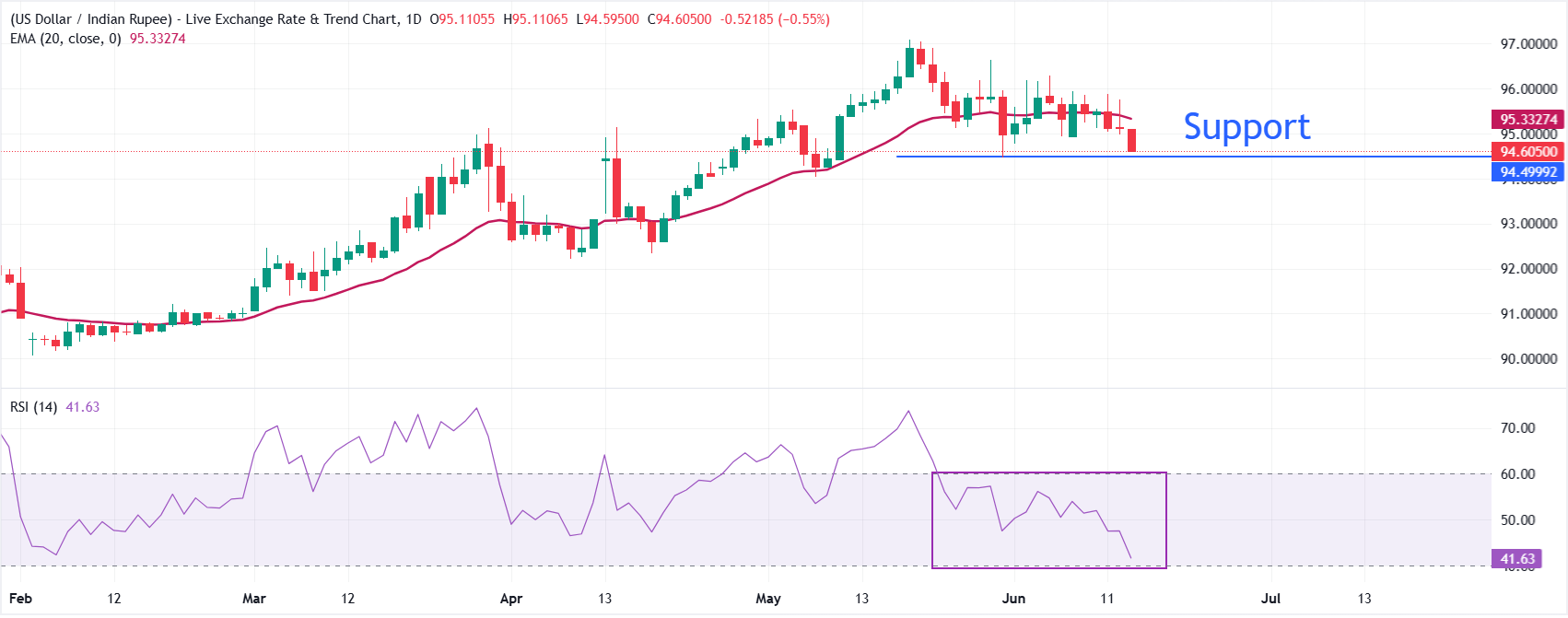
USD/INR tumbles to near 94.60 in the opening trade. The near-term bias of the pair turns bearish as it extends distance with the 20-day exponential moving average (EMA), which is at 95.33, on the downside.
The pair’s slide away from that dynamic barrier keeps the short-term trend under pressure, while the Relative Strength Index (RSI) near 42 leans lower, suggesting sellers retain control despite not yet reaching oversold territory.
On the topside, initial resistance is defined by the 20-day EMA at 95.33, where a sustained break higher would be needed to ease the current downside pressure and open the way for a deeper corrective bounce towards 96.00. Looking down, the pair could slide to the May 7 low at 94.03 if it drops below the May 29 low at 94.46.
(The technical analysis of this story was written with the help of an AI tool.)
Indian Rupee FAQs
The Indian Rupee (INR) is one of the most sensitive currencies to external factors. The price of Crude Oil (the country is highly dependent on imported Oil), the value of the US Dollar – most trade is conducted in USD – and the level of foreign investment, are all influential. Direct intervention by the Reserve Bank of India (RBI) in FX markets to keep the exchange rate stable, as well as the level of interest rates set by the RBI, are further major influencing factors on the Rupee.
The Reserve Bank of India (RBI) actively intervenes in forex markets to maintain a stable exchange rate, to help facilitate trade. In addition, the RBI tries to maintain the inflation rate at its 4% target by adjusting interest rates. Higher interest rates usually strengthen the Rupee. This is due to the role of the ‘carry trade’ in which investors borrow in countries with lower interest rates so as to place their money in countries’ offering relatively higher interest rates and profit from the difference.
Macroeconomic factors that influence the value of the Rupee include inflation, interest rates, the economic growth rate (GDP), the balance of trade, and inflows from foreign investment. A higher growth rate can lead to more overseas investment, pushing up demand for the Rupee. A less negative balance of trade will eventually lead to a stronger Rupee. Higher interest rates, especially real rates (interest rates less inflation) are also positive for the Rupee. A risk-on environment can lead to greater inflows of Foreign Direct and Indirect Investment (FDI and FII), which also benefit the Rupee.
Higher inflation, particularly, if it is comparatively higher than India’s peers, is generally negative for the currency as it reflects devaluation through oversupply. Inflation also increases the cost of exports, leading to more Rupees being sold to purchase foreign imports, which is Rupee-negative. At the same time, higher inflation usually leads to the Reserve Bank of India (RBI) raising interest rates and this can be positive for the Rupee, due to increased demand from international investors. The opposite effect is true of lower inflation.













