

Is Crypto not meant for humans but AI?
The next big wave of crypto users may not be human. AI agents, or autonomous bots, are rapidly entering the market to manage wallets and move capital without human input. Industry leaders are already getting ready for this so-called “agentic economy,” in which machines, not people, could soon dominate the flow of money.
Artificial Intelligence bots are flooding the Decentralized Finance (DeFi) and traditional markets. Cryptocurrency market leaders are building protocols to boost this new bot-driven economy, automating payments and trading, anticipating a future in which AI agents will surpass humans in transaction volume.

Given that the agentic economy built on blockchain networks is interoperable, it could lead to a massive increase in DeFi activity, including active wallets, value transferred, and inflows into vaults, alongside fast, automated payments. What to watch as this revolution unfolds?
A future of AI-powered automated payment
Some of the most prominent leaders in the crypto industry have already laid the foundation for this upcoming “agentic economy.”
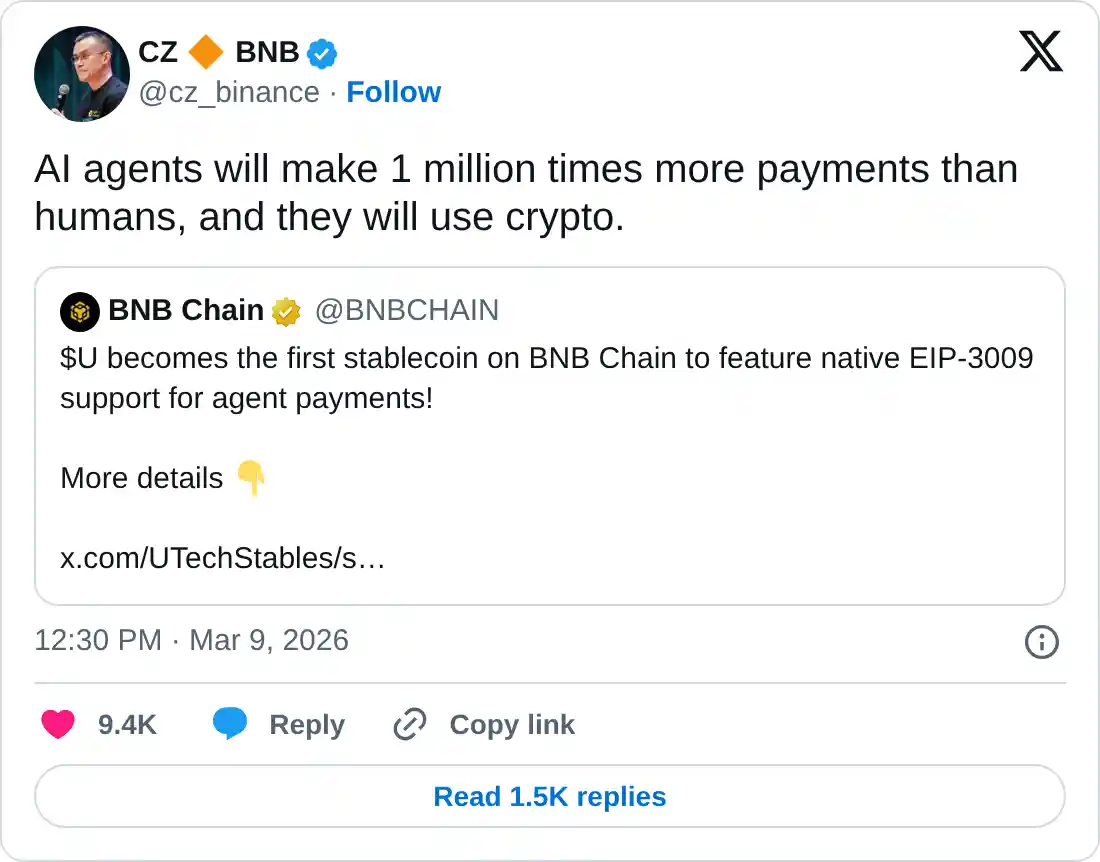
Changpeng Zhao, the former CEO of Binance, recently claimed that AI agents will make 1 million times as many payments as humans and will use crypto as agents require high frequency, low latency, and a decentralized or minimal counterparty-friction framework.
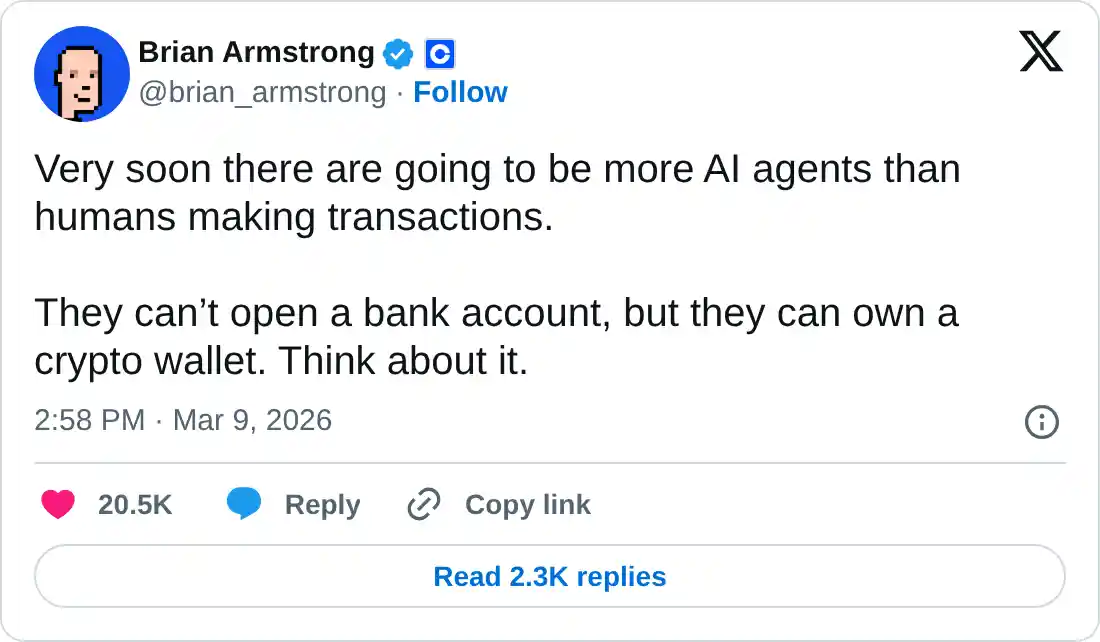
Striking a similar tone, Coinbase CEO Brian Armstrong said in an X post that “Very soon, there are going to be more AI agents than humans making transactions.” He further stated that these transactions could mainly be made through crypto wallets, since AI agents lack bank accounts, which require human verification.
Both Binance and Coinbase are moving into this new bot-driven market, rolling out tools that enable AI agents to make payments and transactions autonomously.
Binance’s BNB Chain has onboarded its first US dollar-pegged stablecoin, U, with native EIP-3009 support, enabling on- and off-rail support for AI agents as a preliminary attempt to capitalize on new micro-payments. Similarly, Coinbase has launched the x402 protocol to enable automatic payments on its Base chain network, with extended API support.
Joining the automated-payments race, payment giants such as Mastercard and Visa are integrating Trusted Agent Protocol (TAP), which links an AI agent identity to a verified human, bypassing the Know Your Customer (KYC) barrier for bots. This hybrid model could serve as a protection mechanism for high-value autonomous transactions, which can be monitored, limited, or overridden.
Meanwhile, Google has launched the Agent Payments Protocol (AP2), which PayPal uses and is powered by PayPal’s US Dollar stablecoin (PYUSD) for a similar human-user-authorized agent transaction.
The on-chain economy of AI agents
The AI agents are dominating on-chain activity and revenue but remain at an early stage in handling large-value transactions.
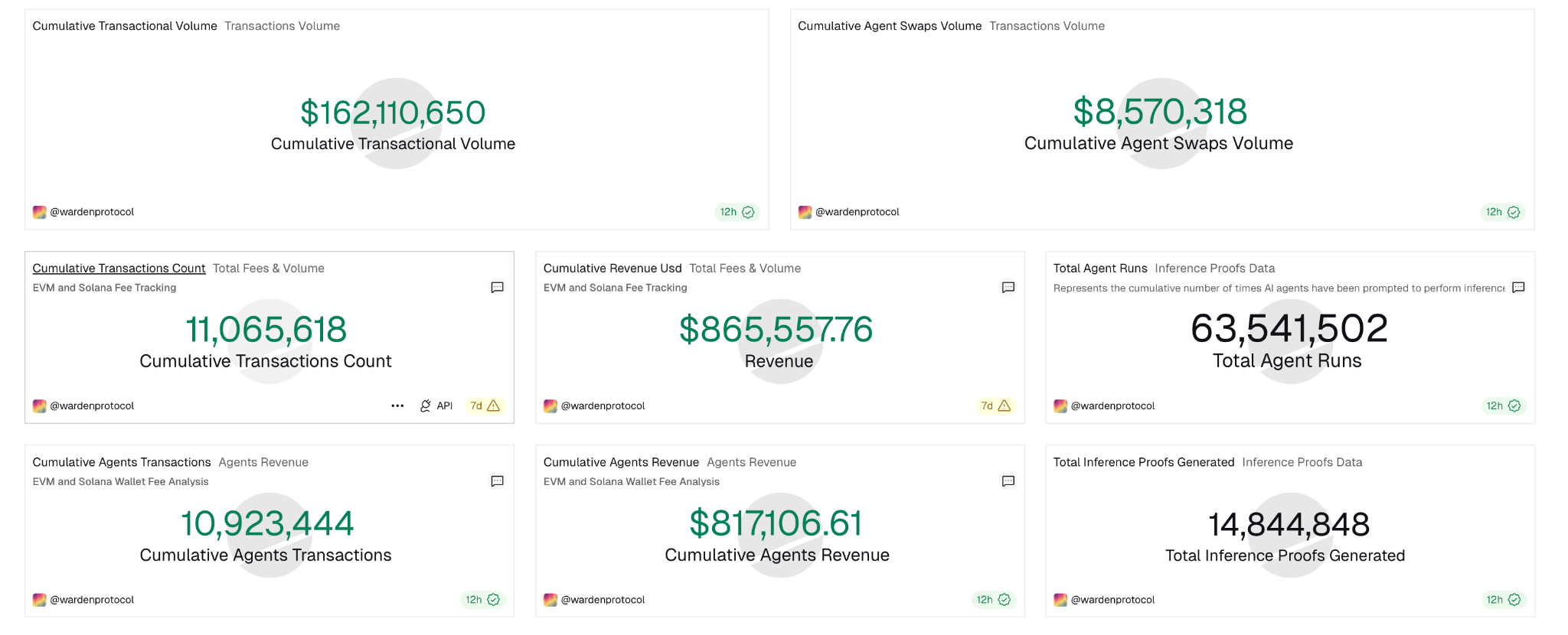
According to data from Dune Analytics, the on-chain transactional activity of AI-driven commerce is on a steady rise. The cumulative agent-driven transaction volume has reached $162.1 million, still a small share of the total volume of transactions, indicating that the AI agent economy is still at an early stage.
However, AI agents already make up a vast majority of the revenue of blockchains such as Ethereum and Solana. Both chains generated a total revenue of $865,557, 99% of which came from AI bots, Dune Analytics data shows.
Stablecoins: Fuel of the agentic economy
The rising share of stablecoins in the crypto market fuels the agentic economy, providing a programmable, fast settlement layer for agents, enabling automatic payments across multiple blockchains with/without human approval. Traditional networks will require additional infrastructure, such as on- and off-ramp services for stablecoins, support for multiple tokens, and a market maker to stabilize network fees.
The adoption of stablecoins advances the agenda of shifting US debt to on-chain, as US-Dollar-pegged stablecoins dominate the market and are backed by US bonds. This loosely aligns with pro-crypto regulations in the US.
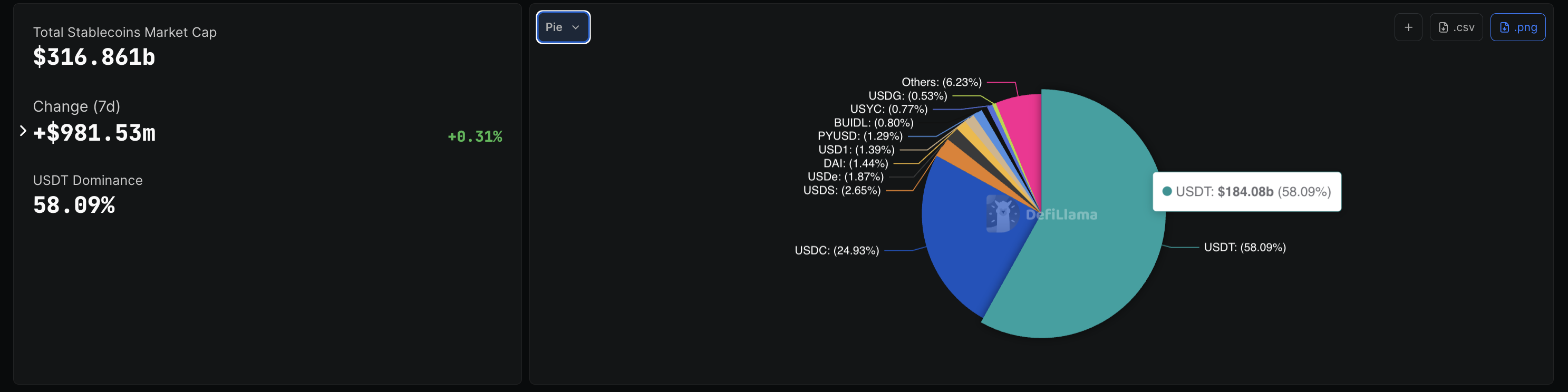
DeFiLlama data shows the stablecoin market capitalization stands at $316.86 billion, with Tether’s US Dollar-pegged USDT holding 58% market share.
As agentic commerce grows, the payment infrastructure will require additional support to handle the surge in transaction volume and the speed at which it occurs.
Implications for crypto traders
The rise of AI agents in crypto markets is already starting to impact on-chain activity and capital flows.
A boost in DeFi activity due to the agentic economy can provide tips for traders. For example, a spike in Transactions per Second (TPS) or the number of active wallets could be an early indication of bot-driven inflows programmed to farm for higher yields on networks such as Solana, Ethereum, and other programmable layer-1 blockchains that adopt protocols for agentic commerce.
These provide an early signal for short- to medium-term traders, as a rise in network usage often leads to a delayed spot price surge in the native token, which fuels the network.
Crypto projects focused on enabling this infrastructure (such as Stable, which builds rails for agent-driven stablecoin payments) could provide upside for long-term investors, as they build the core of the new generation of value transfer rather than just capturing market narratives.
Finally, AI-driven trades to maximize yield from DeFi vaults could improve the current passive approach to investing in cryptocurrencies, increasing yields without manual reshuffling.
The rise of AI agents means that changes in on-chain metrics may increasingly reflect automated behaviour. Monitoring these signals well could help traders identify shifts in capital flows earlier and adapt their strategies accordingly.














