

Pi Network, Worldcoin struggle despite growth in identity-verified users
- Pi Network and Worldcoin consolidate on Thursday, while maintaining a broader decline despite growing identity-verified users.
- Both projects have reached roughly 18 million verified users, reflecting rapid adoption.
- Pi Network is shifting focus toward Web 3.0 utility while Worldcoin pivots to AI-agentic identity.
Pi Network (PI) and Worldcoin (WLD) are holding steady at press time on Thursday but remain in a prevailing downward trend. These emerging cryptocurrencies have roughly 18 million verified users, making them one of the leading identity-based projects. Still, the technical outlook for the PI and WLD tokens remains bearish, with both tokens at risk of further decline as both teams pivot to develop real-world utility.

Pi Network, Worldcoin adoption nears 18 million verified users each
Pi Network started as a mobile mining cryptocurrency, but the shift to Know Your Customer (KYC) verification for mainnet migration, which enables transfers to the Centralized Exchanges (CEXs), has resulted in over 18 million verified users.

On the other hand, World Foundation announced that over 17.98 million users have verified their World ID at an orb, a hardware device that verifies uniqueness and humanness.
Given that both projects focus on providing humans but struggle to monetize their user bases and deliver real-world utility, the core teams are pivoting domains. Pi Network is focused on upgrading its mainnet to version 26 of the Stellar protocol, which will enable smart contract functionality and is currently being pushed to the testnet.
World Foundation pivots to providing identity for AI agents on platforms such as Browserbase, Exa, Okta, and Vercel. The plan is to add a human layer to the workflow, requiring human verification for execution.
The shift in Pi Network and Worldcoin toward providing real-world utility could add value to their tokens, driving their prices higher. Until then, the adoption numbers could struggle to boost spot-market demand.
Technical outlook: Pi Network and Worldcoin risk plummeting under pressure
Pi Network extends a declining trend beneath both the 50-day and 200-day Exponential Moving Averages (EMAs). The price forms a falling channel pattern on the daily chart with two parallel declining trendlines.
The Moving Average Convergence Divergence (MACD) holds marginally above its signal line on the daily chart while positive histogram bars shrink. At the same time, the Relative Strength Index (RSI) at 44 continues to reflect subdued demand.
On the topside, initial resistance is at the 50-day EMA near $0.1770, with the descending resistance trendline around $0.1862 as the next hurdle.
Looking down, the April 13 low at $0.1633, near the support trendline at $0.1600, serves as the immediate demand zone. A break below this zone would risk a test of the February 23 low at $0.1556.
Meanwhile, Worldcoin also shows a bearish near-term bias, trading below the 50-day and 200-day EMAs at $0.3098 and $0.5187, respectively. The WLD token remains capped by a downward resistance trendline that aligns with the 50-day EMA, keeping rallies in check.
Momentum also leans soft, with the RSI at 42 and the MACD line marginally below the signal line, both of which hint that selling pressure is weak but persists.
On the topside, initial resistance is located at the confluence of the descending trendline and the 50-day EMA near $0.3099. A sustained move above that confluence would be needed to challenge the more strategic resistance at the R1 Pivot Point at $0.3991.
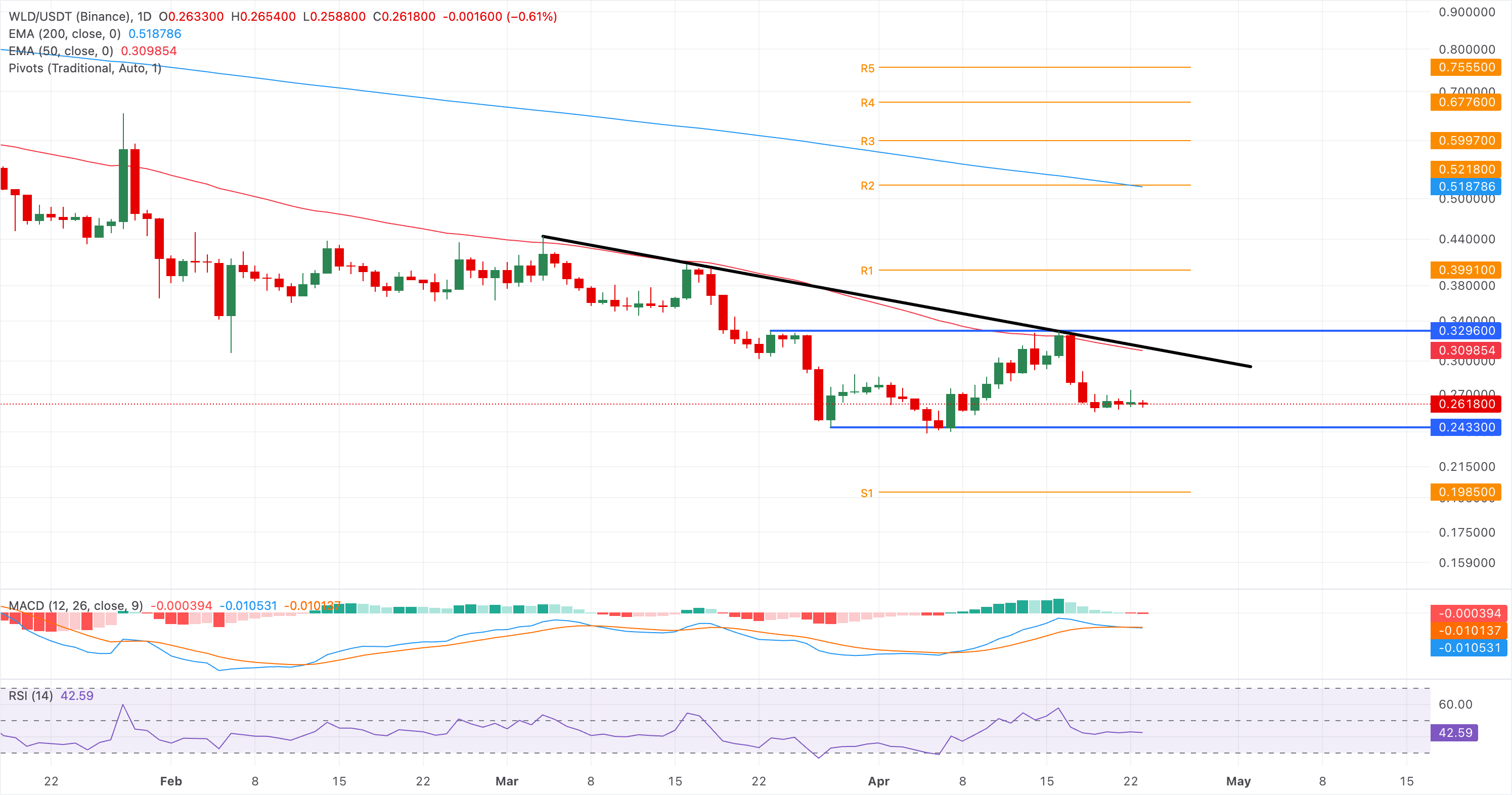
On the flip side, the March 28 low at $0.2433 remains a crucial support, followed by the S1 Pivot Point at $0.1985.
(The technical analysis of this story was written with the help of an AI tool.)














