

US Treasury yields sink as soft data fuels Fed easing bets
Bởi Christian Borjon Valencia
Ngày xuất bản: 11 Feb 2026 | Ngày chỉnh sửa: 11 Feb 2026


BÀI VIẾT PHỔ BIẾN

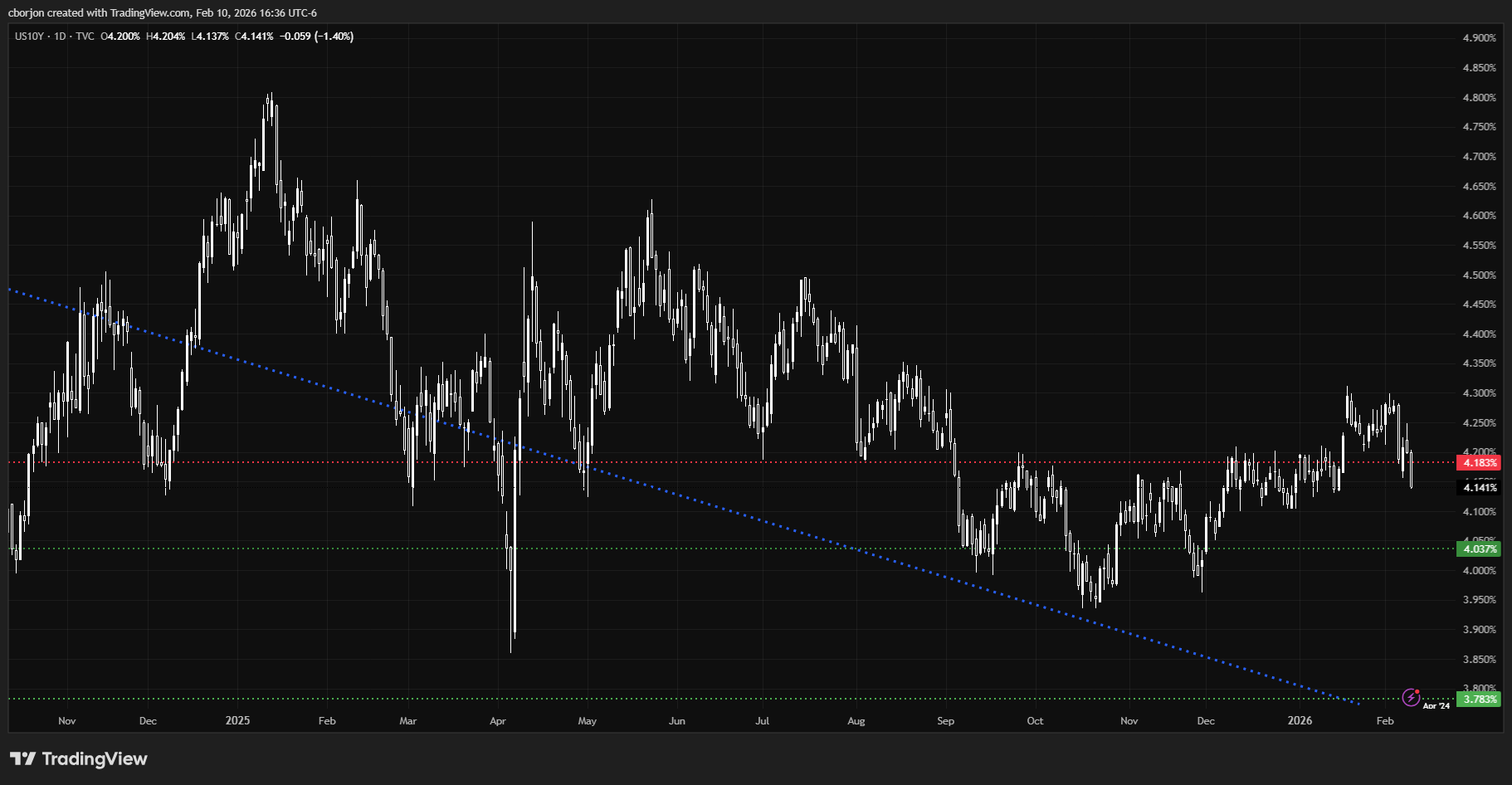
US Treasury yields fell across the curve, with he US 10-year Treasury note, the benchmark diving nearly six basis points down at 4.141% sponsored by softer than expected economic data, which would warrant further easing by the Federal Reserve (Fed).
- US 10-year yield falls nearly six bps as markets price deeper Federal Reserve easing.
- Weak Retail Sales and softer Employment Cost Index signal slowing demand and easing labor pressures.
- Money markets price 58 bps of easing via Chicago Board of Trade ahead of NFPs.
US Treasury yields fell across the curve, with he US 10-year Treasury note, the benchmark diving nearly six basis points down at 4.141% sponsored by softer than expected economic data, which would warrant further easing by the Federal Reserve (Fed).
Benchmark yields slide for a fourth day as weak US data reinforces expectations of renewed Fed rate cuts
The yield of the US 10-year T-note is poised to post its fourth consecutive day of losses, as investors grow confident that the Fed will resume its easing cycle.
US Retail Sales in December missed estimates and remained unchanged at 0%. At the same time, the Employment Cost Index (ECI) for the last quarter of 2025 rose by 0.7% QoQ, beneath the July-September quarter of 0.8% and missed estimates.
After the data, money markets had priced in 58 basis points of easing, as depicted by data from the Chicago Board of Trade (CBOT).
Speeches by Regional Fed Presidents Lorie Logan and Beth Hammack, although hawkish, failed to underpin US yields, but capped the Greenback’s losses.
The US Dollar Index (DXY), which measures the performance of the buck’s value versus six currencies, is firm at 96.84, unchanged.
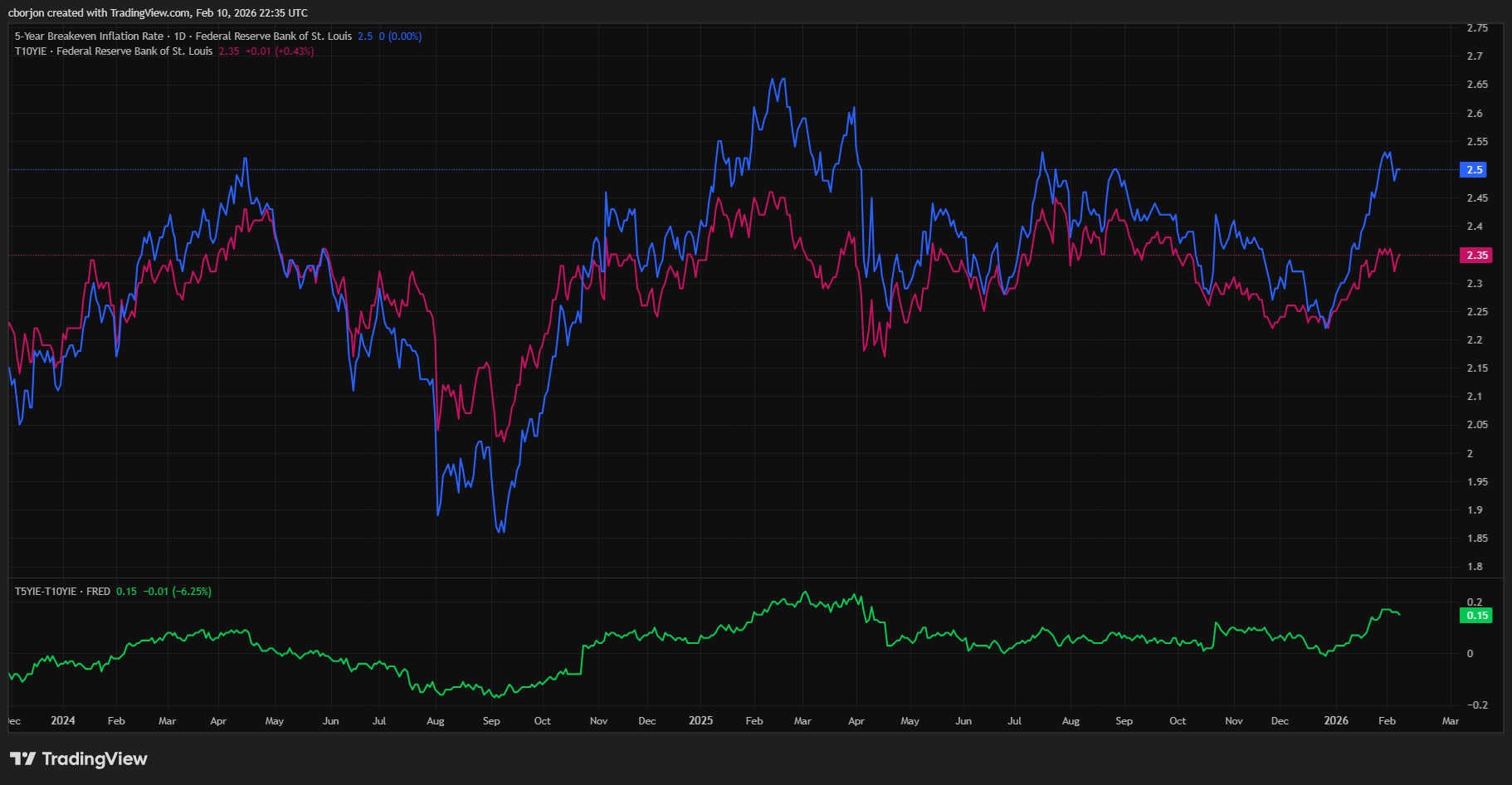
In the meantime, the financial markets inflation expectations for five-years are at 2.5% according to the 5-year Breakeven Inflation Rate. For a ten-year, the 10-year Breakeven rose to 2.35%, an indication that markets see inflation at around that average.
Traders focus shifts to US Nonfarm Payrolls
On Wednesday, the US Nonfarm Payrolls for January are expected to move the needle. Economists expect the economy to add 70K to the workforce, up from December’s 50K. The Unemployment Rate is foreseen to remain unchanged at 4.4%.
US 10-year Treasury note yield
Fed FAQs
Monetary policy in the US is shaped by the Federal Reserve (Fed). The Fed has two mandates: to achieve price stability and foster full employment. Its primary tool to achieve these goals is by adjusting interest rates. When prices are rising too quickly and inflation is above the Fed’s 2% target, it raises interest rates, increasing borrowing costs throughout the economy. This results in a stronger US Dollar (USD) as it makes the US a more attractive place for international investors to park their money. When inflation falls below 2% or the Unemployment Rate is too high, the Fed may lower interest rates to encourage borrowing, which weighs on the Greenback.
The Federal Reserve (Fed) holds eight policy meetings a year, where the Federal Open Market Committee (FOMC) assesses economic conditions and makes monetary policy decisions. The FOMC is attended by twelve Fed officials – the seven members of the Board of Governors, the president of the Federal Reserve Bank of New York, and four of the remaining eleven regional Reserve Bank presidents, who serve one-year terms on a rotating basis.
In extreme situations, the Federal Reserve may resort to a policy named Quantitative Easing (QE). QE is the process by which the Fed substantially increases the flow of credit in a stuck financial system. It is a non-standard policy measure used during crises or when inflation is extremely low. It was the Fed’s weapon of choice during the Great Financial Crisis in 2008. It involves the Fed printing more Dollars and using them to buy high grade bonds from financial institutions. QE usually weakens the US Dollar.
Quantitative tightening (QT) is the reverse process of QE, whereby the Federal Reserve stops buying bonds from financial institutions and does not reinvest the principal from the bonds it holds maturing, to purchase new bonds. It is usually positive for the value of the US Dollar.

Hơn một triệu người dùng dựa vào FXStreet để có dữ liệu thị trường thời gian thực, công cụ biểu đồ, góc nhìn chuyên gia và tin tức Forex. Lịch kinh tế toàn diện và các hội thảo web giáo dục giúp nhà giao dịch luôn cập nhật và đưa ra quyết định có tính toán. FXStreet có khoảng 60 nhân sự, chia giữa trụ sở Barcelona và nhiều khu vực toàn cầu.
Đọc thêm








