USD/INR bounces back amid uncertainty over Iran’s response to US one-page proposal
Bởi Sagar Dua
Đã cập nhật: 7 May 2026


BÀI VIẾT PHỔ BIẾN

The Indian Rupee (INR) opens on a weak note against the US Dollar (USD) on Thursday, failing to capitalize on Wednesday’s strong upside move.
- The Indian Rupee falls against the US Dollar to near 94.87 after a huge upside move on Wednesday.
- Iran calls the US one-page MoU a “wish list”, which restricts Tehran from uranium enrichment.
- FIIs remain in the sellers’ mode despite US-Iran truce optimism.
The Indian Rupee (INR) opens on a weak note against the US Dollar (USD) on Thursday, failing to capitalize on Wednesday’s strong upside move. The USD/INR pair rises 0.35% to near 94.87 amid the absence of a positive response from Iran toward the one-page memorandum of understanding (MoU) to end the war with the United States (US).
Iran still reviews US one-page MoU
While there are positive comments from the US and Pakistan that Washington and Tehran are close to reaching a deal, Iran has stated that it is still reviewing the US proposal, according to BBC.
In the latest update, a senior member of Iran's parliament has dismissed the US proposal, calling it a "wish list", according to BBC.
The confirmation of the one-page MoU, which is a 14-point proposal, by both sides would lead to an immediate ceasefire and establish a 30-day negotiation window. The peace proposal includes Iran’s pause on uranium enrichment, releasing Iranian frozen assets, and the reopening of the Strait of Hormuz.
Meanwhile, the lack of follow-up selling in oil prices after a vertical decline on Wednesday is also keeping the Indian Rupee under pressure. As of writing, the WTI Oil price is slightly down to near $92.80. On Wednesday, the WTI Oil price plummeted over 13% to $86.90, but recovered some of its losses and closed above $93.00.
FIIs remain in dump mode
Despite the dominance of risk flows in global markets amid optimism over the US-Iran peace deal, Foreign Institutional Investors (FIIs) continue to dump their stake in the Indian stock market. So far in May, FIIs have remained net sellers in two of the three trading days and have offloaded their stake worth Rs. 6,620.86 crore.
Increased concerns over India’s growth and inflation outlook amid expectations that energy prices will remain higher for a prolonged period, even if the US and Iran reach a peace plan today, are hurting the sentiment of foreign investors toward the Indian stock market.
US NFP comes under spotlight
While the Indian Rupee is struggling to attract meaningful bids amid the risk-on sentiment, the appeal of the US Dollar has diminished. At press time, the US Dollar Index (DXY), which tracks the Greenback’s value against six major currencies, is flat around 98.00; but is close to its over two-month low of 97.62 posted on Wednesday.
Going forward, investors will pay close attention to the US Nonfarm Payrolls (NFP) data for April, which will be released on Friday, to get fresh cues on the Federal Reserve’s (Fed) monetary policy outlook. The employment report is expected to show that the economy created 60K fresh jobs.
Technical Analysis: USD/INR holds key 20-day EMA
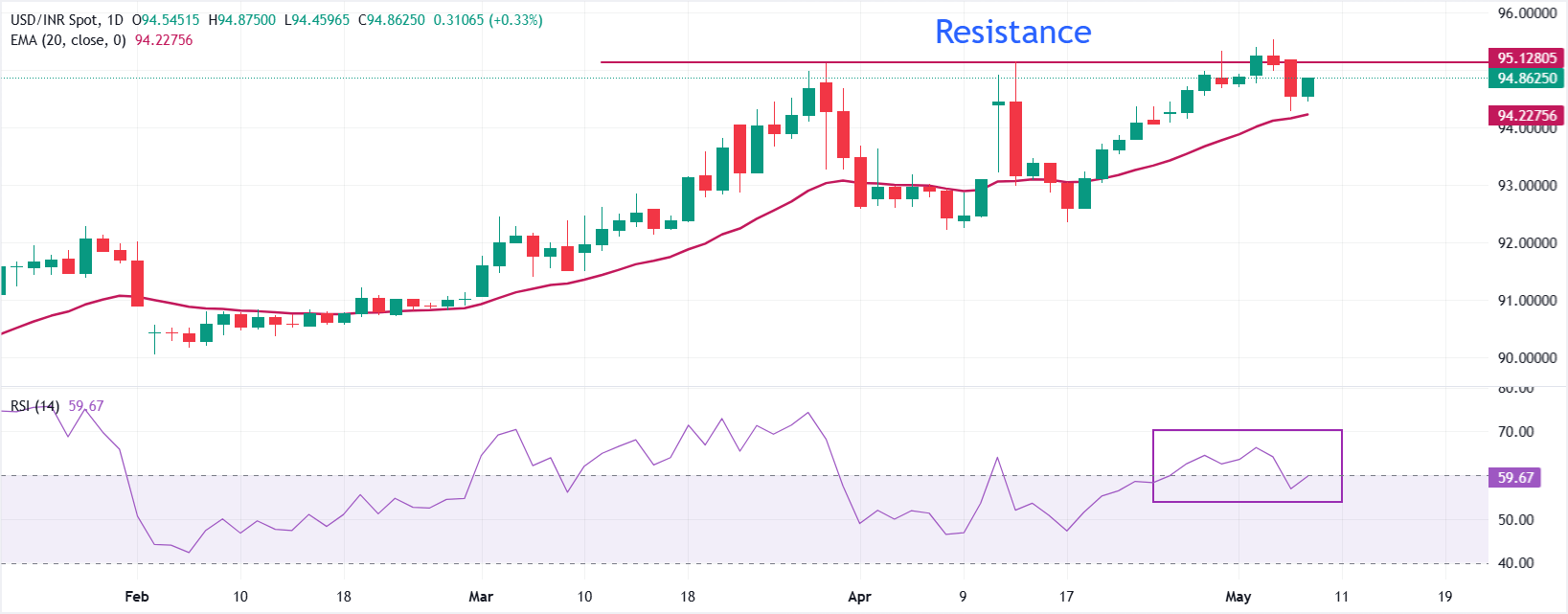
USD/INR trades higher at around 94.87 in the opening session on Thursday. The pair holds a bullish near-term bias as spot remains above the 20-day Exponential Moving Average (EMA) at 94.2288. The pair is consolidating near recent highs while staying comfortably supported by this dynamic floor, and the Relative Strength Index (RSI) around 59 suggests positive but not overstretched momentum, which hints that buyers still have the upper hand as long as price holds above the 20-day EMA.
On the downside, immediate support is seen at the 20-day EMA near 94.23; a decisive break below this level would expose a deeper corrective move toward 93.00. Looking up, the pair could enter uncharted territory if it manages to break above the all-time high of 95.53 posted on Tuesday. Initial resistance would be 96.00, followed by 96.50.
(The technical analysis of this story was written with the help of an AI tool.)
Indian Rupee FAQs
The Indian Rupee (INR) is one of the most sensitive currencies to external factors. The price of Crude Oil (the country is highly dependent on imported Oil), the value of the US Dollar – most trade is conducted in USD – and the level of foreign investment, are all influential. Direct intervention by the Reserve Bank of India (RBI) in FX markets to keep the exchange rate stable, as well as the level of interest rates set by the RBI, are further major influencing factors on the Rupee.
The Reserve Bank of India (RBI) actively intervenes in forex markets to maintain a stable exchange rate, to help facilitate trade. In addition, the RBI tries to maintain the inflation rate at its 4% target by adjusting interest rates. Higher interest rates usually strengthen the Rupee. This is due to the role of the ‘carry trade’ in which investors borrow in countries with lower interest rates so as to place their money in countries’ offering relatively higher interest rates and profit from the difference.
Macroeconomic factors that influence the value of the Rupee include inflation, interest rates, the economic growth rate (GDP), the balance of trade, and inflows from foreign investment. A higher growth rate can lead to more overseas investment, pushing up demand for the Rupee. A less negative balance of trade will eventually lead to a stronger Rupee. Higher interest rates, especially real rates (interest rates less inflation) are also positive for the Rupee. A risk-on environment can lead to greater inflows of Foreign Direct and Indirect Investment (FDI and FII), which also benefit the Rupee.
Higher inflation, particularly, if it is comparatively higher than India’s peers, is generally negative for the currency as it reflects devaluation through oversupply. Inflation also increases the cost of exports, leading to more Rupees being sold to purchase foreign imports, which is Rupee-negative. At the same time, higher inflation usually leads to the Reserve Bank of India (RBI) raising interest rates and this can be positive for the Rupee, due to increased demand from international investors. The opposite effect is true of lower inflation.

Hơn một triệu người dùng dựa vào FXStreet để có dữ liệu thị trường thời gian thực, công cụ biểu đồ, góc nhìn chuyên gia và tin tức Forex. Lịch kinh tế toàn diện và các hội thảo web giáo dục giúp nhà giao dịch luôn cập nhật và đưa ra quyết định có tính toán. FXStreet có khoảng 60 nhân sự, chia giữa trụ sở Barcelona và nhiều khu vực toàn cầu.
Đọc thêm