

USD/INR extends winning streak amid firm US Dollar, higher oil prices
- The Indian Rupee falls further against the US Dollar due to rising oil prices.
- FIIs remain net sellers for three trading days in a row.
- India’s Composite PMI has come in higher at 58.3 in April from 57.0 in March.
The Indian Rupee (INR) extends its losing streak for the fourth trading day against the US Dollar (USD) on Thursday. The USD/INR pair jumps to near 94.15, the highest level seen in over a week, as higher oil prices due to the closure of the Strait of Hormuz, a critical passage to almost 20% of global energy supply, continue to keep the Indian Rupee under pressure.

During the press time, the WTI Oil price is up over 1.5% above $93.50. Theoretically, currencies from economies, such as India, which rely heavily on oil imports to meet their energy needs, underperform in a high oil price environment.
Energy flows through Hormuz remain suspended for indefinite period
While United States (US) President Donald Trump has announced a ceasefire extension with Iran until Washington receives a unified proposal from Tehran, the oil price remains high due to the Hormuz closure.
Iran maintains its vow that it won’t reopen the Strait of Hormuz until the US removes the blockade on Iranian sea ports, a move that was taken to freeze Iranian business activity and cripple the economy. Iranian military groups near the Hormuz continue to attack ships aiming to pass through the Hormuz.
According to a report from The Wall Street Journal (WSJ), Iranian media said the Islamic Revolutionary Guard Corps (IRGC) fired on three ships in the Strait of Hormuz and escorted two of them to Iranian waters, and is bringing those ships to Iran.
FIIs remain net sellers for third trading day
Foreign investors continue offloading their stake from the Indian stock market after a brief pause in the April 15-17 period, when they bought shares worth Rs. 1,731.71 crore. So far this week, Foreign Institutional Investors (FIIs) have pared their stake worth Rs. 5,057.28 crore.
It seems that fears of lower India Inc. earnings projections by market experts in the wake of higher oil prices are impacting the sentiment of overseas investors towards the Indian stock market.
On the economic data front, India’s preliminary HSBC Composite Purchasing Managers’ Index (PMI) data for April has come in stronger compared to its previous readings. The Composite PMI arrives at 58.3, higher than 57.0 in March. The Manufacturing and the Services PMI expanded at a faster pace to 55.9 and 57.9, respectively.
Higher US Dollar also supports USD/INR
Rising oil prices due to the Hormuz closure have improved the appeal of the US Dollar, assuming that elevating energy prices would prompt US inflation expectations, a scenario that boosts hawkish Federal Reserve (Fed) bets.
Later in the day, investors will focus on the flash US S&P Global PMI data for April, which will be published at 13:45 GMT.
Technical Analysis: USD/INR gains for fourth straight trading day
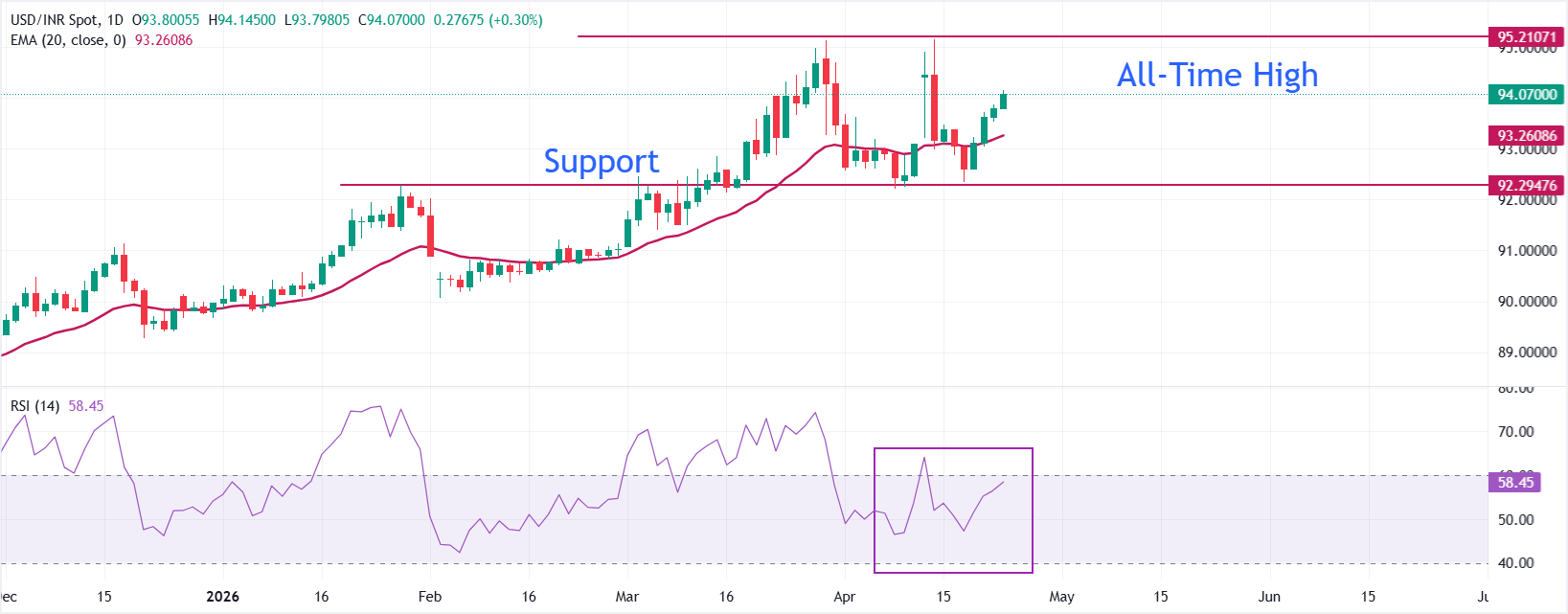
USD/INR trades higher at around 94.15 as of writing. The pair holds a bullish near-term bias as spot remains above the 20-day Exponential Moving Average (EMA) at 93.2609, keeping the recent rebound intact after bouncing off the low-92 area earlier in the month.
The Relative Strength Index (RSI) at 58.45 stays below overbought territory yet leans to the upside, suggesting buyers retain control but without extreme momentum.
On the downside, initial support is seen at the 20-day EMA around 93.26, where a break would signal fading bullish pressure and open the door to a deeper correction toward 93.00, followed by the March 3 high at 92.46. On the topside, the pair seems on track to revisit the all-time high above 95.00.
(The technical analysis of this story was written with the help of an AI tool.)
Indian Rupee FAQs
The Indian Rupee (INR) is one of the most sensitive currencies to external factors. The price of Crude Oil (the country is highly dependent on imported Oil), the value of the US Dollar – most trade is conducted in USD – and the level of foreign investment, are all influential. Direct intervention by the Reserve Bank of India (RBI) in FX markets to keep the exchange rate stable, as well as the level of interest rates set by the RBI, are further major influencing factors on the Rupee.
The Reserve Bank of India (RBI) actively intervenes in forex markets to maintain a stable exchange rate, to help facilitate trade. In addition, the RBI tries to maintain the inflation rate at its 4% target by adjusting interest rates. Higher interest rates usually strengthen the Rupee. This is due to the role of the ‘carry trade’ in which investors borrow in countries with lower interest rates so as to place their money in countries’ offering relatively higher interest rates and profit from the difference.
Macroeconomic factors that influence the value of the Rupee include inflation, interest rates, the economic growth rate (GDP), the balance of trade, and inflows from foreign investment. A higher growth rate can lead to more overseas investment, pushing up demand for the Rupee. A less negative balance of trade will eventually lead to a stronger Rupee. Higher interest rates, especially real rates (interest rates less inflation) are also positive for the Rupee. A risk-on environment can lead to greater inflows of Foreign Direct and Indirect Investment (FDI and FII), which also benefit the Rupee.
Higher inflation, particularly, if it is comparatively higher than India’s peers, is generally negative for the currency as it reflects devaluation through oversupply. Inflation also increases the cost of exports, leading to more Rupees being sold to purchase foreign imports, which is Rupee-negative. At the same time, higher inflation usually leads to the Reserve Bank of India (RBI) raising interest rates and this can be positive for the Rupee, due to increased demand from international investors. The opposite effect is true of lower inflation.













