

USD/JPY Price Forecast: Bearish momentum builds as price slips below key SMAs
Bởi Vishal Chaturvedi
Ngày xuất bản: 28 Jan 2026 | Ngày chỉnh sửa: 28 Jan 2026


BÀI VIẾT PHỔ BIẾN

The Japanese Yen (JPY) remains on the front foot against the US Dollar (USD) on Tuesday, with growing intervention risks and broad-based weakness in the Greenback reinforcing downside pressure on the pair.
- USD/JPY extends losses amid rising intervention risks and broad US Dollar weakness.
- Traders look to Wednesday’s Fed decision for the next directional catalyst.
- Technicals turn bearish with price slipping below key moving averages.
The Japanese Yen (JPY) remains on the front foot against the US Dollar (USD) on Tuesday, with growing intervention risks and broad-based weakness in the Greenback reinforcing downside pressure on the pair. At the time of writing, USD/JPY trades near 153.06, hovering around over two-month lows after last week’s sharp reversal.
While there has been no official confirmation of direct intervention so far, Japanese officials have continued to issue firm warnings, saying they are watching FX developments with a strong sense of urgency and are prepared to “take appropriate action” against excessive moves.
Markets are now looking ahead to the Federal Reserve’s (Fed) interest rate decision on Wednesday. While no rate change is expected, traders will focus on the Fed Chair Jerome Powell's tone and guidance.
Any signal that rate cuts could come later this year may weigh further on the US Dollar and push USD/JPY lower. On the other hand, a more cautious or hawkish message could offer the pair some near-term support.
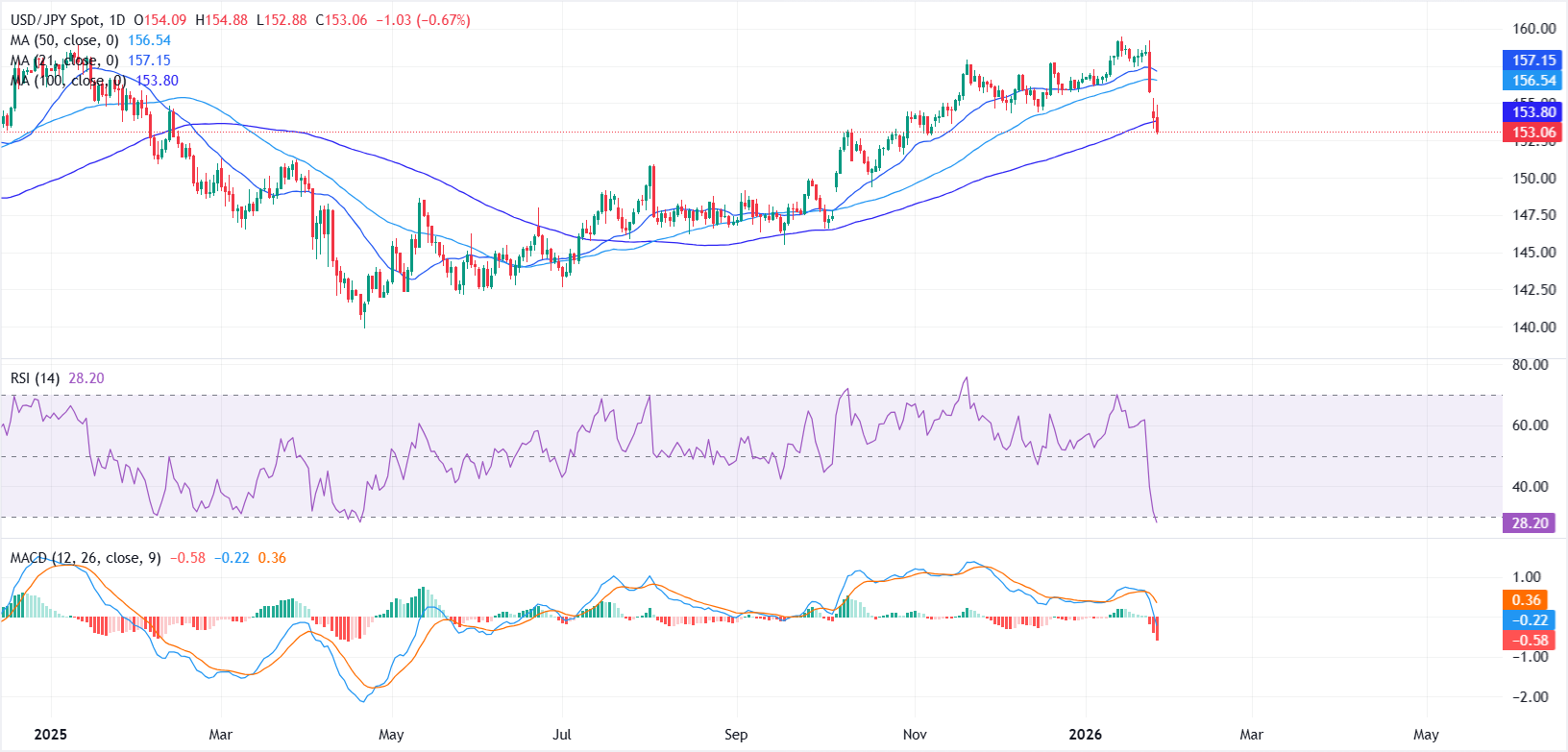
From a technical perspective, the near-term outlook for USD/JPY has turned bearish, with prices slipping decisively below key moving averages. On the daily chart, the shorter-term Simple Moving Averages (SMAs) have rolled over, while the 100-day SMA still edges modestly higher. However, price is now trading below the 21, 50 and 100-day SMAs.
Momentum indicators are also leaning lower. The Moving Average Convergence Divergence (MACD) line sits below the Signal line and beneath zero, with a deepening negative histogram that suggests strengthening downside momentum.
Meanwhile, the Relative Strength Index (RSI) has fallen to around 28, pushing into oversold territory and showing the strength of the recent sell-off
On the downside, a sustained break below the 153.00 handle would expose the October 29 low at 151.54, followed by the 150.00 psychological level. A clear move below 150 would likely open the door for a deeper corrective pullback.
On the upside, a daily close back above 155.00 would help ease immediate bearish pressure. However, as long as the pair trades below the 100-day SMA, the path of least resistance remains to the downside.
Fed FAQs
Monetary policy in the US is shaped by the Federal Reserve (Fed). The Fed has two mandates: to achieve price stability and foster full employment. Its primary tool to achieve these goals is by adjusting interest rates. When prices are rising too quickly and inflation is above the Fed’s 2% target, it raises interest rates, increasing borrowing costs throughout the economy. This results in a stronger US Dollar (USD) as it makes the US a more attractive place for international investors to park their money. When inflation falls below 2% or the Unemployment Rate is too high, the Fed may lower interest rates to encourage borrowing, which weighs on the Greenback.
The Federal Reserve (Fed) holds eight policy meetings a year, where the Federal Open Market Committee (FOMC) assesses economic conditions and makes monetary policy decisions. The FOMC is attended by twelve Fed officials – the seven members of the Board of Governors, the president of the Federal Reserve Bank of New York, and four of the remaining eleven regional Reserve Bank presidents, who serve one-year terms on a rotating basis.
In extreme situations, the Federal Reserve may resort to a policy named Quantitative Easing (QE). QE is the process by which the Fed substantially increases the flow of credit in a stuck financial system. It is a non-standard policy measure used during crises or when inflation is extremely low. It was the Fed’s weapon of choice during the Great Financial Crisis in 2008. It involves the Fed printing more Dollars and using them to buy high grade bonds from financial institutions. QE usually weakens the US Dollar.
Quantitative tightening (QT) is the reverse process of QE, whereby the Federal Reserve stops buying bonds from financial institutions and does not reinvest the principal from the bonds it holds maturing, to purchase new bonds. It is usually positive for the value of the US Dollar.

Hơn một triệu người dùng dựa vào FXStreet để có dữ liệu thị trường thời gian thực, công cụ biểu đồ, góc nhìn chuyên gia và tin tức Forex. Lịch kinh tế toàn diện và các hội thảo web giáo dục giúp nhà giao dịch luôn cập nhật và đưa ra quyết định có tính toán. FXStreet có khoảng 60 nhân sự, chia giữa trụ sở Barcelona và nhiều khu vực toàn cầu.
Đọc thêm








