

WTI Price Forecast: Breaks above $100 as Trump says China will buy US Oil
- WTI Oil extends gains beyond the key $100 level after the Trump-Xi summit.
- Oil prices jump as Trump affirms that China will buy US Oil.
- Beijing's two-day meeting ended with no specific plans to reopen the Strait of Hormuz.
Crude Oil prices maintain their bullish trend on Friday, with the US Benchmark West Texas Intermediate (WTI) barrel pushing to fresh weekly highs above $100.00, after US President Donald Trump affirmed that China agreed to buy US Crude, but no specific plan to reopen the critical Strait of Hormuz has arisen from Trump's summit with Chinese President Xi Jinping.
The two-day Trump-Xi meeting ended on Friday with more compliments than concrete agreements between the world’s two major economies. The US President affirmed that the Asian country is committed to reopening the critical waterway but without giving further details, and said that “they have agreed to buy Oil from the United States,” which sent Crude prices rallying. Chinese authorities, however, have failed to confirm that point so far.
Technical Analysis: Aiming for the $100 level
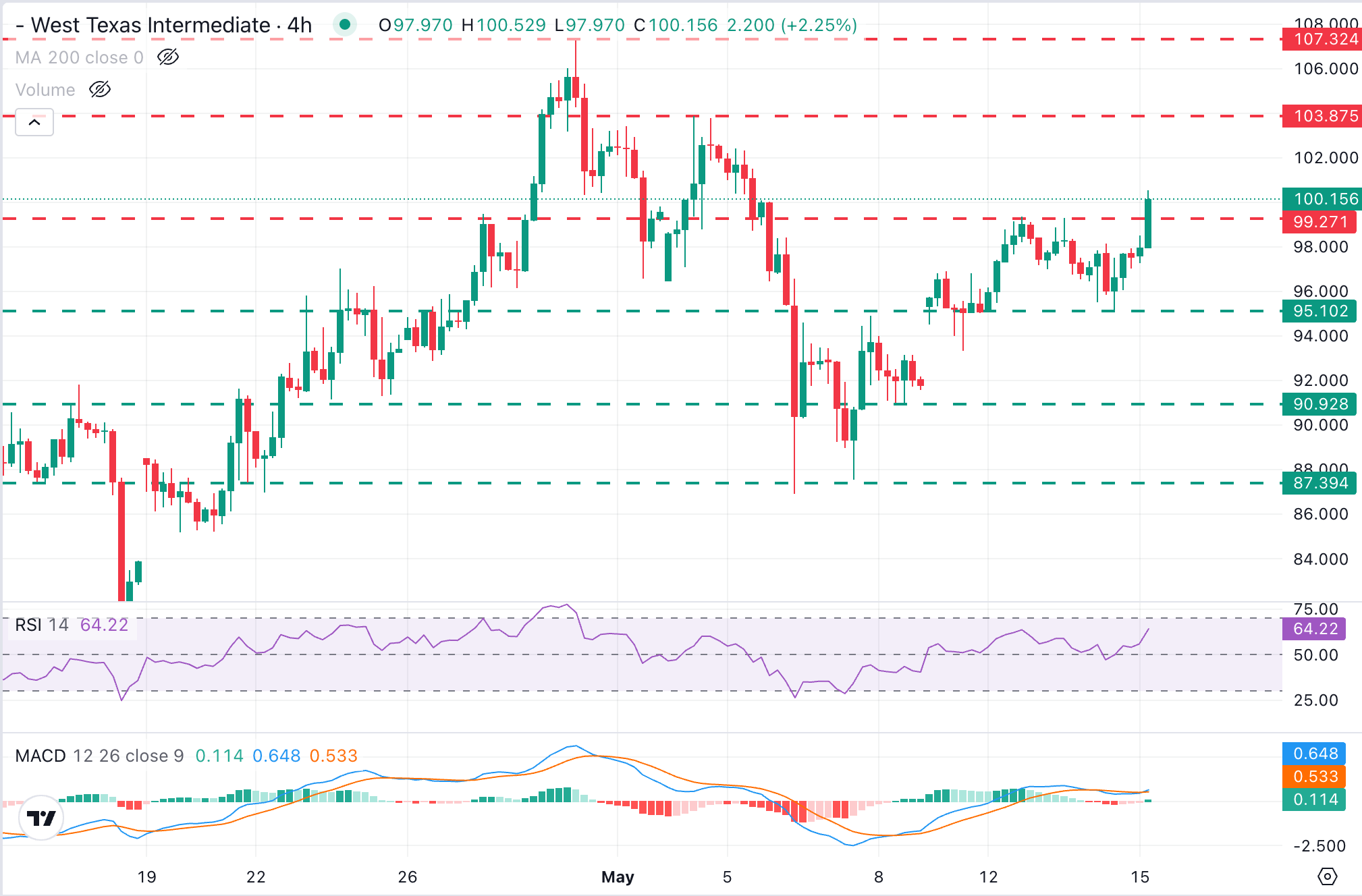
WTI US Oil trades at $100.05 amid a near-term bullish tone. The Relative Strength Index (RSI) on the 4-hour chart is at 64.22, highlighting a solid upside momentum, while the Moving Average Convergence Divergence (MACD) has turned back into positive territory, hinting that buyers are regaining control after the latest consolidation.
If price action consolidates above the $100 psychological, the next upside targets emerge at the early May highs, in the $103.80 area, followed by the April 30 high, at $107.35.
On the downside, immediate support is seen at Thursday's low of $95.11 ahead of the May 8 low, near $90.90, and the area between May 6 and 7 lows, at $86.90-$87.55.
(The technical analysis of this story was written with the help of an AI tool.)
WTI Oil FAQs
WTI Oil is a type of Crude Oil sold on international markets. The WTI stands for West Texas Intermediate, one of three major types including Brent and Dubai Crude. WTI is also referred to as “light” and “sweet” because of its relatively low gravity and sulfur content respectively. It is considered a high quality Oil that is easily refined. It is sourced in the United States and distributed via the Cushing hub, which is considered “The Pipeline Crossroads of the World”. It is a benchmark for the Oil market and WTI price is frequently quoted in the media.
Like all assets, supply and demand are the key drivers of WTI Oil price. As such, global growth can be a driver of increased demand and vice versa for weak global growth. Political instability, wars, and sanctions can disrupt supply and impact prices. The decisions of OPEC, a group of major Oil-producing countries, is another key driver of price. The value of the US Dollar influences the price of WTI Crude Oil, since Oil is predominantly traded in US Dollars, thus a weaker US Dollar can make Oil more affordable and vice versa.
The weekly Oil inventory reports published by the American Petroleum Institute (API) and the Energy Information Agency (EIA) impact the price of WTI Oil. Changes in inventories reflect fluctuating supply and demand. If the data shows a drop in inventories it can indicate increased demand, pushing up Oil price. Higher inventories can reflect increased supply, pushing down prices. API’s report is published every Tuesday and EIA’s the day after. Their results are usually similar, falling within 1% of each other 75% of the time. The EIA data is considered more reliable, since it is a government agency.
OPEC (Organization of the Petroleum Exporting Countries) is a group of 12 Oil-producing nations who collectively decide production quotas for member countries at twice-yearly meetings. Their decisions often impact WTI Oil prices. When OPEC decides to lower quotas, it can tighten supply, pushing up Oil prices. When OPEC increases production, it has the opposite effect. OPEC+ refers to an expanded group that includes ten extra non-OPEC members, the most notable of which is Russia.














