

Trade The World
Canadian Dollar middles as investor sentiment slows to a crawl
Bởi Joshua Gibson
Ngày xuất bản: 1 Oct 2025 | Ngày chỉnh sửa: 1 Oct 2025


POPULAR ARTICLES

The Canadian Dollar (CAD) held mostly in place on Tuesday, with market flows broadly drawing down as the US government careens into a funding shutdown.
- The Canadian Dollar held steady against the US Dollar on Tuesday.
- Markets are holding back and waiting to see if the latest US NFP jobs data gets released.
- A looming US government shutdown is pressing down on market momentum.
The Canadian Dollar (CAD) held mostly in place on Tuesday, with market flows broadly drawing down as the US government careens into a funding shutdown. The latest US Nonfarm Payrolls (NFP) jobs data dump, which has taken on additional significance as markets watch for signs of further Federal Reserve (Fed) rate cuts, may be delayed or suspended until the US government reopens.
Purchasing Managers Index (PMI) figures for both Canada and the US are due on Wednesday, but the data release will likely have limited impact. The US government’s fiscal year officially kicks off on October 1, and investors will largely be focusing on the federal shutdown.
Daily digest market movers: Canadian Dollar freezes amid political tensions
- The Canadian Dollar is holding steady near key technical levels against the US Dollar as Loonie flows dry up.
- Markets are awaiting further developments about the looming US government shutdown.
- This week’s key NFP labor release could be delayed or outright canceled, and markets haven’t decided how they feel about it yet.
- US government shutdowns are typically not market movers, but investors are concerned about how long this one could last.
- The Trump administration has threatened to engage in stark executive actions during a shutdown, including axing thousands of federal worker jobs during the blackout.
Canadian Dollar price forecast
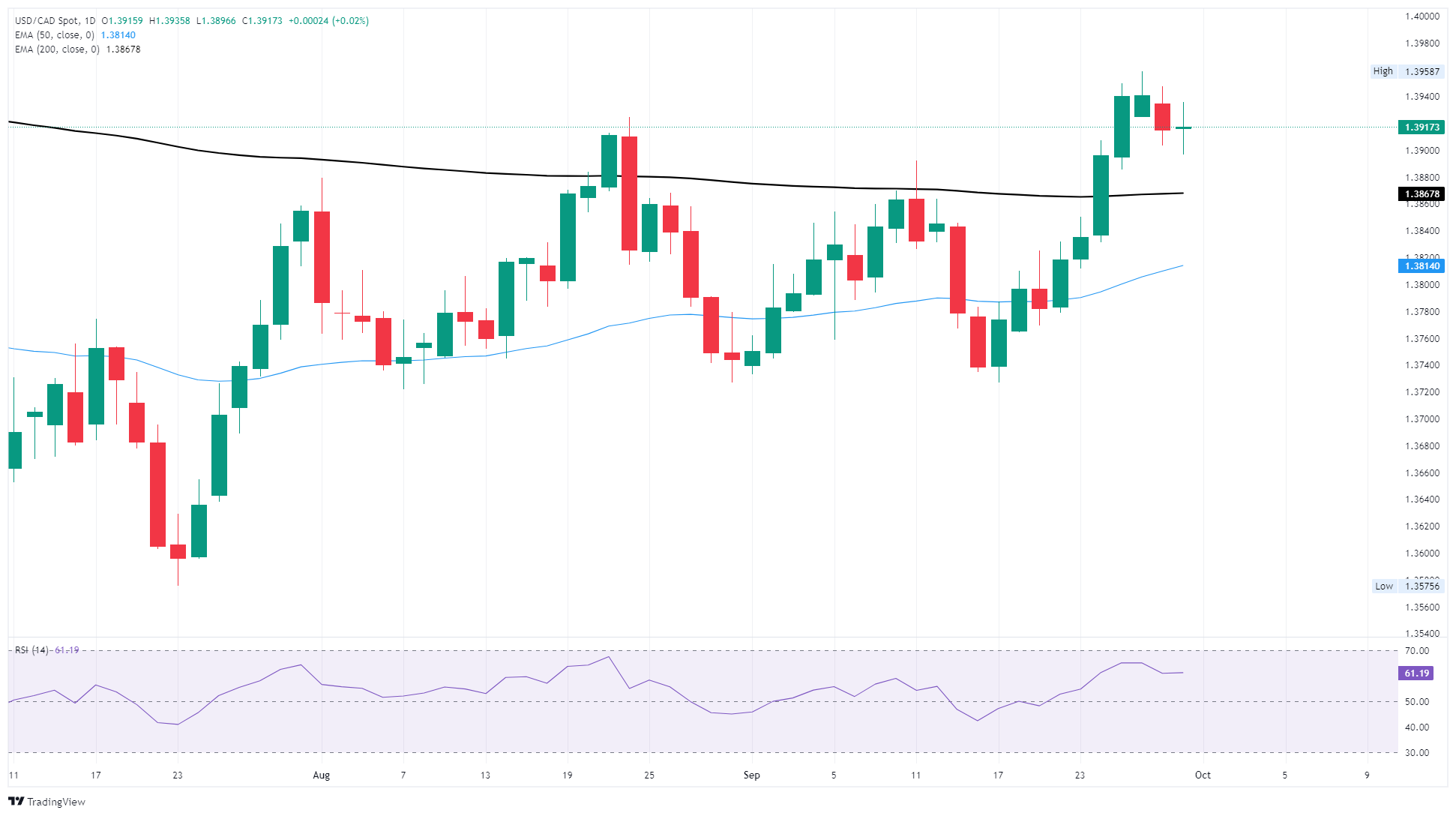
The Canadian Dollar has hit a slow patch against the US Dollar, holding steady and churning in place after tapping a near-term technical ceiling near 1.3960. The Canadian Dollar slumped against the Greenback recently, tumbling to fresh lows and pushing the USD/CAD chart back above the 200-day Exponential Moving Average (EMA) near 1.3870.
USD/CAD daily chart
Canadian Dollar FAQs
The key factors driving the Canadian Dollar (CAD) are the level of interest rates set by the Bank of Canada (BoC), the price of Oil, Canada’s largest export, the health of its economy, inflation and the Trade Balance, which is the difference between the value of Canada’s exports versus its imports. Other factors include market sentiment – whether investors are taking on more risky assets (risk-on) or seeking safe-havens (risk-off) – with risk-on being CAD-positive. As its largest trading partner, the health of the US economy is also a key factor influencing the Canadian Dollar.
The Bank of Canada (BoC) has a significant influence on the Canadian Dollar by setting the level of interest rates that banks can lend to one another. This influences the level of interest rates for everyone. The main goal of the BoC is to maintain inflation at 1-3% by adjusting interest rates up or down. Relatively higher interest rates tend to be positive for the CAD. The Bank of Canada can also use quantitative easing and tightening to influence credit conditions, with the former CAD-negative and the latter CAD-positive.
The price of Oil is a key factor impacting the value of the Canadian Dollar. Petroleum is Canada’s biggest export, so Oil price tends to have an immediate impact on the CAD value. Generally, if Oil price rises CAD also goes up, as aggregate demand for the currency increases. The opposite is the case if the price of Oil falls. Higher Oil prices also tend to result in a greater likelihood of a positive Trade Balance, which is also supportive of the CAD.
While inflation had always traditionally been thought of as a negative factor for a currency since it lowers the value of money, the opposite has actually been the case in modern times with the relaxation of cross-border capital controls. Higher inflation tends to lead central banks to put up interest rates which attracts more capital inflows from global investors seeking a lucrative place to keep their money. This increases demand for the local currency, which in Canada’s case is the Canadian Dollar.
Macroeconomic data releases gauge the health of the economy and can have an impact on the Canadian Dollar. Indicators such as GDP, Manufacturing and Services PMIs, employment, and consumer sentiment surveys can all influence the direction of the CAD. A strong economy is good for the Canadian Dollar. Not only does it attract more foreign investment but it may encourage the Bank of Canada to put up interest rates, leading to a stronger currency. If economic data is weak, however, the CAD is likely to fall.

FXStreet
Hơn một triệu người dùng dựa vào FXStreet để có dữ liệu thị trường thời gian thực, công cụ biểu đồ, góc nhìn chuyên gia và tin tức Forex. Lịch kinh tế toàn diện và các hội thảo web giáo dục giúp nhà giao dịch luôn cập nhật và đưa ra quyết định có tính toán. FXStreet có khoảng 60 nhân sự, chia giữa trụ sở Barcelona và nhiều khu vực toàn cầu.
Read More








