

Dow Jones Industrial Average rises as Trump rules out military action over Greenland
Bởi Joshua Gibson
Ngày xuất bản: 22 Jan 2026 | Ngày chỉnh sửa: 22 Jan 2026


BÀI VIẾT PHỔ BIẾN

US equities rebounded on Wednesday after President Trump ruled out using military force to acquire Greenland, easing a key source of market anxiety.
- US stocks rebounded after Trump ruled out military action on Greenland
- Gains faded as tariff risks and EU-US trade tensions remained in focus
- Yields fell and banks rose, but policy uncertainty kept investors cautious
US equities rebounded on Wednesday after President Trump ruled out using military force to acquire Greenland, easing a key source of market anxiety. In comments delivered at the World Economic Forum in Davos, Trump said he would not use excessive force, calming fears that had driven a sharp sell-off in the prior session. Stocks moved higher alongside falling Treasury yields, while the dollar stabilized after earlier weakness.
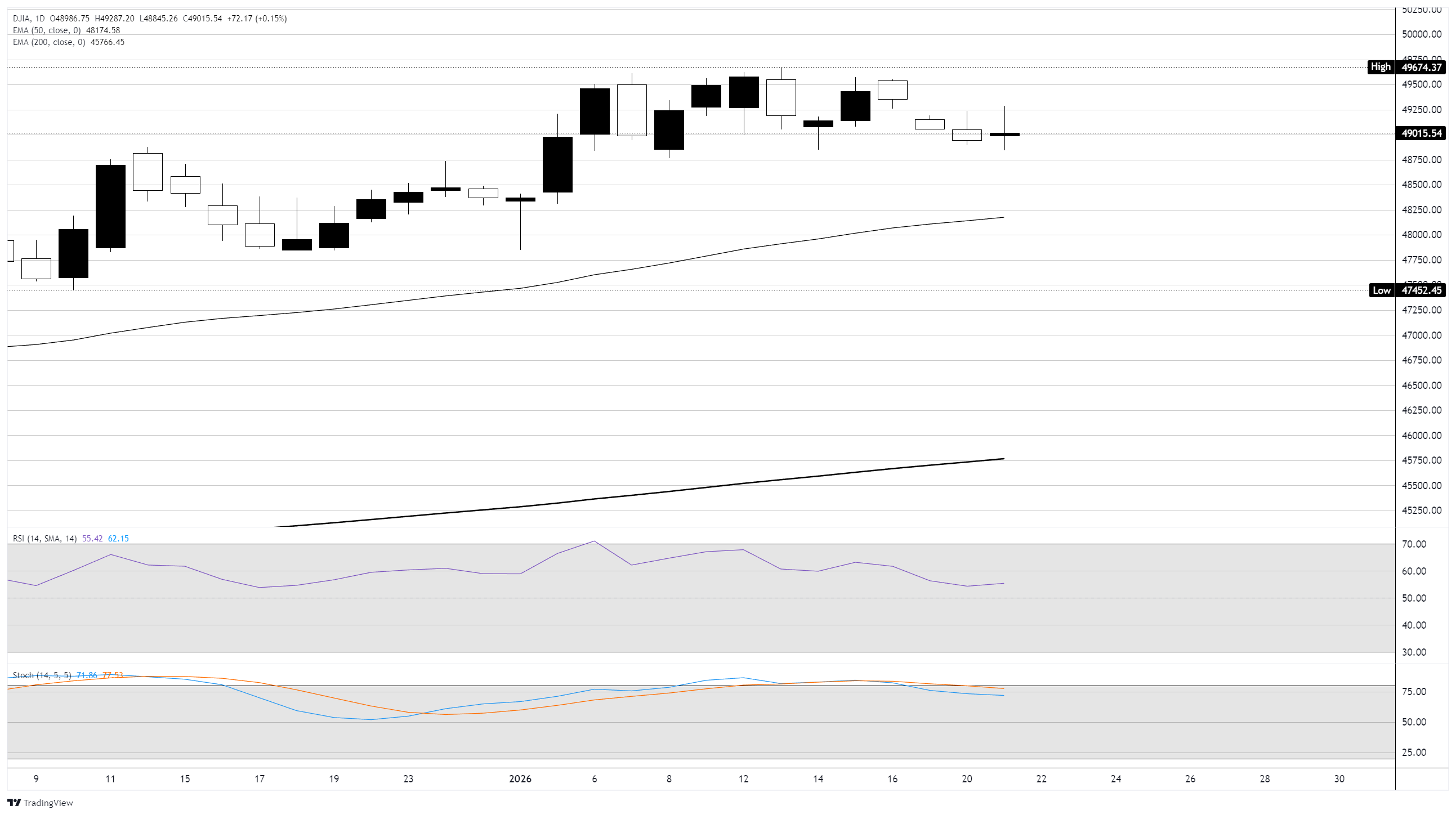
The Dow Jones Industrial Average rose about 160 points, or 0.33 percent, while the S&P 500 gained 0.25 percent and the Nasdaq Composite advanced just 0.1 percent. Gains were more pronounced earlier in the session, but stocks faded from their highs as investors weighed ongoing tariff risks between the US and Europe. Despite ruling out military action, Trump reiterated that he is seeking immediate negotiations over Greenland, keeping geopolitical uncertainty in focus.
Sector performance reflected selective relief rather than broad risk-on positioning. Bank stocks outperformed after Trump said he would ask Congress to pursue a 10 percent credit card interest rate cap, with shares of major lenders posting modest gains. Bond prices rose and yields fell following Trump’s remarks, reversing part of Tuesday’s sharp move higher. The prior session’s sell-off had marked the worst day for US equities since October and briefly pushed the S&P 500 and Nasdaq into negative territory for 2026.
Policy and Trade Risks Remain in Focus
Despite Wednesday’s rebound, investor caution remained elevated. European lawmakers suspended approval of the EU-US trade deal agreed in July, citing Trump’s proposed tariffs of 10 to 25 percent on European goods tied to Greenland negotiations. European leaders warned that escalating tariffs could trigger retaliatory measures, including restrictions on US companies’ access to the single market.
Adding to the policy backdrop, Supreme Court justices expressed skepticism over whether President Trump has the authority to dismiss Federal Reserve Governor Lisa Cook. Comments from the bench highlighted concerns about preserving Fed independence, a factor closely watched by markets amid elevated political uncertainty. While the immediate tail risk around Greenland eased, investors remain focused on how trade policy, institutional independence, and geopolitical negotiations may shape market volatility in the days ahead.
Dow Jones daily chart
Dow Jones FAQs
The Dow Jones Industrial Average, one of the oldest stock market indices in the world, is compiled of the 30 most traded stocks in the US. The index is price-weighted rather than weighted by capitalization. It is calculated by summing the prices of the constituent stocks and dividing them by a factor, currently 0.152. The index was founded by Charles Dow, who also founded the Wall Street Journal. In later years it has been criticized for not being broadly representative enough because it only tracks 30 conglomerates, unlike broader indices such as the S&P 500.
Many different factors drive the Dow Jones Industrial Average (DJIA). The aggregate performance of the component companies revealed in quarterly company earnings reports is the main one. US and global macroeconomic data also contributes as it impacts on investor sentiment. The level of interest rates, set by the Federal Reserve (Fed), also influences the DJIA as it affects the cost of credit, on which many corporations are heavily reliant. Therefore, inflation can be a major driver as well as other metrics which impact the Fed decisions.
Dow Theory is a method for identifying the primary trend of the stock market developed by Charles Dow. A key step is to compare the direction of the Dow Jones Industrial Average (DJIA) and the Dow Jones Transportation Average (DJTA) and only follow trends where both are moving in the same direction. Volume is a confirmatory criteria. The theory uses elements of peak and trough analysis. Dow’s theory posits three trend phases: accumulation, when smart money starts buying or selling; public participation, when the wider public joins in; and distribution, when the smart money exits.
There are a number of ways to trade the DJIA. One is to use ETFs which allow investors to trade the DJIA as a single security, rather than having to buy shares in all 30 constituent companies. A leading example is the SPDR Dow Jones Industrial Average ETF (DIA). DJIA futures contracts enable traders to speculate on the future value of the index and Options provide the right, but not the obligation, to buy or sell the index at a predetermined price in the future. Mutual funds enable investors to buy a share of a diversified portfolio of DJIA stocks thus providing exposure to the overall index.

Hơn một triệu người dùng dựa vào FXStreet để có dữ liệu thị trường thời gian thực, công cụ biểu đồ, góc nhìn chuyên gia và tin tức Forex. Lịch kinh tế toàn diện và các hội thảo web giáo dục giúp nhà giao dịch luôn cập nhật và đưa ra quyết định có tính toán. FXStreet có khoảng 60 nhân sự, chia giữa trụ sở Barcelona và nhiều khu vực toàn cầu.
Đọc thêm








