

Bitcoin Price Forecast: BTC struggles as ETF outflow streak extends to six straight week
- Bitcoin steadies at $64,500 on Monday after falling nearly 4% in the previous week.
- Geopolitical uncertainty remains elevated despite progress in the first round of US-Iran talks in Switzerland, keeping investors cautious.
- Institutional selling persists, as spot Bitcoin ETFs record their sixth consecutive week of withdrawals.
Bitcoin (BTC) trades around $64,000 at the time of writing on Monday after declining nearly 4% in the previous week. BTC investors remain cautious despite signs of progress in the first round of US-Iran peace talks in Switzerland. Institutional demand continues to weaken, with spot Exchange Traded Funds (ETFs) recording the sixth consecutive week of outflows, extending a negative streak that began in mid-May. The Crypto King’s recovery isn't likely to be sustained unless institutional demand for BTC increases this week.

US-Iran peace deal advances, but uncertainty continues to cap risky assets
Geopolitical uncertainty remains elevated as investors assess mixed signals surrounding the ongoing US-Iran peace talks.
Iran’s Foreign Minister described the first round of high-level negotiations in Switzerland as showing “progress,” despite talks opening under heightened tensions following US President Donald Trump’s warning that military action could resume if diplomacy fails, as reported by the Guardian.
A joint statement from mediators Qatar and Pakistan said the US and Iran agreed to a roadmap towards a final deal within 60 days, offering cautious optimism.
However, uncertainty persists as negotiations covering the technical details of the framework agreement between lower-level officials are set to continue throughout the week, with the conflict involving Israel and Iran-backed Hezbollah in Lebanon remaining one of the key issues on the agenda.
These developments have slightly improved risk sentiment, but not enough to help Bitcoin rebound decisively.
Institutional selling continues
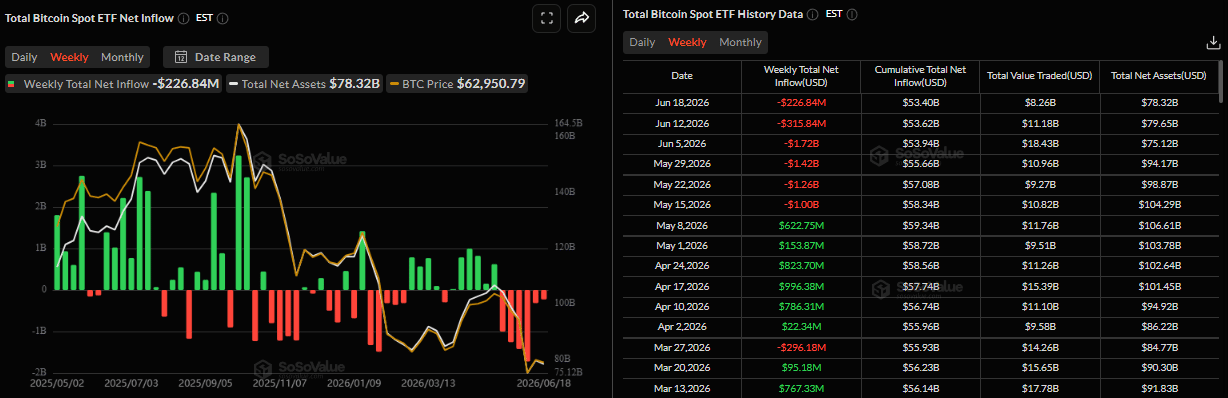
Institutional demand continues to weaken. SoSoValue weekly data show that spot BTC ETFs recorded an outflow of $226.84 million last week, marking the sixth consecutive week of withdrawals. While outflows were more muted compared to prior weeks, these continued withdrawals weigh on Bitcoin's price outlook.
“The market is still looking for a strong enough catalyst to break out of the range-bound conditions seen over the past several weeks," said Simon-Peter Massabni, Head of Business Development at XS.com.
Although selling pressure from US spot Bitcoin ETFs has eased in recent weeks, institutional demand remains subdued, with the funds recording six consecutive weeks of net outflows, he added.
One of the biggest pressures on Bitcoin right now is the rebound in the US dollar (USD). After the June meeting, the Fed delivered a hawkish message, weakening expectations for near-term rate cuts, keeping US Treasury yields elevated. In an environment where liquidity has not meaningfully improved, capital tends to favor assets with more stable yields over highly volatile assets such as Bitcoin.
Unless ETF inflows resume and macroeconomic conditions become more supportive, the current rebound is likely to remain technical rather than signaling the start of a sustained bullish trend.
Bitcoin Price Forecast: Momentum indicators show some signs of optimism
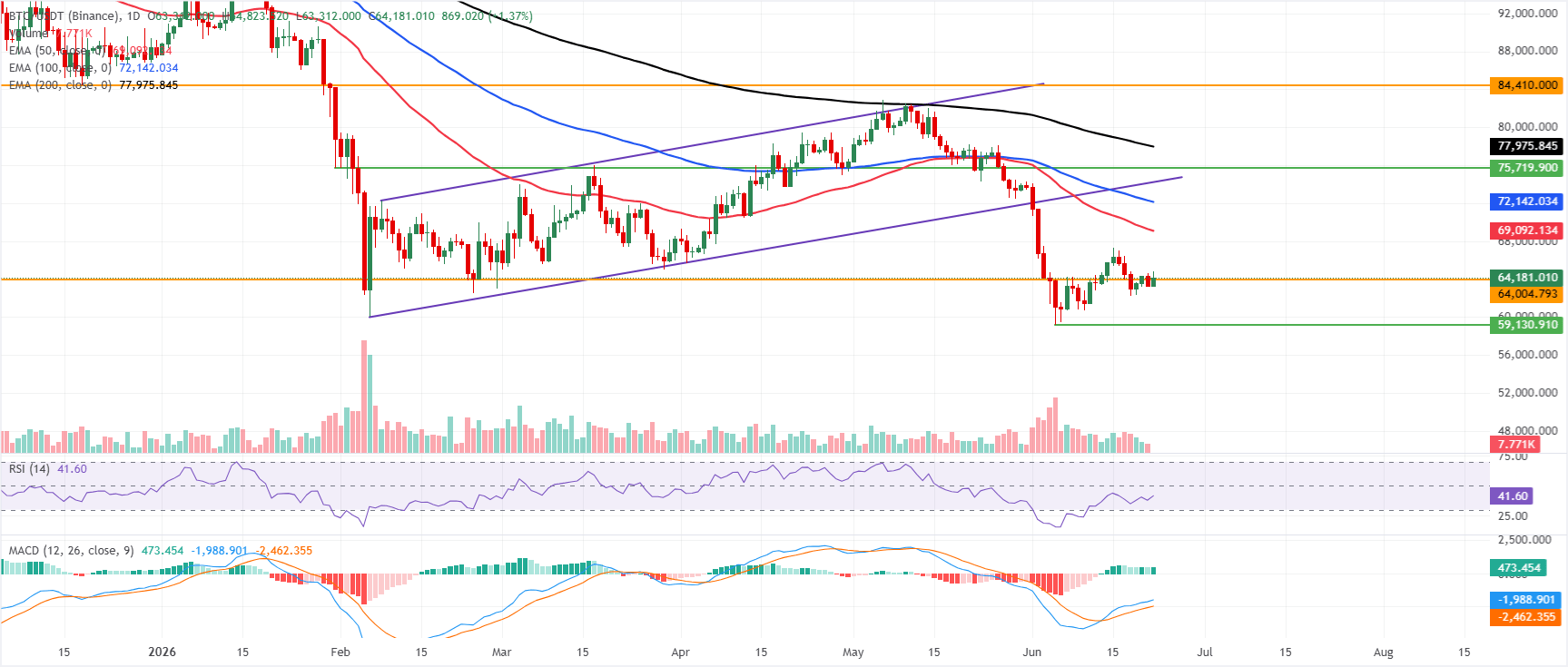
Bitcoin maintains a bearish bias as price remains well below the 50-day, 100-day, and 200-day Exponential Moving Averages (EMAs), clustered from roughly $69,100 to $77,900.
The loss of the former rising trendline, now a resistance barrier near $74,238, underscores that the market remains in corrective mode. At the same time, the Relative Strength Index (RSI) has recovered from deeply oversold territory toward the low-40s, hinting at easing downside pressure but not yet signaling a bullish reversal. The Moving Average Convergence Divergence (MACD) indicator remains in positive territory, though the recent flattening of the MACD line relative to its signal line suggests waning recovery momentum.
On the topside, immediate resistance is seen at the 50-day EMA around $69,092, followed by the 100-day EMA near $72,142 and the broken rising trendline close to $74,238. Above that, the 200-day EMA at about $77,975 and the horizontal barrier at $84,410 outline a broader supply zone.
On the downside, first support is located at the horizontal level around $64,005, where a clear break would expose fresh lows and extend the current downtrend on the daily timeframe.
(The technical analysis of this story was written with the help of an AI tool.)
Bitcoin, altcoins, stablecoins FAQs
Bitcoin is the largest cryptocurrency by market capitalization, a virtual currency designed to serve as money. This form of payment cannot be controlled by any one person, group, or entity, which eliminates the need for third-party participation during financial transactions.
Altcoins are any cryptocurrency apart from Bitcoin, but some also regard Ethereum as a non-altcoin because it is from these two cryptocurrencies that forking happens. If this is true, then Litecoin is the first altcoin, forked from the Bitcoin protocol and, therefore, an “improved” version of it.
Stablecoins are cryptocurrencies designed to have a stable price, with their value backed by a reserve of the asset it represents. To achieve this, the value of any one stablecoin is pegged to a commodity or financial instrument, such as the US Dollar (USD), with its supply regulated by an algorithm or demand. The main goal of stablecoins is to provide an on/off-ramp for investors willing to trade and invest in cryptocurrencies. Stablecoins also allow investors to store value since cryptocurrencies, in general, are subject to volatility.
Bitcoin dominance is the ratio of Bitcoin's market capitalization to the total market capitalization of all cryptocurrencies combined. It provides a clear picture of Bitcoin’s interest among investors. A high BTC dominance typically happens before and during a bull run, in which investors resort to investing in relatively stable and high market capitalization cryptocurrency like Bitcoin. A drop in BTC dominance usually means that investors are moving their capital and/or profits to altcoins in a quest for higher returns, which usually triggers an explosion of altcoin rallies.














