

Gold Price Forecast: XAU/USD slides to $4,700 ahead of US CPI data
- Gold retreats to $4,700 from $4.770 highs, but remains within the last few days' ranges.
- Concerns about the fragility of the US-Iran ceasefire have curbed risk appetite on Tuesday.
- The USD and US Treasury yields rally ahead of the release of US CPI data.
Gold (XAU/USD) shows moderate losses on Tuesday, trading a few pips below the $4,700 level at the time of writing after failing to find acceptance above $4,770 earlier on the day. The precious metal remains within previous ranges, but the risk has shifted to the downside as concerns about the US-Iran ceasefire and investors’ cautiousness ahead of the US Consumer Price Index (CPI) release are buoying the US Dollar (USD).

US President Donald Trump warned earlier on Tuesday that the ceasefire is on “life support,” and CNN, citing some of his aides, has reported that the president would be seriously considering resuming combat operations.
On the macroeconomic front, all eyes are on the US CPI release, due later on Tuesday. Consumer inflation is expected to have surged to a 3.7% annual rate in April, its highest level since September 2023, amid the energy shock from Iran’s war. Investors remain wary of a higher-than-expected CPI that would put pressure on the Fed to confirm the hawkish turn. US Treasury yields and the US Dollar are on the rise.
Technical Analysis: Gold looks ready to resume its bearish correction
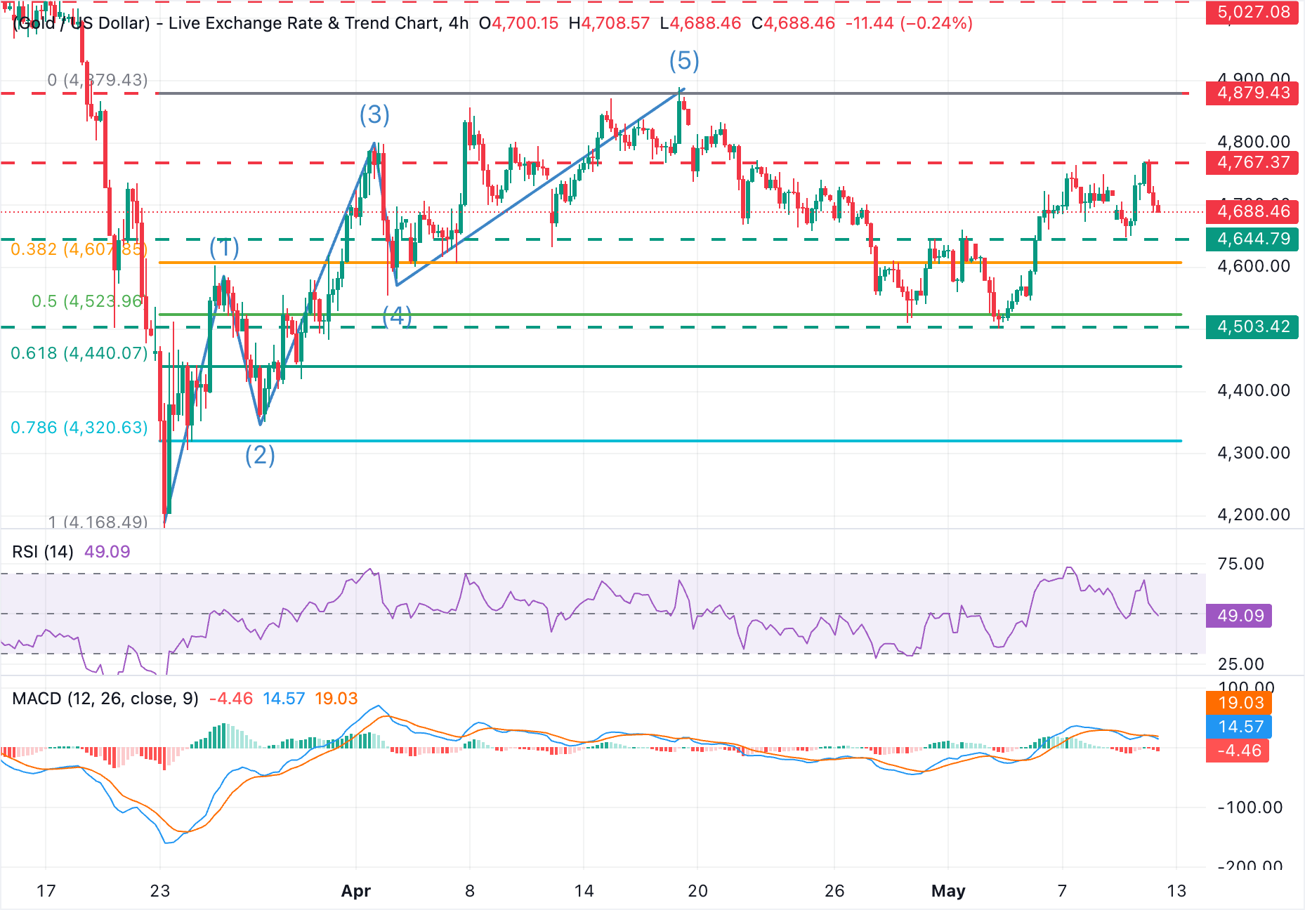
XAU/USD's technical picture shows a neutral-to-bearish bias on the 4-hour chart, with the pair consolidating below the $4,770 resistance area. The bigger picture, however, suggests that the yellow metal would be in an A-B-C correction after the completion of a 5-wave (Elliott Wave) bullish cycle in early April
The 4-hour Relative Strength Index (RSI) has dropped below the key 50 level, while the Moving Average Convergence Divergence (MACD) remains below zero with a negative reading, suggesting that bears are starting to tighten their grip.
On the downside, initial support lies between Monday's low at the $4,645 and the 38.2% Fibonacci retracement of the mentioned cycle, near $4,610. Further down, the late-April and early-May support at the $4,500 level will come into focus. A plausible target for an A-B-C correction would be the 78.6% Fibonacci retracement, at $4,320.
On the topside, Monday's highs, at the mentioned $4,770 area, are expected to keep guarding the path towards the mid-April highs in the area of $4,880.
(The technical analysis of this story was written with the help of an AI tool.)
Gold FAQs
Gold has played a key role in human’s history as it has been widely used as a store of value and medium of exchange. Currently, apart from its shine and usage for jewelry, the precious metal is widely seen as a safe-haven asset, meaning that it is considered a good investment during turbulent times. Gold is also widely seen as a hedge against inflation and against depreciating currencies as it doesn’t rely on any specific issuer or government.
Central banks are the biggest Gold holders. In their aim to support their currencies in turbulent times, central banks tend to diversify their reserves and buy Gold to improve the perceived strength of the economy and the currency. High Gold reserves can be a source of trust for a country’s solvency. Central banks added 1,136 tonnes of Gold worth around $70 billion to their reserves in 2022, according to data from the World Gold Council. This is the highest yearly purchase since records began. Central banks from emerging economies such as China, India and Turkey are quickly increasing their Gold reserves.
Gold has an inverse correlation with the US Dollar and US Treasuries, which are both major reserve and safe-haven assets. When the Dollar depreciates, Gold tends to rise, enabling investors and central banks to diversify their assets in turbulent times. Gold is also inversely correlated with risk assets. A rally in the stock market tends to weaken Gold price, while sell-offs in riskier markets tend to favor the precious metal.
The price can move due to a wide range of factors. Geopolitical instability or fears of a deep recession can quickly make Gold price escalate due to its safe-haven status. As a yield-less asset, Gold tends to rise with lower interest rates, while higher cost of money usually weighs down on the yellow metal. Still, most moves depend on how the US Dollar (USD) behaves as the asset is priced in dollars (XAU/USD). A strong Dollar tends to keep the price of Gold controlled, whereas a weaker Dollar is likely to push Gold prices up.














