

Gold rises within familiar range as Trump says US-Iran talks continue “at a rapid pace”
- Gold edges higher on Tuesday but remains stuck within a two-week range as traders monitor Middle East headlines.
- Inflation worries driven by elevated Crude Oil prices continue to weigh on Gold.
- XAU/USD trades below the 50-day and 100-day SMAs, keeping the near-term technical outlook tilted to the downside.
Gold (XAU/USD) moves higher on Tuesday but remains within a two-week range as traders track rapidly changing headlines from the Middle East. At the time of writing, XAU/USD trades around $4,530, up nearly 1% on the day.
US President Donald Trump said US-Iran negotiations are continuing “at a rapid pace,” despite reports that Iran suspended talks. Trump also told ABC News on Monday that he expects Washington and Tehran to reach an agreement within the next week to extend the ceasefire and reopen the Strait of Hormuz.

Meanwhile, Lebanon’s Embassy in the US said Hezbollah accepted a US-backed proposal for a “mutual cessation of attacks.” The development came after Trump said on Truth Social that, following talks with representatives, Israel called off its planned operation against Hezbollah in Beirut, while Hezbollah also agreed not to attack Israel.
Market sentiment improves somewhat following the latest developments, pushing the US Dollar (USD) and Crude Oil prices slightly lower and helping XAU/USD recover from below $4,500.
Still, the metal lacks upside momentum as rising inflation concerns linked to higher energy prices have stalled the Federal Reserve’s (Fed) disinflation progress, increasing the likelihood of a prolonged period of higher interest rates.
US inflation has accelerated sharply since the US-Iran war began in late February, moving further away from the central bank’s 2% target.
Before the war started, markets were expecting at least two rate cuts this year. That view has now shifted, with traders pricing in the possibility of a rate hike before year-end, according to the CME FedWatch tool. Gold, which does not offer any yield, typically performs better when borrowing costs are low.
The US and Iran remain far apart on several key issues, and unless a peace agreement is reached and the Strait of Hormuz reopens, Gold may continue to trade within its recent range. Traders also appear reluctant to push prices lower as the situation in the Middle East continues to evolve.
On the economic data front, markets now turn their attention to US labor market figures this week, including the JOLTS Job Openings report on Tuesday, the ADP Employment Change on Wednesday and the Nonfarm Payrolls (NFP) report on Friday.
Technical Analysis: XAU/USD holds above 200-day SMA while downside risks persist
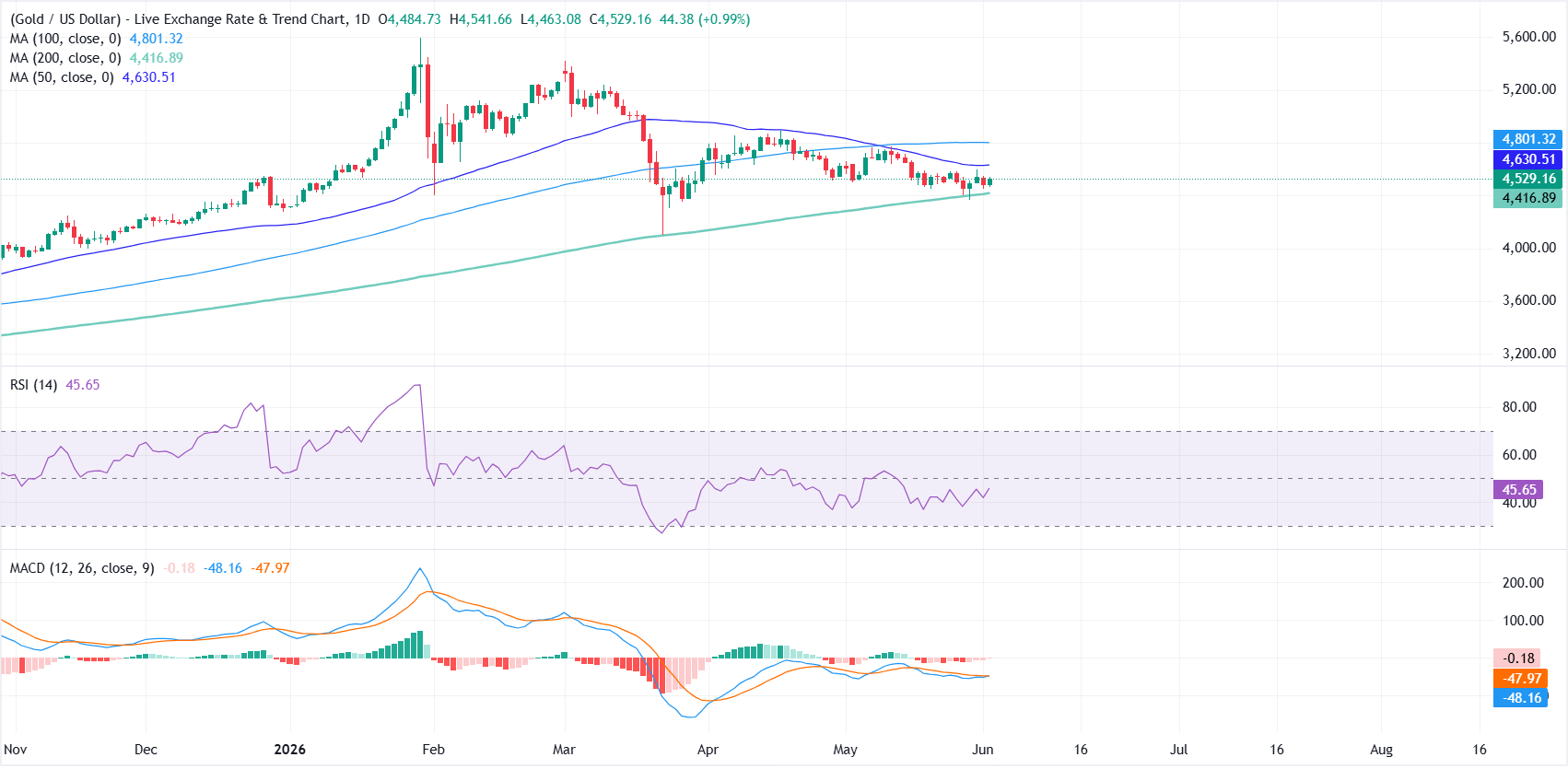
On the daily chart, XAU/USD keeps a bearish near-term bias as spot holds beneath the 50-day Simple Moving Average (SMA) and the 100-day SMA while remaining above the 200-day SMA at $4,416.
The Relative Strength Index (RSI) at 45 stays below the neutral 50 line and the Moving Average Convergence Divergence (MACD) indicator is marginally negative, together suggesting subdued upside momentum while prices consolidate under these key trend gauges.
On the topside, initial resistance is located at the 50-day SMA around $4,630, with a subsequent barrier emerging at the 100-day SMA near $4,801. On the downside, the 200-day SMA at $4,416 forms the first meaningful support zone, and a sustained break under this longer-term average would likely open the door to a deeper corrective phase in XAU/USD.
(The technical analysis of this story was written with the help of an AI tool.)
Gold FAQs
Gold has played a key role in human’s history as it has been widely used as a store of value and medium of exchange. Currently, apart from its shine and usage for jewelry, the precious metal is widely seen as a safe-haven asset, meaning that it is considered a good investment during turbulent times. Gold is also widely seen as a hedge against inflation and against depreciating currencies as it doesn’t rely on any specific issuer or government.
Central banks are the biggest Gold holders. In their aim to support their currencies in turbulent times, central banks tend to diversify their reserves and buy Gold to improve the perceived strength of the economy and the currency. High Gold reserves can be a source of trust for a country’s solvency. Central banks added 1,136 tonnes of Gold worth around $70 billion to their reserves in 2022, according to data from the World Gold Council. This is the highest yearly purchase since records began. Central banks from emerging economies such as China, India and Turkey are quickly increasing their Gold reserves.
Gold has an inverse correlation with the US Dollar and US Treasuries, which are both major reserve and safe-haven assets. When the Dollar depreciates, Gold tends to rise, enabling investors and central banks to diversify their assets in turbulent times. Gold is also inversely correlated with risk assets. A rally in the stock market tends to weaken Gold price, while sell-offs in riskier markets tend to favor the precious metal.
The price can move due to a wide range of factors. Geopolitical instability or fears of a deep recession can quickly make Gold price escalate due to its safe-haven status. As a yield-less asset, Gold tends to rise with lower interest rates, while higher cost of money usually weighs down on the yellow metal. Still, most moves depend on how the US Dollar (USD) behaves as the asset is priced in dollars (XAU/USD). A strong Dollar tends to keep the price of Gold controlled, whereas a weaker Dollar is likely to push Gold prices up.














