

Gold slips as firm US yields cap post-NFP rebound
- ISM Services slows, but employment gauge returns to expansion.
- Fed hike bets cool after weaker payrolls and revisions.
- FOMC minutes, jobless claims and CPI guide next move.
Gold (XAU/USD) price retreats by some 0.50% on Monday as the Greenback remains steady despite traders repricing a less hawkish Federal Reserve (Fed) following last Thursday’s softer-than-expected jobs report. The XAU/USD pair trades at $4,153, down 0.50%.
XAU/USD retreats as steady Dollar and yields cap recovery
Data from the US showed that business activity in the services sector was modestly softer than expected, with the ISM Services PMI dipping from 54.5 to 54. Even though the data indicated a slowdown, the Employment Index improved, while a measure of producer prices slowed from 71.3 to 67.7.

Monday’s data outweighed June’s Nonfarm Payrolls report, which fell short of expectations, and the April and May data, revised lower, an indication of further deterioration.
Traders? trimmed Fed hawkish bets. As of writing, they are expecting an 88% chance of a rate hike at the December meeting, as they priced in 22 basis points of tightening.
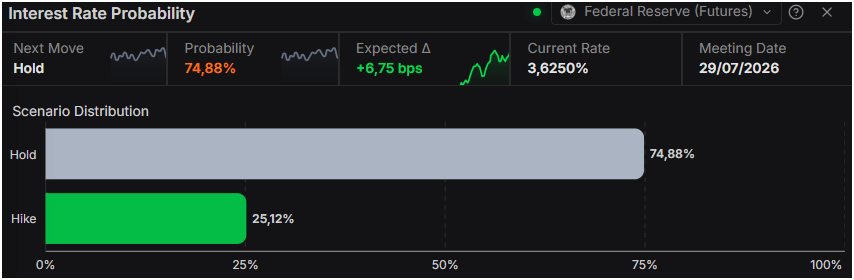
For the July meeting, money markets expect the Fed to hold rates unchanged, with odds at 77%, according to Prime Terminal data.
Bullion weighed by high US yields, strong US Dollar
In the meantime, the US Dollar Index (DXY), which tracks the buck’s value against six currencies, is up 0.03% at 100.90, a headwind for the non-yielding metal. Also, US Treasury yields are steady, with the 10-year benchmark note yielding 4.451%, unchanged.
Geopolitics had fallen to the background as the second round of talks between the US and Iran in Islamabad was set to start next Saturday. Remaining issues include Iran’s nuclear program, frozen assets, the Strait of Hormuz, and Lebanon.
Aside from this, the US economic docket will feature the Fed’s last meeting minutes, followed by Initial Jobless Claims for the week ending July 4, as traders brace for July 14 Consumer Price Index (CPI) figures.
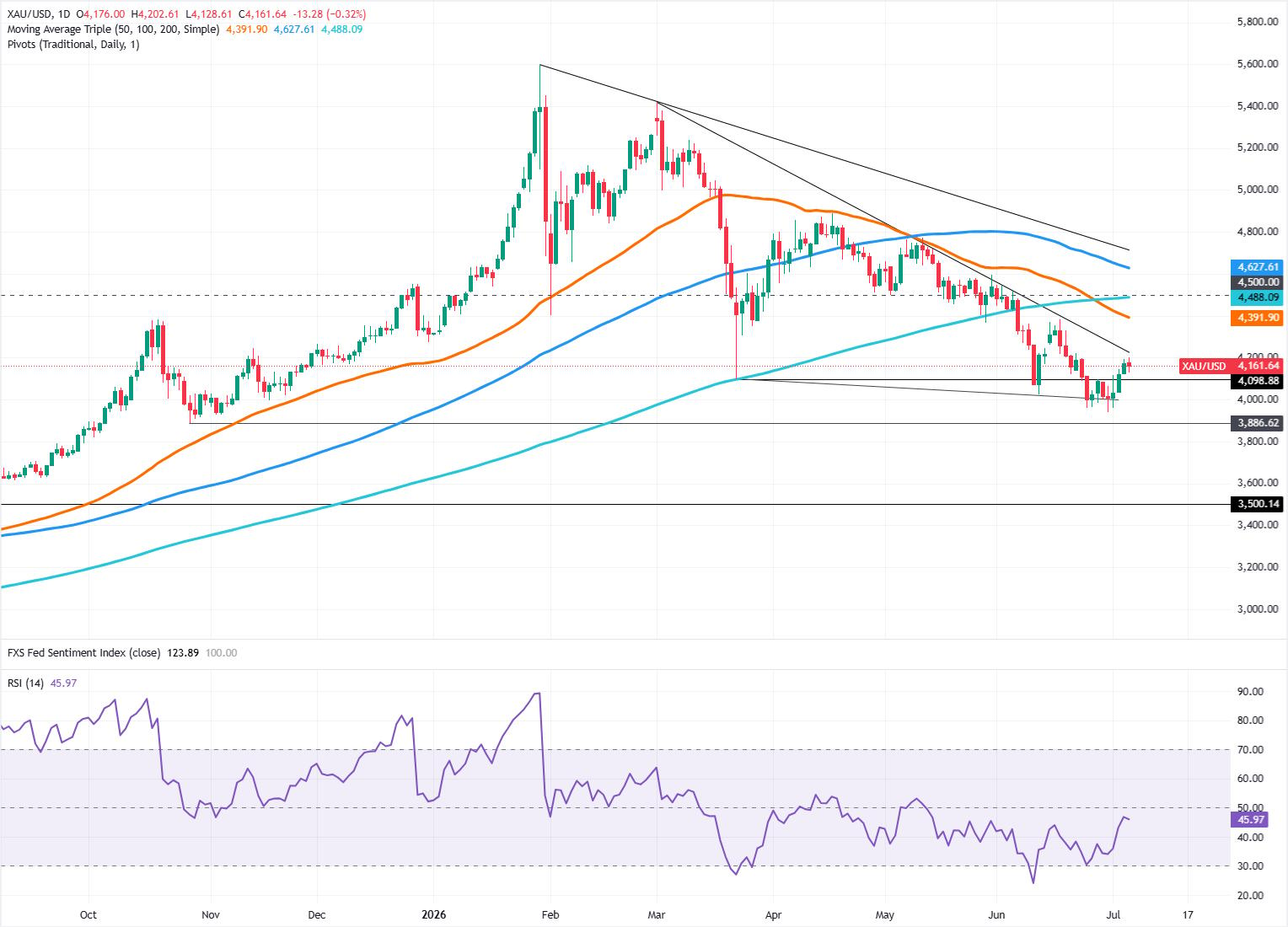
XAU/USD technical outlook: Gold stays bearish, fails to clear $4,200
Gold price downtrend is intact as long as XAU fails to clear a downtrend-resistance trendline at around $4,200-$4,225. Additionally, a 'death-cross' has formed on the daily chart, suggesting sellers have overtaken buyers and opening the door to further losses.
The Relative Strength Index (RSI) is bearish, despite aiming towards its 50-neutral level. However, during the last two trading sessions, it opened the door for further downside.
If XAU/USD drops below $4,200, the next support would be the psychological $4,100, before testing $4,000 and the year-to-date (YTD) low at $3,941.
For a bullish reversal, Gold needs to decisively clear $4,250 before testing $4,300. Overhead lies the 50-day Simple Moving Average (SMA) at $4,391, followed by the 200-day SMA at $4,488, ahead of $4,500.
Gold FAQs
Gold has played a key role in human’s history as it has been widely used as a store of value and medium of exchange. Currently, apart from its shine and usage for jewelry, the precious metal is widely seen as a safe-haven asset, meaning that it is considered a good investment during turbulent times. Gold is also widely seen as a hedge against inflation and against depreciating currencies as it doesn’t rely on any specific issuer or government.
Central banks are the biggest Gold holders. In their aim to support their currencies in turbulent times, central banks tend to diversify their reserves and buy Gold to improve the perceived strength of the economy and the currency. High Gold reserves can be a source of trust for a country’s solvency. Central banks added 1,136 tonnes of Gold worth around $70 billion to their reserves in 2022, according to data from the World Gold Council. This is the highest yearly purchase since records began. Central banks from emerging economies such as China, India and Turkey are quickly increasing their Gold reserves.
Gold has an inverse correlation with the US Dollar and US Treasuries, which are both major reserve and safe-haven assets. When the Dollar depreciates, Gold tends to rise, enabling investors and central banks to diversify their assets in turbulent times. Gold is also inversely correlated with risk assets. A rally in the stock market tends to weaken Gold price, while sell-offs in riskier markets tend to favor the precious metal.
The price can move due to a wide range of factors. Geopolitical instability or fears of a deep recession can quickly make Gold price escalate due to its safe-haven status. As a yield-less asset, Gold tends to rise with lower interest rates, while higher cost of money usually weighs down on the yellow metal. Still, most moves depend on how the US Dollar (USD) behaves as the asset is priced in dollars (XAU/USD). A strong Dollar tends to keep the price of Gold controlled, whereas a weaker Dollar is likely to push Gold prices up.














