

Gold steadies as traders await US NFP for clues on the Fed next move
- Gold rebounds from intraday lows as traders await the US Nonfarm Payrolls report for May.
- Elevated Oil prices and Middle East tensions continue to shape the outlook for bullion.
- Technically, XAU/USD remains bearish, with the RSI below 50 and the MACD in negative territory.
Gold (XAU/USD) recovers part of its earlier losses on Friday as traders reposition ahead of the US Nonfarm Payrolls (NFP) report, due at 12:30 GMT. At the time of writing, XAU/USD is trading around $4,462 after hitting an intraday low of $4,428.
Economists expect the US economy to have added 85K jobs in May, down from 115K in April, while the Unemployment Rate is forecast to remain unchanged at 4.3%.

The data could provide the catalyst for Gold to break out of the narrow range it has traded in since mid-May. However, geopolitical tensions in the Middle East continue to exert influence on the precious metal's fortunes.
Gold has behaved more like a risk-sensitive asset since the US-Iran war began in late February, falling whenever geopolitical tensions escalate and rebounding whenever hopes of a peace deal gain traction.
The metal is still down about 17% from pre-war levels. The drop in Gold has been accompanied by a sharp rise in Oil prices, which has fueled inflation concerns and reinforced expectations that the Federal Reserve (Fed) will keep interest rates higher for longer.
This remains a major headwind for Gold, which tends to perform better in a lower interest-rate environment. According to the CME FedWatch Tool, traders expect the US central bank to keep interest rates in the 3.50%-3.75% range over the coming months, while pricing in a 38% chance of a 25-basis-point (bps) rate hike by the December meeting.
A stronger-than-expected NFP report would likely support the case for the Fed to keep rates unchanged – or even hike them – as officials assess the inflation impact of higher energy prices. A weaker reading, on the other hand, could encourage traders to dial back bets on higher interest rates, providing some relief for non-yielding metal.
Besides rate expectations, traders continue to monitor developments in the Middle East.
Hopes for an imminent US-Iran peace deal appear to be fading after Iran-backed Hezbollah rejected the ceasefire between Israel and Lebanon, with both sides resuming exchanges of fire. Tehran has repeatedly stressed that any agreement with Washington must include a lasting ceasefire in Lebanon.
Technical Analysis: sellers retain control below mid Bollinger Band
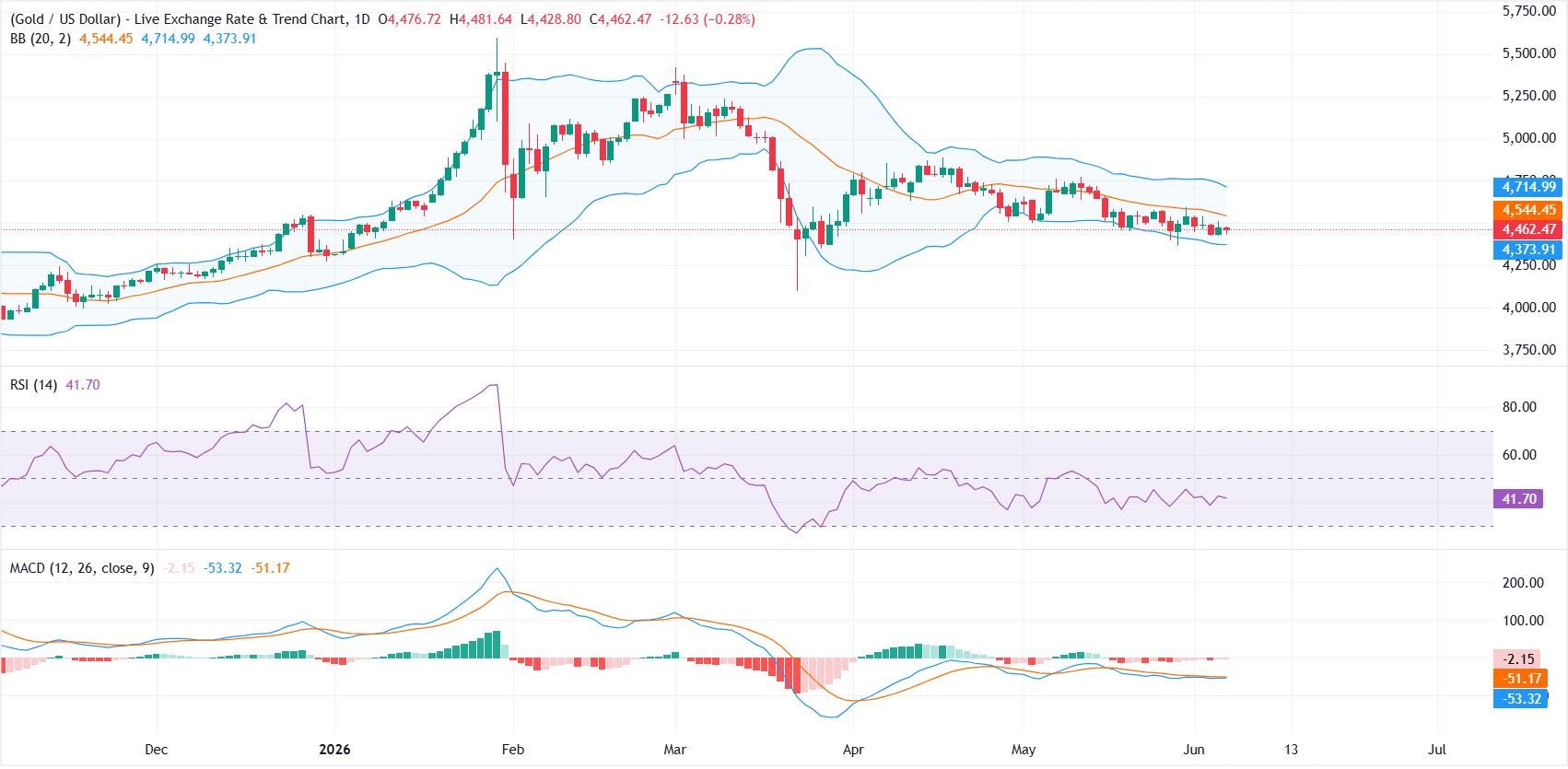
On the daily chart, XAU/USD remains under near-term bearish pressure, with spot holding beneath the Bollinger Bands middle line at roughly $4,544. Momentum indicators lean soft, as the Relative Strength Index (RSI) hovers just below the neutral 50 mark and the Moving Average Convergence Divergence (MACD) indicator stays in negative territory, hinting that recovery attempts are likely to be shallow while price trades below overhead resistance.
On the downside, initial support is located near the lower Bollinger Band around $4,374, where buyers could attempt to slow the decline. Still, a daily close below this level would expose deeper losses. On the upside, a move back above the $4,544 area is needed to ease the immediate bearish tone, with the upper Bollinger Band near $4,715 acting as the next resistance hurdle.
(The technical analysis of this story was written with the help of an AI tool.)
Gold FAQs
Gold has played a key role in human’s history as it has been widely used as a store of value and medium of exchange. Currently, apart from its shine and usage for jewelry, the precious metal is widely seen as a safe-haven asset, meaning that it is considered a good investment during turbulent times. Gold is also widely seen as a hedge against inflation and against depreciating currencies as it doesn’t rely on any specific issuer or government.
Central banks are the biggest Gold holders. In their aim to support their currencies in turbulent times, central banks tend to diversify their reserves and buy Gold to improve the perceived strength of the economy and the currency. High Gold reserves can be a source of trust for a country’s solvency. Central banks added 1,136 tonnes of Gold worth around $70 billion to their reserves in 2022, according to data from the World Gold Council. This is the highest yearly purchase since records began. Central banks from emerging economies such as China, India and Turkey are quickly increasing their Gold reserves.
Gold has an inverse correlation with the US Dollar and US Treasuries, which are both major reserve and safe-haven assets. When the Dollar depreciates, Gold tends to rise, enabling investors and central banks to diversify their assets in turbulent times. Gold is also inversely correlated with risk assets. A rally in the stock market tends to weaken Gold price, while sell-offs in riskier markets tend to favor the precious metal.
The price can move due to a wide range of factors. Geopolitical instability or fears of a deep recession can quickly make Gold price escalate due to its safe-haven status. As a yield-less asset, Gold tends to rise with lower interest rates, while higher cost of money usually weighs down on the yellow metal. Still, most moves depend on how the US Dollar (USD) behaves as the asset is priced in dollars (XAU/USD). A strong Dollar tends to keep the price of Gold controlled, whereas a weaker Dollar is likely to push Gold prices up.













