

Indian Rupee flattens while recovery in oil prices dampens outlook
- The Indian Rupee trades calmly against the US Dollar, while oil prices have recovered due to US-Iran deal uncertainty.
- US-Iran negotiations appear to have halted due to the exchange of attacks between Israel and Lebanon.
- Investors await the US JOLTS Job Openings data and the RBI policy.
The Indian Rupee (INR) trades almost flat against the US Dollar (USD) in the opening session on Tuesday. The USD/INR pair flattens around 95.00, while the Indian Rupee’s outlook has become uncertain as oil prices have bounced back due to fresh concerns over the United States (US)-Iran deal.
As of writing, the WTI Oil price trades 1.25% lower to near $90, but recovered strongly by over 4.5% on Monday. Theoretically, currencies from economies, such as India, which rely heavily on oil imports to meet their energy needs, tend to underperform when oil prices recover.

US-Iran negotiations toward a deal have been halted
Iran's Tasnim News agency reported on Monday that members of the negotiating team of Tehran have stopped message exchanges with the US through mediators in protest against attacks on Lebanon.
Iran’s Parliament Speaker Mohammad Bagher Ghalibaf also said a post on X that the US naval blockade and war crimes in Lebanon are clear evidence of US noncompliance with the ceasefire. Separately, Iranian Foreign Minister Seyed Abbas Araghchi warned the US and Iran of serious consequences if there were military actions on all fronts, including Lebanon.
Meanwhile, US President Donald Trump has calmed market nerves by expressing confidence, in an interview with ABC News, that an agreement with Iran to extend the ceasefire and reopen the Strait of Hormuz over the next week, adding he had quickly resolved a diplomatic "glitch" that threatened to derail progress.
After threats of consequences to the US and Iran, President Donald Trump stated in a post on Truth Social that the exchange of attacks between Israel and Lebanon has been stopped.
Investors keenly await RBI’s policy
This week, the Reserve Bank of India’s monetary policy announcement on Friday will be the key trigger for the Indian currency. The RBI is almost certain to hold the Repo Rate steady at 5.25% and guide a hawkish stance on the monetary policy outlook, as elevated energy prices have prompted inflationary pressures. Investors will also focus on commentary from RBI Governor Sanjay Malhotra regarding the economic outlook in the wake of the Middle East crisis.
FIIs turned out net sellers on first day of June
Foreign Institutional Investors (FIIs) remained net sellers on the first day of June, offloading their stake worth Rs. 3,911.68 crore in the Indian stock market. Overseas investors have been paring their stake for a long time. Meanwhile, the Middle East tensions-driven energy supply shock has raised concerns over India Inc.'s projected earnings.
US JOLTS Job Openings data in spotlight
In Tuesday’s session, investors will focus on the US JOLTS Job Openings data for April, which will be published at 14:00 GMT. The JOLTS Job Openings data will provide cues regarding the job demand, information that influences the Federal Reserve’s (Fed) monetary policy expectations.
The data is expected to show that US employers posted 6.82 million fresh jobs, close to the March reading of 6.866 million.
Technical Analysis: USD/INR struggles to return above 20-day EMA
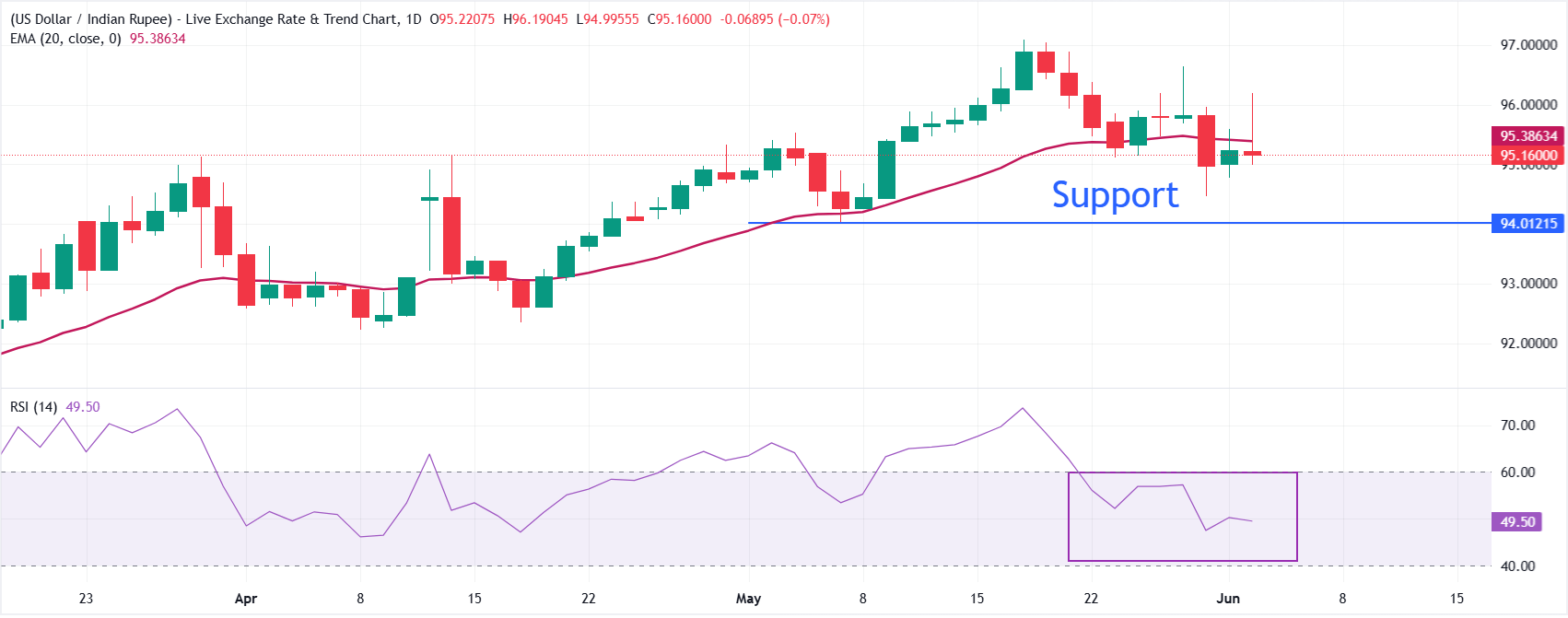
USD/INR trades almost flat at around 95.00, keeping a mildly bearish near-term tone as it holds just under the 20-day Exponential Moving Average (EMA) at 95.38. The pair has slipped back from recent highs, and the inability to reclaim the short-term EMA suggests upside attempts are being capped, while the Relative Strength Index (14) near 49.5 hints at fading momentum and a more balanced, consolidative backdrop rather than strong directional pressure.
On the topside, immediate resistance is located at the 20-day EMA around 95.39, and a daily close above this barrier would be needed to ease the current downside bias and reopen the path toward the May 28 high at 95.67. Looking down, the pair could decline towards 94.00 if it drops below the May 29 low at 94.46.
(The technical analysis of this story was written with the help of an AI tool.)
Silver FAQs
Silver is a precious metal highly traded among investors. It has been historically used as a store of value and a medium of exchange. Although less popular than Gold, traders may turn to Silver to diversify their investment portfolio, for its intrinsic value or as a potential hedge during high-inflation periods. Investors can buy physical Silver, in coins or in bars, or trade it through vehicles such as Exchange Traded Funds, which track its price on international markets.
Silver prices can move due to a wide range of factors. Geopolitical instability or fears of a deep recession can make Silver price escalate due to its safe-haven status, although to a lesser extent than Gold's. As a yieldless asset, Silver tends to rise with lower interest rates. Its moves also depend on how the US Dollar (USD) behaves as the asset is priced in dollars (XAG/USD). A strong Dollar tends to keep the price of Silver at bay, whereas a weaker Dollar is likely to propel prices up. Other factors such as investment demand, mining supply – Silver is much more abundant than Gold – and recycling rates can also affect prices.
Silver is widely used in industry, particularly in sectors such as electronics or solar energy, as it has one of the highest electric conductivity of all metals – more than Copper and Gold. A surge in demand can increase prices, while a decline tends to lower them. Dynamics in the US, Chinese and Indian economies can also contribute to price swings: for the US and particularly China, their big industrial sectors use Silver in various processes; in India, consumers’ demand for the precious metal for jewellery also plays a key role in setting prices.
Silver prices tend to follow Gold's moves. When Gold prices rise, Silver typically follows suit, as their status as safe-haven assets is similar. The Gold/Silver ratio, which shows the number of ounces of Silver needed to equal the value of one ounce of Gold, may help to determine the relative valuation between both metals. Some investors may consider a high ratio as an indicator that Silver is undervalued, or Gold is overvalued. On the contrary, a low ratio might suggest that Gold is undervalued relative to Silver.














