

Silver Price Forecast: XAG/USD tumbles to near $76 amid renewed concerns over Mideast peace
- Silver price slumps to near $76.00 as oil prices rise on renewed Mideast uncertainty.
- US Central Command stated that strikes launched in southern Iran were due to self-defense.
- Traders have pared dovish Fed bets as inflationary pressures have accelerated due to elevated energy prices.
Silver price (XAG/USD) trades 2% lower to near $76.50 during the European trading session on Tuesday. The white metal resumes its downside journey after rising in the last four trading days, as financial market participants turn cautious over peace in the Middle East.
On Monday, the Iranian state media reported that explosions had been heard in the Iranian city of Bandar Abbas for reasons that remain unclear. Later, US Central Command took the responsibility, but described the attack as "self-defense" and was designed "to protect our troops from threats posed by Iranian forces", BBC reported.

However, US President Donald Trump has confirmed that negotiations with Iran are “progressing well”, indicating that hopes of the US-Iran deal are still alive.
The renewed US-Iran uncertainty has resulted in a sharp recovery in the oil price. As of writing, the WTI Oil price trades 1.5% higher to near $91.00.
Higher oil prices have remained a major concern for the Silver price, given that elevated energy prices have prompted US inflation pressures that have forced traders to pare dovish Federal Reserve (Fed) bets.
Technically, the scenario of the Fed holding interest rates at their current levels for longer or raising them bodes poorly for non-yielding assets, such as Silver.
Silver technical analysis
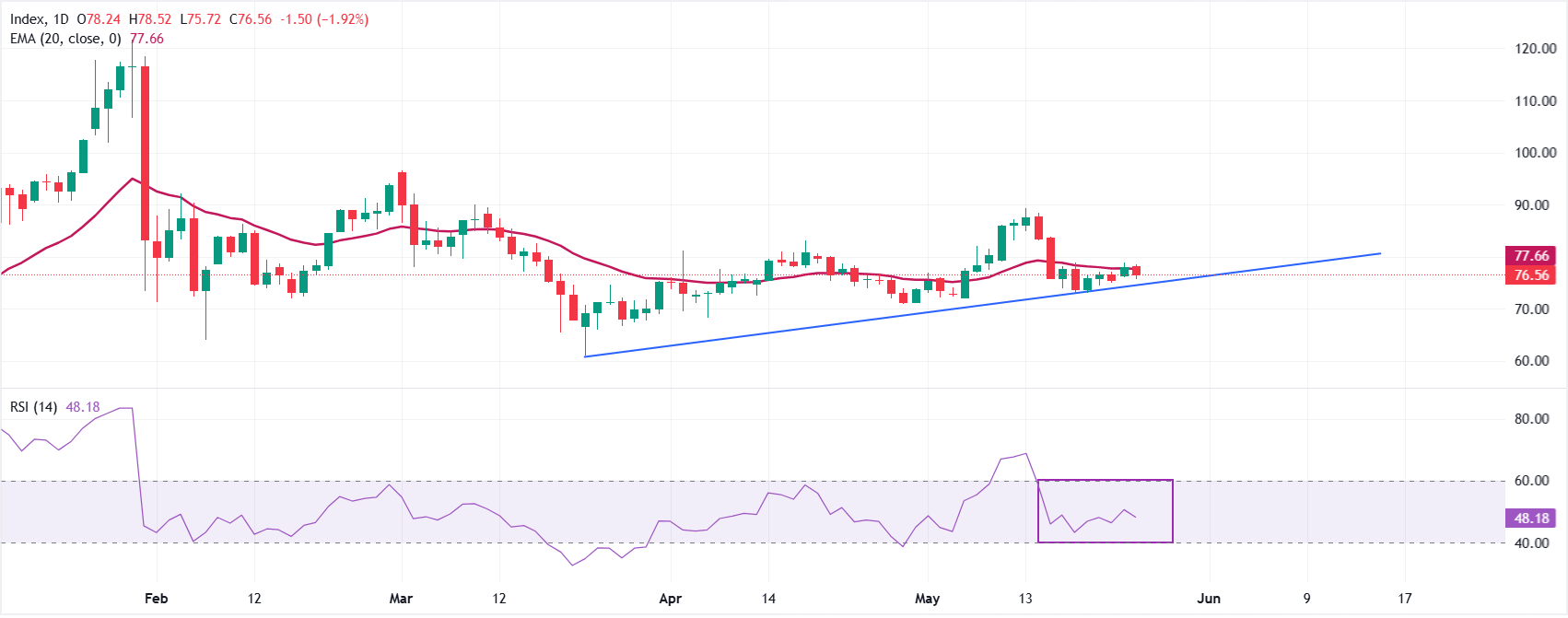
XAG/USD trades lower at around $76.56 at press time. The near-term tone of the white metal is uncertain as it struggles to return above the 20-day exponential moving average (EMA), which is at $77.66.
The Relative Strength Index (14) oscillates inside the 40.00-60.00 zone, indicating that the overall trend is sideways.
On the topside, initial resistance is defined by the 20-day EMA at $77.66, and a sustained break above this dynamic barrier would be needed to ease current downside pressure; a scenario that could lead to further upside towards the May 15 high at $83.88.
Looking down, the rising trend line around $75.96 is the immediate resistance; a daily close below this level would expose the Silver price towards $70.00.
(The technical analysis of this story was written with the help of an AI tool.)
Silver FAQs
Silver is a precious metal highly traded among investors. It has been historically used as a store of value and a medium of exchange. Although less popular than Gold, traders may turn to Silver to diversify their investment portfolio, for its intrinsic value or as a potential hedge during high-inflation periods. Investors can buy physical Silver, in coins or in bars, or trade it through vehicles such as Exchange Traded Funds, which track its price on international markets.
Silver prices can move due to a wide range of factors. Geopolitical instability or fears of a deep recession can make Silver price escalate due to its safe-haven status, although to a lesser extent than Gold's. As a yieldless asset, Silver tends to rise with lower interest rates. Its moves also depend on how the US Dollar (USD) behaves as the asset is priced in dollars (XAG/USD). A strong Dollar tends to keep the price of Silver at bay, whereas a weaker Dollar is likely to propel prices up. Other factors such as investment demand, mining supply – Silver is much more abundant than Gold – and recycling rates can also affect prices.
Silver is widely used in industry, particularly in sectors such as electronics or solar energy, as it has one of the highest electric conductivity of all metals – more than Copper and Gold. A surge in demand can increase prices, while a decline tends to lower them. Dynamics in the US, Chinese and Indian economies can also contribute to price swings: for the US and particularly China, their big industrial sectors use Silver in various processes; in India, consumers’ demand for the precious metal for jewellery also plays a key role in setting prices.
Silver prices tend to follow Gold's moves. When Gold prices rise, Silver typically follows suit, as their status as safe-haven assets is similar. The Gold/Silver ratio, which shows the number of ounces of Silver needed to equal the value of one ounce of Gold, may help to determine the relative valuation between both metals. Some investors may consider a high ratio as an indicator that Silver is undervalued, or Gold is overvalued. On the contrary, a low ratio might suggest that Gold is undervalued relative to Silver.














