


Top 3 Price Prediction: Bitcoin, Ethereum, Ripple – BTC recovers from support, ETH and XRP eyes bullish breakout
- Bitcoin price extends its recovery on Friday after finding support around the key level earlier this week.
- Ethereum nears the 23.6% Fibonacci retracement level at $2,138, a close above would suggest an upside move.
- XRP approaches the upper boundary of its falling channel, signaling a potential bullish breakout.
Bitcoin (BTC), Ethereum (ETH), and Ripple (XRP) extend their recovery on Friday after recent corrective moves. BTC is trading above $77,700 after finding support around major levels, and ETH is near the key resistance zone, where a breakout could trigger further rebounds. Meanwhile, XRP approaches its upper boundary of the falling channel; a close above signals a bullish move.

Bitcoin's major support holds strong
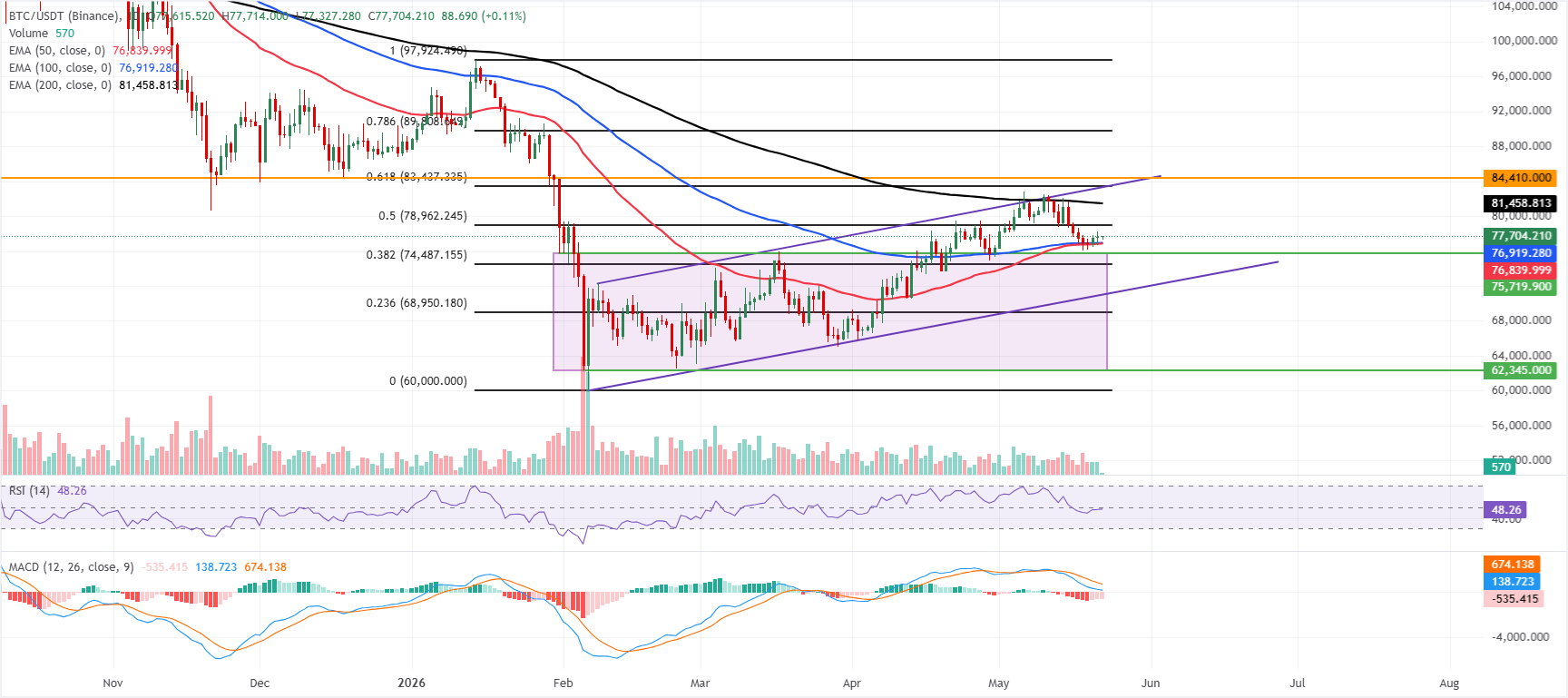
Bitcoin price extends its recovery, trading above $77,704 and holding above the 50- and 100-day Exponential Moving Averages (EMAs) near $76,840–$76,920, suggesting underlying dip-buying interest despite a dense topside cap.
The Crypto King is still pinned below the 200-day EMA at $81,458 and the 50% Fibonacci retracement of the latest swing at $78,962, leaving the broader structure in consolidation rather than in a clear breakout phase. The Relative Strength Index (RSI) hovers just below the 50 mark, while the Moving Average Convergence Divergence (MACD) remains in negative territory, suggesting that momentum is subdued and rallies could face selling pressure into overhead levels.
On the topside, initial resistance is located at the 50% Fibonacci retracement at $78,962, followed by the 200-day EMA at $81,458; a sustained move above these would open the way toward the 61.8% retracement at $83,437 and the horizontal barrier around $84,410.
On the downside, immediate support comes from the cluster of the 100-day EMA at $76,919 and the 50-day EMA at $76,840, with the 38.2% Fibonacci retracement at $74,487 next in line if those levels give way. A deeper slide would expose the former trendline break area around $70,995 and the 23.6% retracement near $68,950, where stronger medium-term demand would be expected to emerge.
Ethereum tests key resistance
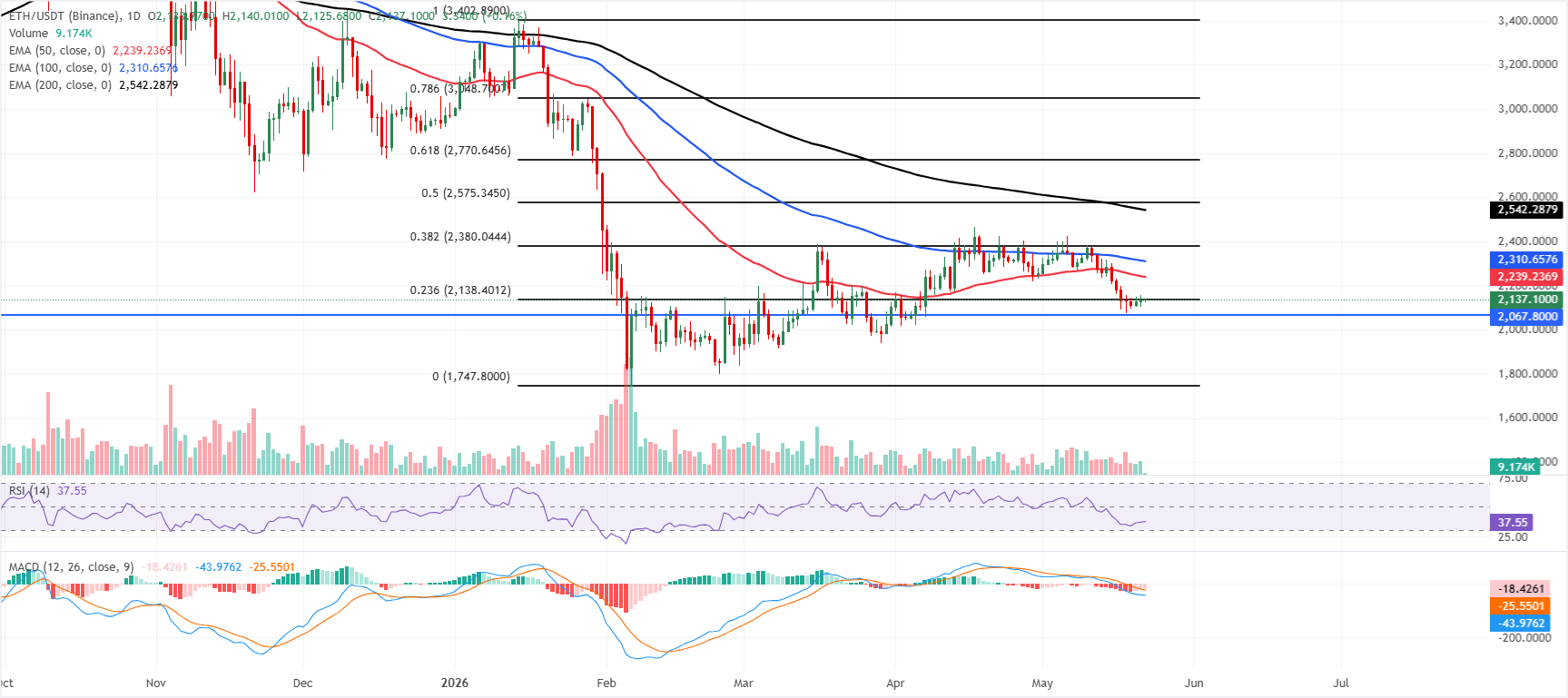
Ethereum trades at $2,137. Price remains below the 50-, 100-, and 200-day EMAs, which fan out well above the market and reinforce an overarching downtrend.
ETH is also capped almost immediately by the 23.6% Fibonacci retracement at roughly $2,138, underscoring the lack of topside traction after the recent slide. The RSI hovers just above 37, suggesting weak but not extreme downside pressure, while the negative MACD still hints at prevailing bearish momentum, though it has moderated from prior extremes.
On the upside, initial resistance is at the 23.6% Fibonacci retracement near $2,138, with further hurdles at the 50-day EMA near $2,239 and the 100-day EMA near $2,310. Above these, the 38.2% retracement near $2,380 and the distant 200-day EMA near the $2,542 mark are progressively stronger supply zones within the broader corrective structure.
On the downside, immediate support is seen at the horizontal level around $2,067, ahead of the more distant cycle low anchor near $1,748; a clear break under the former would likely expose the latter and extend the current bearish phase.
XRP could extend gains if it breaks above the channel pattern
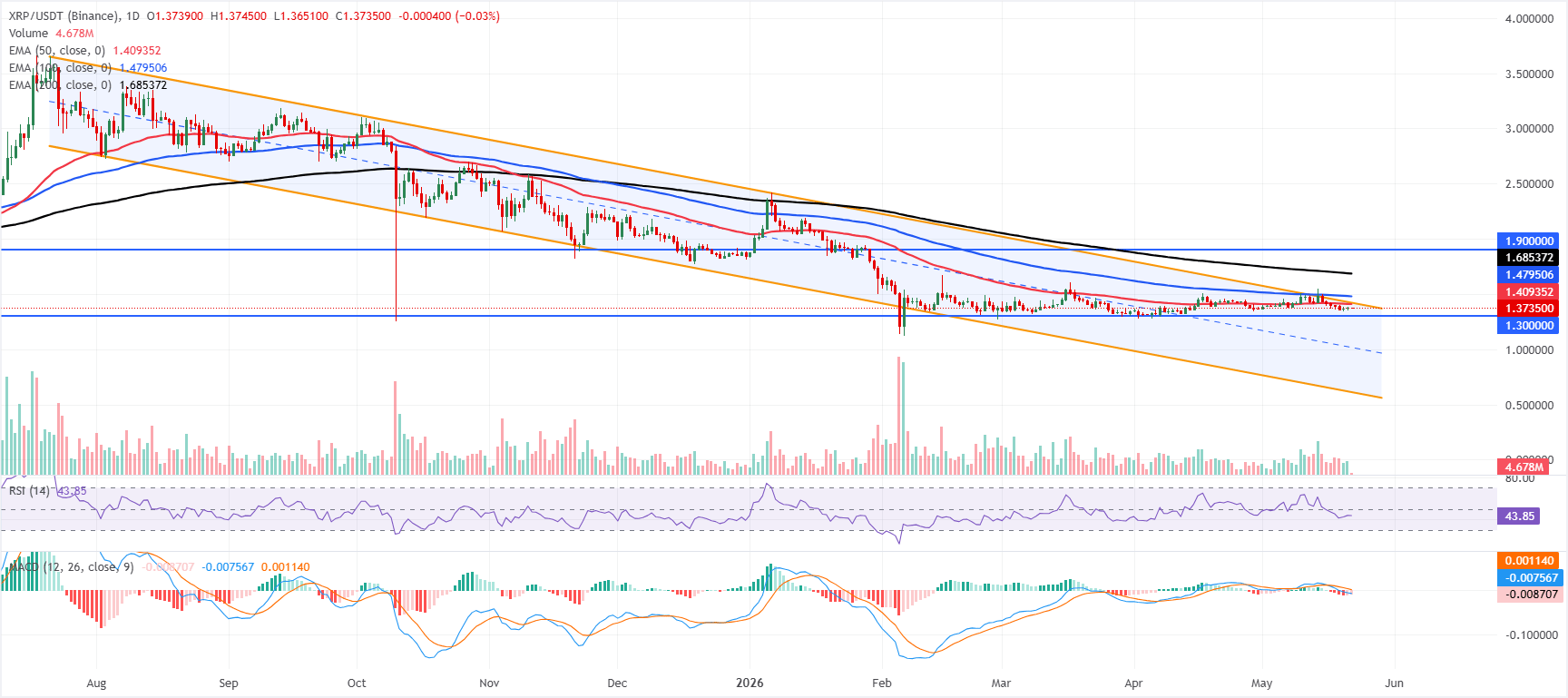
XRP price trades at $1.373, maintaining a bearish near-term bias as it holds below a stack of EMAs. The 50-day EMA at $1.409 is the first cap, reinforced by the upper boundary of the prevailing downward channel near $1.420, while the 100-day and 200-day EMAs at $1.479 and $1.685 sit higher and underscore a broader corrective phase.
Momentum backs this downward tone, with the RSI hovering around 43 in negative territory and the MACD below zero, hinting that rallies are likely to face selling pressure.
On the topside, immediate resistance is located at the 50-day EMA around $1.409, followed by the channel boundary near $1.420; a daily close above this area would be needed to ease the current pressure and expose the 100-day EMA at $1.479, ahead of the more distant 200-day EMA near $1.685 and the horizontal barrier at $1.900.
On the downside, initial support is seen at the horizontal level of $1.300, where a break lower would signal a continuation of the decline and open the door to deeper losses within the broader downtrend channel.
(The technical analysis of this story was written with the help of an AI tool.)
Cryptocurrency metrics FAQs
The developer or creator of each cryptocurrency decides on the total number of tokens that can be minted or issued. Only a certain number of these assets can be minted by mining, staking or other mechanisms. This is defined by the algorithm of the underlying blockchain technology. On the other hand, circulating supply can also be decreased via actions such as burning tokens, or mistakenly sending assets to addresses of other incompatible blockchains.
Market capitalization is the result of multiplying the circulating supply of a certain asset by the asset’s current market value.
Trading volume refers to the total number of tokens for a specific asset that has been transacted or exchanged between buyers and sellers within set trading hours, for example, 24 hours. It is used to gauge market sentiment, this metric combines all volumes on centralized exchanges and decentralized exchanges. Increasing trading volume often denotes the demand for a certain asset as more people are buying and selling the cryptocurrency.
Funding rates are a concept designed to encourage traders to take positions and ensure perpetual contract prices match spot markets. It defines a mechanism by exchanges to ensure that future prices and index prices periodic payments regularly converge. When the funding rate is positive, the price of the perpetual contract is higher than the mark price. This means traders who are bullish and have opened long positions pay traders who are in short positions. On the other hand, a negative funding rate means perpetual prices are below the mark price, and hence traders with short positions pay traders who have opened long positions.
热门文章
1日本央行行长植田和男:长期利率由市场决定,反映多种因素2今日印度金价:根据FXStreet数据,黄金上涨3Ripple 和 Stellar 前景:随着衍生品市场转为温和看涨,价格自关键技术支撑位反弹4GBP/USD价格预测:空头等待两周区间下破之际,汇价守住1.32005EUR/JPY价格预测:在看跌倾向主导下维持在177.00下方6Dogecoin价格预测:在ETF资金流出之际,DOGE测试0.0800美元支撑位7黄金在美元小幅回落之际自4,150美元反弹,但仍维持在持续两周的区间内8获Ripple支持的 Evernorth 携4.73亿枚 XRP 储备在纳斯达克上市9亚洲股市暴跌,KOSPI在来自中国的芯片竞争压力下面临血洗















本网站提供的信息仅具有一般性质,不构成个人财务建议。在根据本网站上的任何信息采取行动之前,您应结合自身的目标、财务状况和需求,考虑该信息是否适合您。投资差价合约(CFD)和外汇保证金合约具有重大风险,并不适合所有投资者。您的亏损可能超过初始入金。您并不拥有,也不享有任何相关标的资产的权益。我们建议您寻求独立意见,并在交易前确保您已充分了解所涉及的风险。在购买本网站列出的任何产品之前,务必阅读并考虑相关披露文件。本网站提供的信息和广告并非面向任何在其所在国家或司法管辖区使用此类信息会违反当地法律法规的人士。本网站提供的产品和服务不面向美国、马来西亚和泰国居民。
TMGM 是由多家金融监管机构授权。
TMGM 集团下的 Trademax Australia Limited 公司(交易名称为TMGM),是由澳大利亚证券和投资委员(ASIC)监管的金融服务公司,金融服务牌照号为 436416,公司地址为 Level 28, One International Tower, 100 Barangaroo Avenue, 2000 Sydney, NSW Australia.
邮箱:support@tmgm.com.au
TMGM 集团下的 Trademax Global Limited公司(交易名称为TMGM),是由瓦努阿图金融服务委员会(VFSC)监管的金融服务公司,金融牌照号为 40356,注册地址为 1276, Kumul Highway, Port Vila, Vanuatu, Republic of Vanuatu.
邮箱:support@tmgm.com
Trademax Global Markets (SE) Limited,以 TMGM 名义经营,获塞舌尔金融服务管理局(FSA)授权并监管,许可证号为 SD224。公司注册地址为塞舌尔马埃岛 Providence Estate ABIS 中心13号办公室。
邮箱:support@tmgm.com
TMGM集团下的Trademax Global Markets (International) Pty Ltd公司(交易名称为TMGM),是由毛里求斯金融服务委员会监管的金融服务公司. 牌照号为 GB22201012,注册地址为33, Edith Cavell Street C/o IQ EQ Fund Services (Mauritius) Ltd Port Louis, 11324 Mauritius.
邮箱:support@tmgm.com
版权所有 © TMGM。保留所有权利