文章

Flag Pattern Chart Trading: Bull and Bear Flags

Direct Answer: Flag pattern chart trading is a technical analysis trading strategy that identifies short-term trend continuation patterns, characterized by a brief price correction (the flag) after a strong, sharp price movement (the flagpole). It signals that the prevailing market trend (Flagpole), whether bullish or bearish, will likely resume after this pause, allowing traders to enter at a more advantageous price before the trend continues. Flag pattern trading strategy goes, entry: choose a breakout close or support retest pullback level, place the stop beyond the flag extreme, then pick profit target either using RRR by percentage from the breakout point or Fibonacci Tools.

Key Takeaways

  • Flag patterns are continuation setups. They signal the prevailing trend will resume — not reverse.

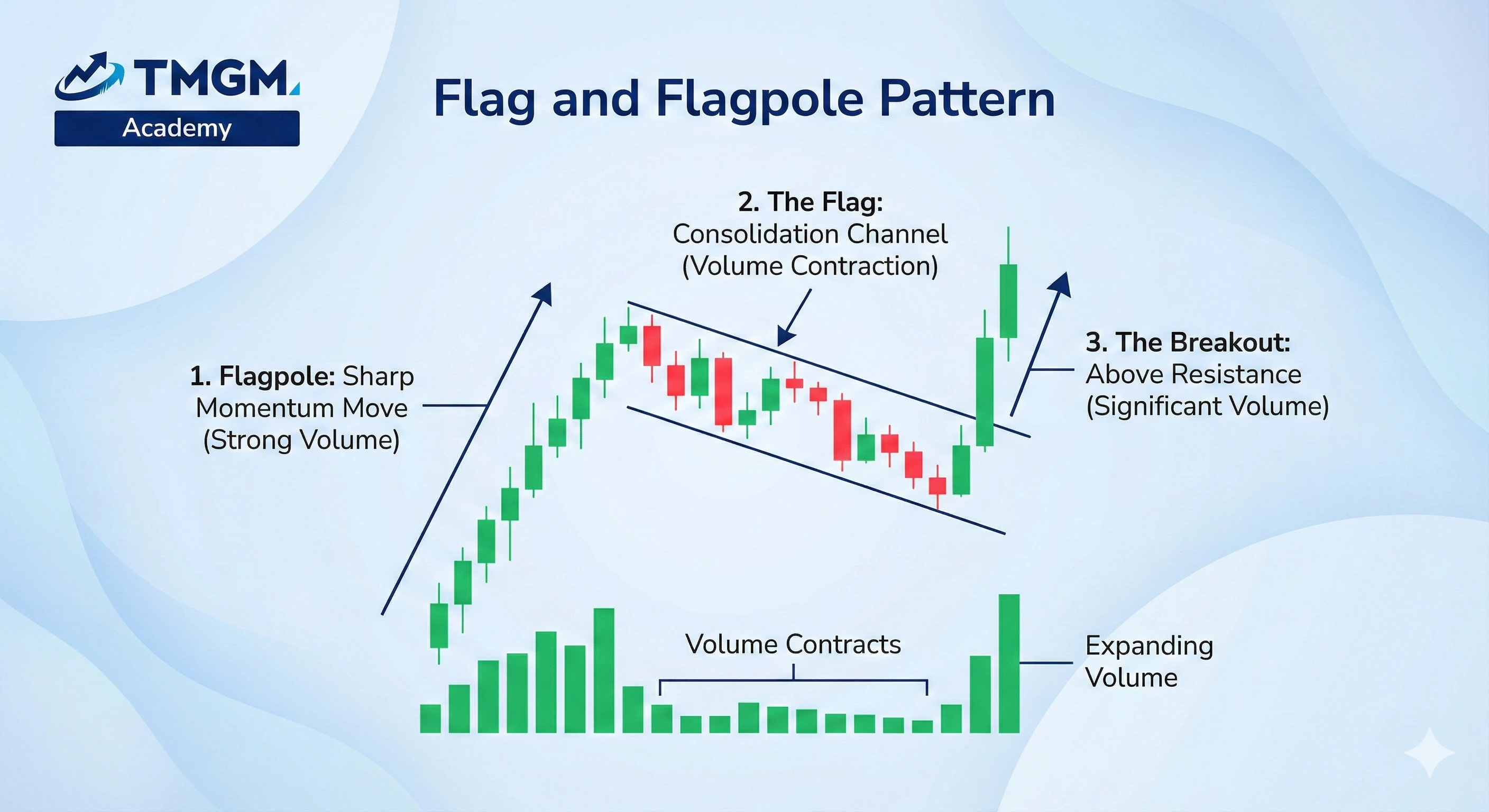
  • Three-part structure: Flagpole (Current Market Trend) → Flag (Temporary Consolidation) → Breakout.

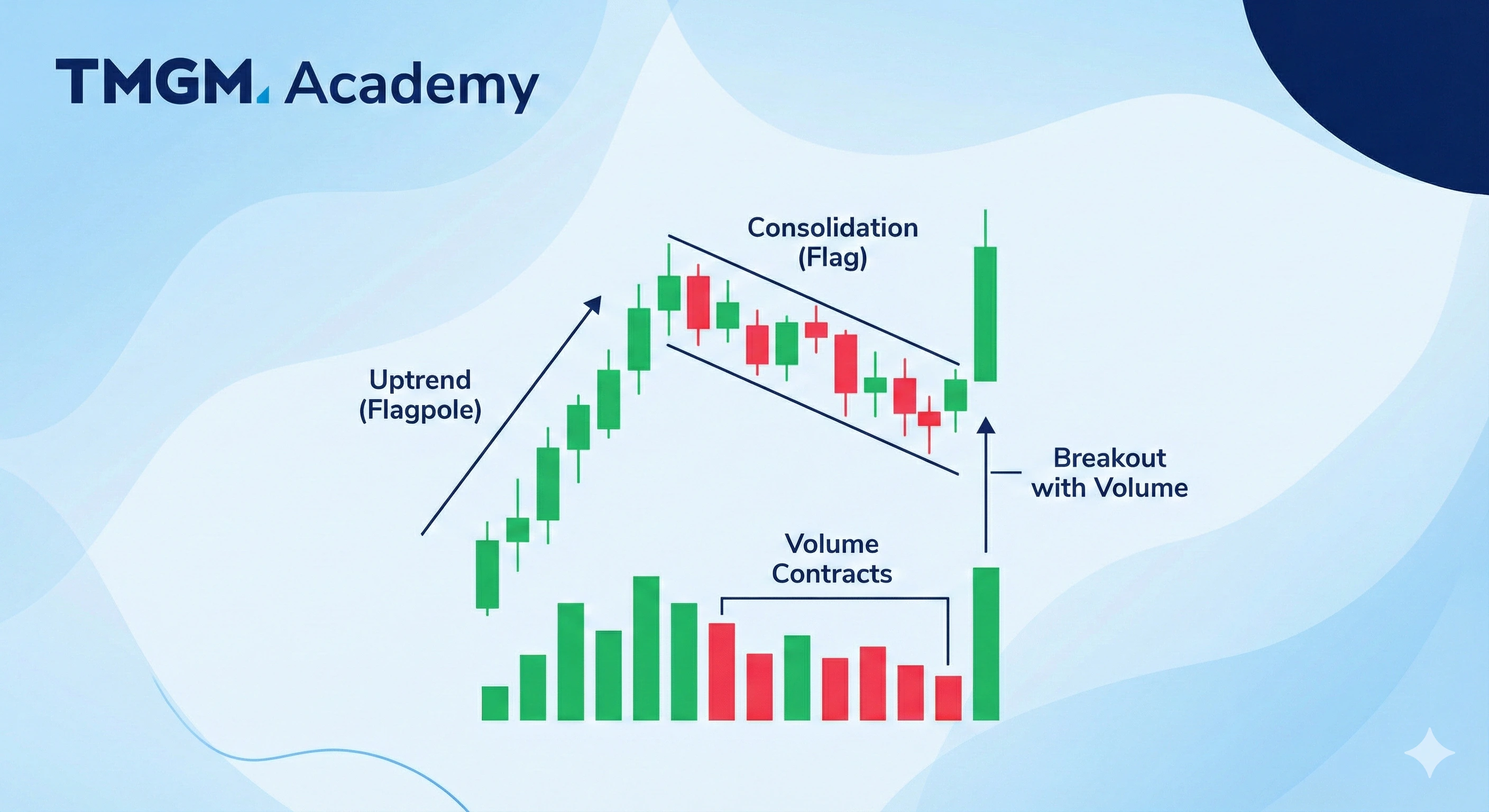
  • Bull flag = bullish continuation. Forms in uptrends with a downward-sloping or flat consolidation channel.

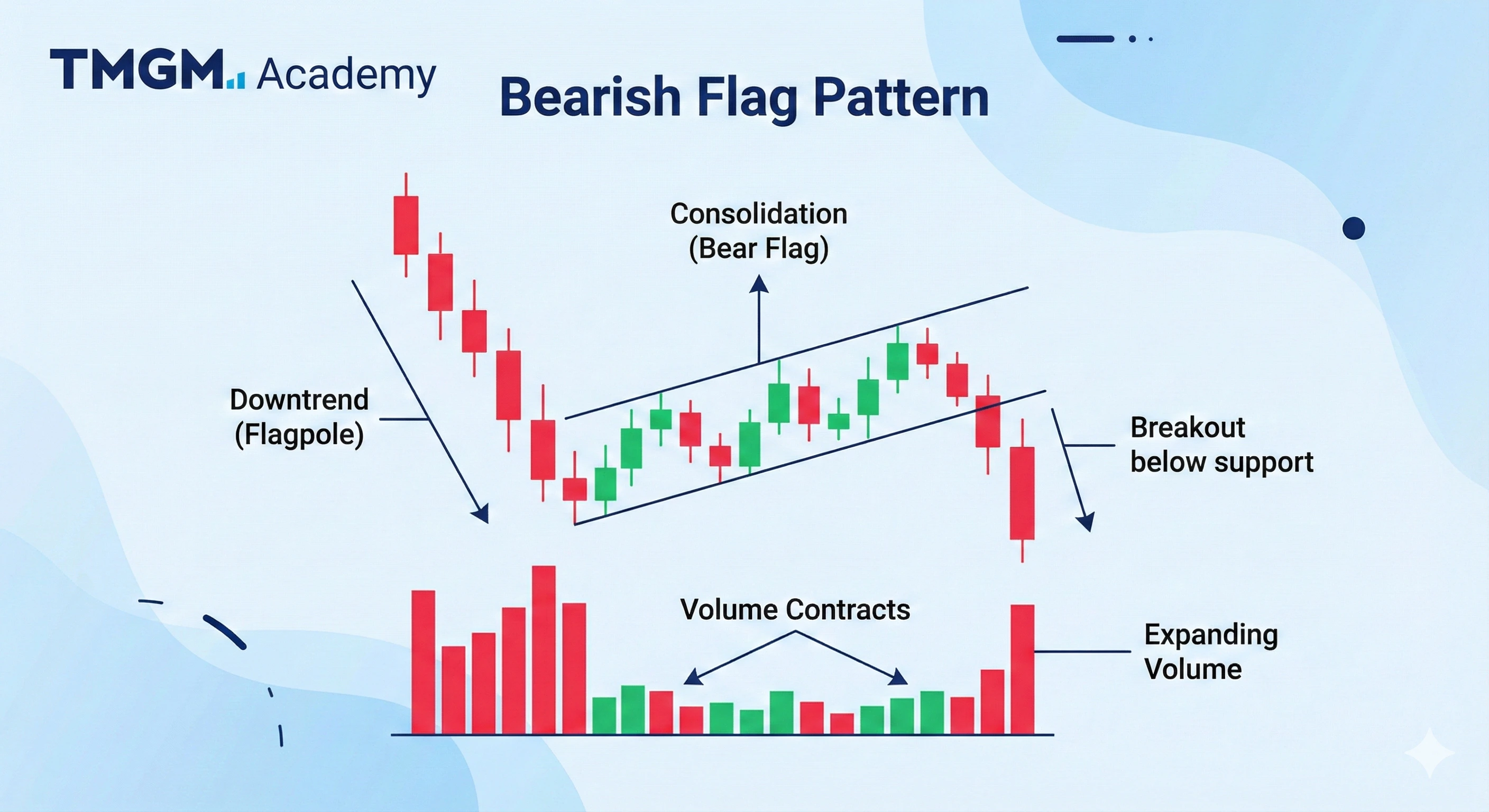
  • Bear flag = bearish continuation. Forms in downtrends with an upward-sloping or flat consolidation channel.

  • Volume contraction during the flag is non-negotiable. It confirms the pause is temporary, not a trend reversal.

  • Volume re-expansion on breakout confirms the trade. Low-volume breakouts are false breakout signals.

  • Minimum 2:1 risk-to-reward. If the setup doesn't meet this threshold, skip it.


What Is a Flag Pattern in Chart Pattern Trading?

A flag pattern is a continuation chart pattern that shows a temporary pause in a strong trend before the move resumes in the same direction. Flag pattern in trading is used to identify entry points in a market with strong momentum.

The flag chart pattern is consistent across all markets, which makes the flag pattern one of the most widely recognised setups in technical analysis.


Structural Breakdown of a Flag Pattern

 Structural Breakdown of a Flag Pattern 

Market Phase

Price Behavior

Order Flow

Implication

Trend/ Momentum Forming (Flagpole)

Sharp directional move, high volume

Aggressive buyer/seller imbalance

Trend strength confirmed

Pause (Flag)

Tight counter-trend drift, volume drops

Profit-taking, temporary balance

Volatility compression — flag forms

Breakout

Break of channel resistance, volume spike

Imbalance resumes in trend direction

Continuation confirmed


The Three Core Components of a Flag and Pole Pattern

1. The Flagpole

The flagpole is the sharp momentum move that defines the pole and flag pattern. It is usually steep, fast, and supported by strong volume.  


2. The Flag (Consolidation Channel)

The flag is a consolidation channel that slopes against the trend with contraction in volume.


3. The Breakout

The breakout is the 3rd component. Flag patterns always end with a breakout, with the price action closing above/below the flag channel’s resistance level (same direction as Flagpole) with significant volume. A breakout on low volume is a red flag.


Why Flag Patterns Form — The Mechanism & Market Psychology Behind Flag Patterns

Flag patterns form because markets often move in cycles of Trends/Momentum with Pullback pauses in between.

A strong trend often creates a momentum that runs so fast (forming the flagpole), causing traders who profited early to want to take profit and leave. This causes a temporary sell-off which forms the (flag) . 

When that pullback is complete, the flag pattern often breaks out with volume. 

In short: Flag patterns reflect buying and selling tug-of-war behaviour. 


In-depth Explanation: 

During the flagpole phase, aggressive buying or selling creates a clear and strong momentum price move, called a trend. After initial momentum has been built, retail momentum traders often follow, making the flagpole more obvious.

During the flag phase, traders take profit and cause a sell-off. Volume also contracts because in a true Flag Pattern, where market trend is supposed to continue, opposing interest is low and therefore a reducing momentum from the opposite trend shows up as lowering price with lowering volume (Flag). The market is rebalancing, not reversing. When the balance resumes, the flag pattern breaks out with volume expansion and the trend continues.

Hence, the flag is the setup window, where traders can buy during the flag, or after the breakout. 


Important Note

Flag Pattern traders use this temporary supply of liquidity to build more positions, expecting the support level to hold. However, the flag can sometimes extend or reverse without warning. Hence, it is best for beginners to wait for the breakout candle to close above (bull flag) or below (bear flag) the channel resistance level before committing to the trade.


Flags are typically seen mid-trend and not at tops or bottoms. – [CME Group Education. Trend and Continuation Patterns. CMEGroup.com]

Types of Flag Patterns

Bullish Flag Pattern (Bull Flag Pattern)

A bullish flag pattern forms an uptrend (flagpole) due to strong buying momentum. Then, the flag component consolidates in a downward-sloping or horizontal channel. Volume contracts during the flag component phase. The setup completes when price breaks above the upper resistance with expanding volume.


Bearish Flag Pattern (Bear Flag Pattern)

A bear flag pattern forms a downtrend (flagpole) due to strong selling momentum. Then the bear flag component pulls back upward in a controlled channel with volume contraction during the flag. The setup completes when price breaks below the lower resistance with expanding volume.

The bear flag pattern is also sometimes called the Inverted Flag Pattern, hinting that bull flag pattern is the most common and bear flag pattern is considered in inverted flag.


How to Trade Flag Patterns? Flag Pattern Trading Strategy

Flag pattern trading uses three key decisions: entry technique, stop-loss placement, and profit target via the measured move. Every valid setup requires all three to be defined before the trade is placed.

  1. Entry Techniques

    1. Pullback Entry (Aggressive): Enter as the flag component establishes a firm support level,

    2. Breakout Entry (Classic): Enter as price breaks out and closes above the upper channel resistance level (if trading bull flag pattern) or below the lower support level (if trading bear flag pattern). 

    3. Retest Entry (Conservative): Wait for the breakout candle to finish, then enter on the first retest of the newly established support. This strategy offers a stronger confirmation, in exchange for a lesser return, but most traders find it worth the cost because of the strong confirmation.

  2. Stop-Loss Placement

    1. Structural stop: Place below the lowest point of the flag (bullish flag pattern) or above the highest point (bearish flag pattern). 

    2. ATR-based stop: In volatile markets, some use 1 ATR as your stop distance to account for spread and slippage without premature stop-outs. 

  3. Profit Target

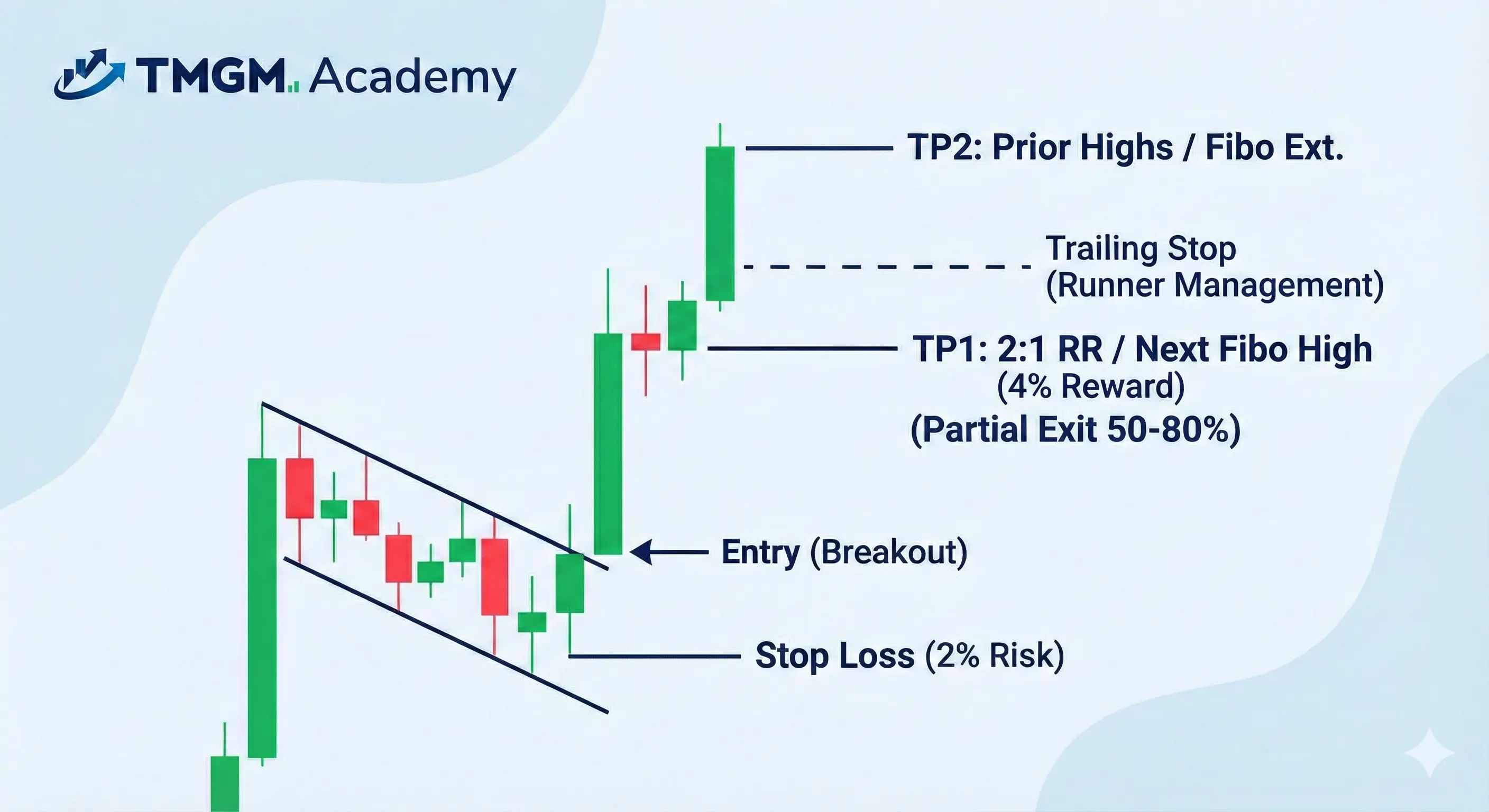
    1. 2:1 RRR: The most classic way is to follow your RRR. If your stop is about 2% loss, then your reward should at least be 4% profit to make the trade worth your while. 2:1 RRR (Risk to Reward Ratio) is a classic, low risk and adequate return ratio.

    2. Previous High: Another classic way to plot to take profit targets is using the previous high. If your asset is not in a price discovery mode, then using the previous high is reasonable as it is a natural selling pressure point.

    3. Fibonacci Tools: A very common tool that many professional traders use is Fibonacci Extension. Fibonacci extension measures where the next resistance could be and you can place your TP’s around those levels.


Seasoned trader take profit ladder for flags

  1. TP1 base target: Set first take profit at 2:1 RR or a Fibonacci take profit level

  2. Partial exit: Close 50 to 80 percent at TP1

  3. TP2 stretch target: Set second take profit at prior highs or Fibonacci extension levels

  4. Runner management: Keep the remainder open and use a trailing stop to capture momentum extensions

Risk Management for Flag Pattern Trading

A structurally valid setup without disciplined risk management will eventually cost you more than you make over time. 

Risk Management Framework

Risk Rules

Institutional Standard

Risk per trade

0.5%–1% of total account capital

Minimum risk-to-reward

2:1 

Hard Stop placement

Outside flag structure or 1 ATR beyond flag extreme

Scaling in

  1. During the Flag’s strong support level

  2. After breakout confirmation (retest)


Common Mistakes Traders Make with Flag Patterns

Most flag pattern mistakes fall into six buckets: trading weak flagpoles, entering before a confirmed breakout, ignoring volume, overtrading tiny flags on ultra low timeframes, setting sloppy targets, and skipping basic risk control like a defined stop loss.

  • Weak flagpoles: If the initial trend move is shallow or lacks momentum and volume, skip it.

  • No volume check: Treat volume as confirmation, not a nice to have.

  • Micro timeframes: 1 minute flags are mostly noise and volume signals are unreliable.

  • Unclear exits: Plan TP levels before entry, not after price moves.

  • No stop loss: Every trade needs a pre-set exiting level.

Conclusion — Is the Flag Pattern Reliable?

The flag pattern is one of the highest-probability continuation setups in technical analysis — when applied correctly in trending markets. The structure is objective, risk is defined, and targets are measurable.

Reliability depends on four factors: momentum strength, volume contraction during the flag, volume expansion on the breakout, and higher-timeframe alignment. A bullish flag pattern or bearish flag pattern that meets all four criteria is a high-quality trade. One that misses any of them carries substantially elevated risk.

Traders who develop the discipline to skip setups that do not meet the structural criteria — especially in low-liquidity or range-bound environments — will find flag pattern trading to be a durable, repeatable edge across markets and timeframes.

今日更明智地進行交易

10,000 美元演示資金
100多個市場
低費用,低點差
Trading App

FAQ — Flag Pattern Trading

Does the flag pattern actually work?

+

What does a flag pattern mean on a chart?

+

What is the difference between a bull flag pattern and a bear flag pattern?

+

How reliable is the bullish flag pattern?

+

Does chart pattern trading really work?

+
TMGM
Trade The World
TMGM 學院和市場洞察團隊是由金融分析師和交易策略師組成的專業團隊。憑藉實時機構數據和超過十年的市場運營經驗,團隊提供基於事實的分析,涵蓋外匯、黃金、加密貨幣、股票、大宗商品(如能源)和指數。我們的內容受到嚴格監管,如我們的編輯政策頁面所述。TMGM 遵循 ASIC 和 VFSC 準則。
加入超過100萬客戶,使用我們屢獲殊榮的交易平台
1
申請真實
交易帳戶
2
完成帳戶
入金
3
立即開始
交易
立即註冊