

Euro stays firm above 1.1600 as dovish December bets rise to 87%
作者 Christian Borjon Valencia
發布日期: 29 Nov 2025 | 修改日期: 29 Nov 2025


熱門文章

EUR/USD steadies during Friday’s North American session set to finish the week and November’s in positive territory with gains o 0.81% and 0.59%, respectively as traders seem certain that the Federal Reserve will cut rates in December.
- EUR/USD steady as traders betting on Fed easing next month.
- Fed cut odds jump to 87% after dovish Williams and Waller despite mixed US inflation and jobs data.
- Eurozone HICP surprises higher as ECB signals end of easing cycle, supporting further EUR/USD upside.
EUR/USD steadies during Friday’s North American session set to finish the week and November’s in positive territory with gains o 0.81% and 0.59%, respectively as traders seem certain that the Federal Reserve will cut rates in December. The pair trades at 1.1601 after bouncing off daily lows of 1.1555.
Euro ends week and month higher as dovish Fed signals outweigh mixed US data
The US Dollar treads water amid growing speculation for a rate cut. Data from the CME FedWatch Tool shows that the odds for a 25-basis points reduction to the fed funds rate at 87% for the December meeting. The repricing was triggered by dovish comments of New York Fed John Williams and Fed Governor Christopher Waller, who favored reducing borrowing costs at the December meeting.
Data was mixed during the week. Inflation in the producer side stabilized, while jobs data revealed by the US Department of Labor, showed that the number of Americans filling for unemployment benefits, trimmed compared to the previous print.
Across the pond, Retail Sales in Germany missed estimates of October, while the Harmonized Index of Consumer Prices (HICP) for November exceeded forecasts, approaching the 3% threshold. In France, the Gross Domestic Product (GDP) for Q3 was aligned with estimates and the preliminary reading, while Spanish HICP broke the 3% threshold.
Given the backdrop, the EUR/USD path of least resistance is tilted to the upside, as the European Central Bank (ECB) hinted that its easing cycle was over, while the Fed is expected to cut in December.
Next week’s US economic calendar will be packed, featuring the November ISM Manufacturing and Services PMIs, Industrial Production, the ADP Employment Change report, and Initial Jobless Claims for the week ending November 29.
Euro Price This Month
The table below shows the percentage change of Euro (EUR) against listed major currencies this month. Euro was the strongest against the Japanese Yen.
| USD | EUR | GBP | JPY | CAD | AUD | NZD | CHF | |
|---|---|---|---|---|---|---|---|---|
| USD | -0.31% | -0.69% | 1.38% | -0.09% | 0.10% | 0.07% | 0.17% | |
| EUR | 0.31% | -0.39% | 1.63% | 0.22% | 0.39% | 0.38% | 0.48% | |
| GBP | 0.69% | 0.39% | 2.03% | 0.61% | 0.76% | 0.77% | 0.87% | |
| JPY | -1.38% | -1.63% | -2.03% | -1.44% | -1.24% | -1.26% | -1.19% | |
| CAD | 0.09% | -0.22% | -0.61% | 1.44% | 0.12% | 0.16% | 0.26% | |
| AUD | -0.10% | -0.39% | -0.76% | 1.24% | -0.12% | -0.00% | 0.11% | |
| NZD | -0.07% | -0.38% | -0.77% | 1.26% | -0.16% | 0.00% | 0.09% | |
| CHF | -0.17% | -0.48% | -0.87% | 1.19% | -0.26% | -0.11% | -0.09% |
The heat map shows percentage changes of major currencies against each other. The base currency is picked from the left column, while the quote currency is picked from the top row. For example, if you pick the Euro from the left column and move along the horizontal line to the US Dollar, the percentage change displayed in the box will represent EUR (base)/USD (quote).
Daily market movers: Euro poised to extend gains amid Dollar weakness
- The shared currency is propelled by a weak US Dollar as depicted by the US Dollar Index (DXY). DXY, which tracks the buck’s value against a basket of six peers, is down 0.08% at 99.44.
- German’s HICP annual rate rose by 2.6% above forecasts of 2.4%, up from 2.3% in September. Other data in France, GDP for Q3 2025 rose by 0.1% QoQ beating forecasts and up from 0% in Q2.
- Finally, Spain’s HICP expanded by 3.1% YoY in November, down from 3.2% a month ago, but exceeded forecasts of 2.9%.
Technical Outlook: EUR/USD subdued around 1.1600 waiting for catalyst
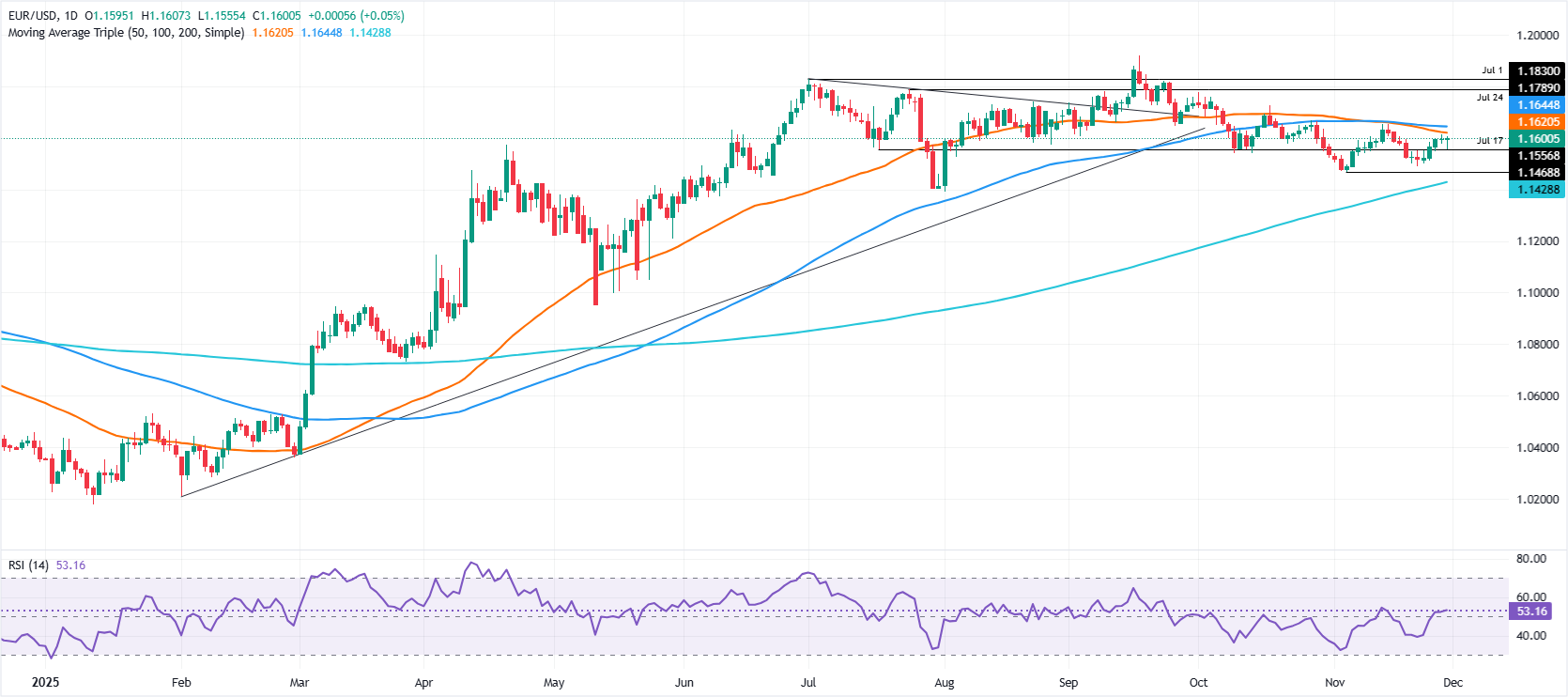
EUR/USD continues to trade sideways, with buyers unable to decisively break above the 1.1600 threshold to extend the advance toward the confluence of the 50- and 100-day Simple Moving Averages (SMAs) at 1.1620/1.1643. Momentum remains mildly positive, as reflected by the Relative Strength Index (RSI), although the indicator has flattened—suggesting that consolidation is likely to persist in the near term.
A clear breakout above the 50-/100-day SMA cluster would expose 1.1650, and once cleared, open the way for a test of the 1.1700 handle.
On the flip side, the Euro tumbling below 1.1550 increases the risk of a slide toward 1.1500. Further weakness would expose the November 5 swing low at 1.1468, followed by the 200-day SMA near 1.1431.
Euro FAQs
The Euro is the currency for the 20 European Union countries that belong to the Eurozone. It is the second most heavily traded currency in the world behind the US Dollar. In 2022, it accounted for 31% of all foreign exchange transactions, with an average daily turnover of over $2.2 trillion a day. EUR/USD is the most heavily traded currency pair in the world, accounting for an estimated 30% off all transactions, followed by EUR/JPY (4%), EUR/GBP (3%) and EUR/AUD (2%).
The European Central Bank (ECB) in Frankfurt, Germany, is the reserve bank for the Eurozone. The ECB sets interest rates and manages monetary policy. The ECB’s primary mandate is to maintain price stability, which means either controlling inflation or stimulating growth. Its primary tool is the raising or lowering of interest rates. Relatively high interest rates – or the expectation of higher rates – will usually benefit the Euro and vice versa. The ECB Governing Council makes monetary policy decisions at meetings held eight times a year. Decisions are made by heads of the Eurozone national banks and six permanent members, including the President of the ECB, Christine Lagarde.
Eurozone inflation data, measured by the Harmonized Index of Consumer Prices (HICP), is an important econometric for the Euro. If inflation rises more than expected, especially if above the ECB’s 2% target, it obliges the ECB to raise interest rates to bring it back under control. Relatively high interest rates compared to its counterparts will usually benefit the Euro, as it makes the region more attractive as a place for global investors to park their money.
Data releases gauge the health of the economy and can impact on the Euro. Indicators such as GDP, Manufacturing and Services PMIs, employment, and consumer sentiment surveys can all influence the direction of the single currency. A strong economy is good for the Euro. Not only does it attract more foreign investment but it may encourage the ECB to put up interest rates, which will directly strengthen the Euro. Otherwise, if economic data is weak, the Euro is likely to fall. Economic data for the four largest economies in the euro area (Germany, France, Italy and Spain) are especially significant, as they account for 75% of the Eurozone’s economy.
Another significant data release for the Euro is the Trade Balance. This indicator measures the difference between what a country earns from its exports and what it spends on imports over a given period. If a country produces highly sought after exports then its currency will gain in value purely from the extra demand created from foreign buyers seeking to purchase these goods. Therefore, a positive net Trade Balance strengthens a currency and vice versa for a negative balance.

Acuity Trading 是一家成立於 2013 年、總部位於倫敦的金融科技公司,專注於 AI 驅動的另類數據與情緒分析,用於交易與投資。他們以可視化新聞與情緒工具革新線上交易體驗,並持續以最新 AI 研究與技術提供可產生阿爾法的另類數據與高度互動的交易工具。
閱讀更多








