

Canadian Dollar faces headwinds on trade tensions and policy anticipation
作者 Joshua Gibson
發布日期: 27 Jan 2026 | 修改日期: 27 Jan 2026


熱門文章

The Canadian Dollar (CAD) enters the week navigating a complex mix of trade uncertainty and macro signals.
- Canadian Dollar reacts to fresh US-Canada trade tensions and tariff headlines.
- USD/CAD market eyes BoC and US economic data releases.
- The Fed is due to release its latest no-change rate call this week, investors looking out for policy hints.
The Canadian Dollar (CAD) enters the week navigating a complex mix of trade uncertainty and macro signals. Renewed US tariff threats tied to Canada’s relationship with China have injected headline risk into FX markets, even as Canadian officials have attempted to calm fears of a near-term escalation. While investors appear skeptical that extreme trade measures will be implemented quickly, the rhetoric alone has been enough to keep the Loonie sensitive to political developments and broader risk sentiment.
Attention is also firmly on monetary policy. The Bank of Canada (BoC) is expected to keep rates unchanged, but markets will closely parse its statement and tone for clues on how policymakers are weighing external trade risks against domestic growth and inflation trends. South of the border, a dense US economic calendar including growth, inflation, and labor-related data has the potential to shift expectations around the Federal Reserve’s (Fed) policy path, with direct implications for the US Dollar side of the USD/CAD pair.
Daily digest market movers: Canadian Dollar loses steam ahead of policy-heavy week
- US tariff threats against Canada over China trade fuel risk-off volatility.
- Canada affirms there will be no free trade deal with China, easing some tariff fears.
- BoC expected to hold rates and release updated forecasts.
- US economic data to be a primary market driver ahead of the Fed’s latest rate call this week.
- The Fed is likewise expected to stand pat, with markets focused on rhetoric and tonal shifts.
USD/CAD price forecast
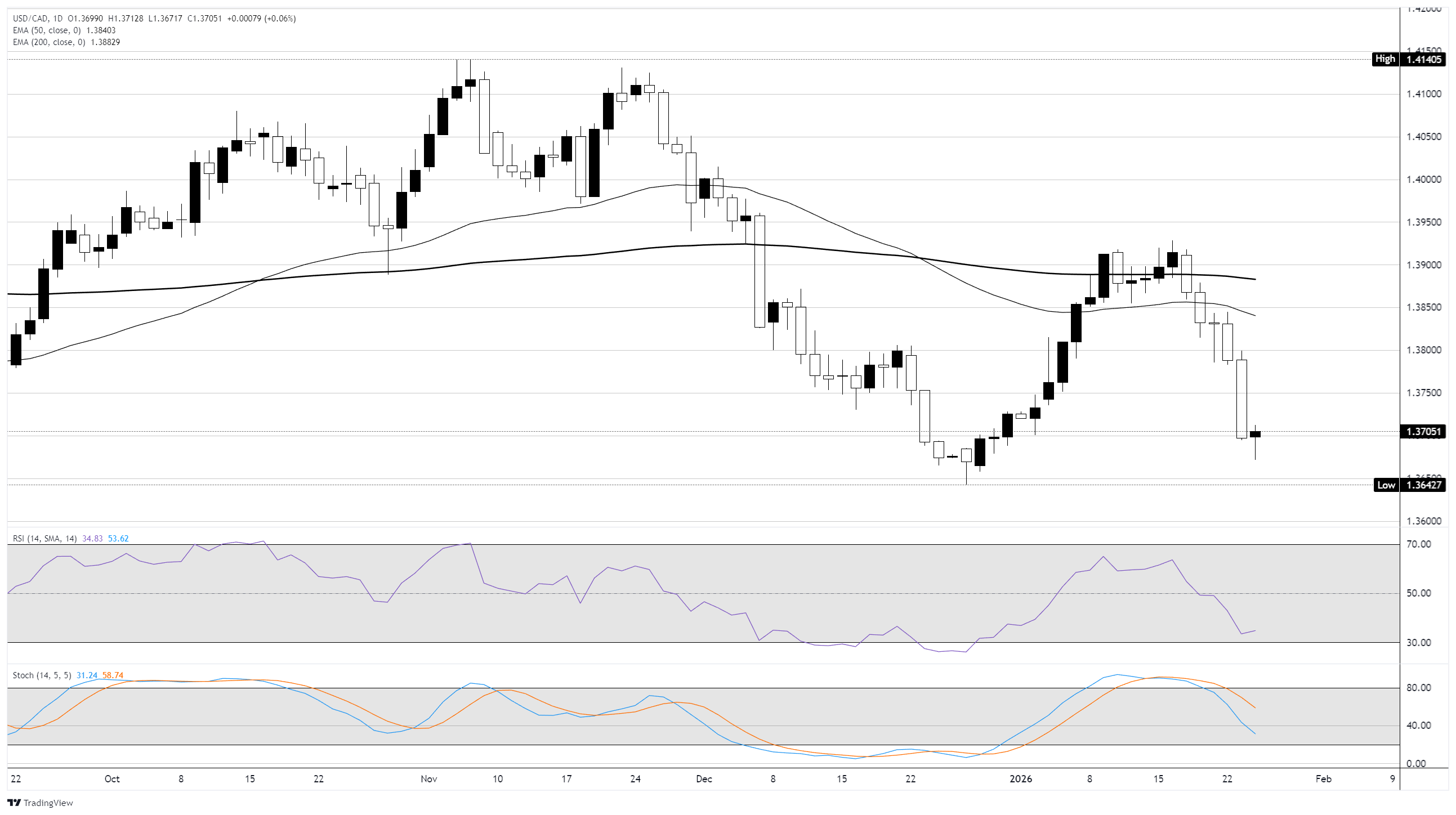
The Canadian Dollar has hit a slow patch following a five-day winning streak against the slumping Greenback. USD/CAD tumbled to its lowest bids in a month before finding near-term support at the 1.3700 handle.
Ongoing weakness in the US Dollar Index (DXY) continues to lend a hand to Loonie markets, tilting overall odds in favor of a continued CAD bull run, but the 1.3600 region remains a long-term hurdle. Overbought/sold patterns on daily candlesticks make a weak argument for a technical bounce back into the 1.4000 region in the coming months.
USD/CAD daily chart
Canadian Dollar FAQs
The key factors driving the Canadian Dollar (CAD) are the level of interest rates set by the Bank of Canada (BoC), the price of Oil, Canada’s largest export, the health of its economy, inflation and the Trade Balance, which is the difference between the value of Canada’s exports versus its imports. Other factors include market sentiment – whether investors are taking on more risky assets (risk-on) or seeking safe-havens (risk-off) – with risk-on being CAD-positive. As its largest trading partner, the health of the US economy is also a key factor influencing the Canadian Dollar.
The Bank of Canada (BoC) has a significant influence on the Canadian Dollar by setting the level of interest rates that banks can lend to one another. This influences the level of interest rates for everyone. The main goal of the BoC is to maintain inflation at 1-3% by adjusting interest rates up or down. Relatively higher interest rates tend to be positive for the CAD. The Bank of Canada can also use quantitative easing and tightening to influence credit conditions, with the former CAD-negative and the latter CAD-positive.
The price of Oil is a key factor impacting the value of the Canadian Dollar. Petroleum is Canada’s biggest export, so Oil price tends to have an immediate impact on the CAD value. Generally, if Oil price rises CAD also goes up, as aggregate demand for the currency increases. The opposite is the case if the price of Oil falls. Higher Oil prices also tend to result in a greater likelihood of a positive Trade Balance, which is also supportive of the CAD.
While inflation had always traditionally been thought of as a negative factor for a currency since it lowers the value of money, the opposite has actually been the case in modern times with the relaxation of cross-border capital controls. Higher inflation tends to lead central banks to put up interest rates which attracts more capital inflows from global investors seeking a lucrative place to keep their money. This increases demand for the local currency, which in Canada’s case is the Canadian Dollar.
Macroeconomic data releases gauge the health of the economy and can have an impact on the Canadian Dollar. Indicators such as GDP, Manufacturing and Services PMIs, employment, and consumer sentiment surveys can all influence the direction of the CAD. A strong economy is good for the Canadian Dollar. Not only does it attract more foreign investment but it may encourage the Bank of Canada to put up interest rates, leading to a stronger currency. If economic data is weak, however, the CAD is likely to fall.

超過一百萬用戶依賴 FXStreet 獲取即時市場數據、圖表工具、專家洞見與外匯新聞。其全面的經濟日曆與教育網路研討會協助交易者保持資訊領先、做出審慎決策。FXStreet 擁有約 60 人的團隊,分布於巴塞隆納總部及全球各地。
閱讀更多








