

China’s Gold-buying spree continues with Hong Kong ETFs hitting records
- China and Hong Kong registered inflows in Gold ETFs during April, with the latter seeing record-high numbers.
- Chinese demand for Gold ETFs remains strong, driven by institutional purchases and lower yields.
- Increasing ETF demand tends to support spot prices, which have been hovering between $4,400 and $4,900 since late March.
China continued to lead Asia’s push into Gold buying via Exchange-Traded Funds (ETFs) in April, with Hong Kong registering its highest inflows ever, as Gold prices stabilized after a major pullback in March.
China’s Gold ETFs registered inflows of $498 million in April, according to data from the World Gold Council (WGC). Asia’s largest economy contributed significantly to the rebound in global Gold ETF inflows, particularly when adding Hong Kong’s $732 million record high.
The surge in ETF inflows in Hong Kong was due to the debut of the CSOP Gold ETF, with about $720 million in assets under management, making it Hong Kong’s largest local physical-gold ETF.
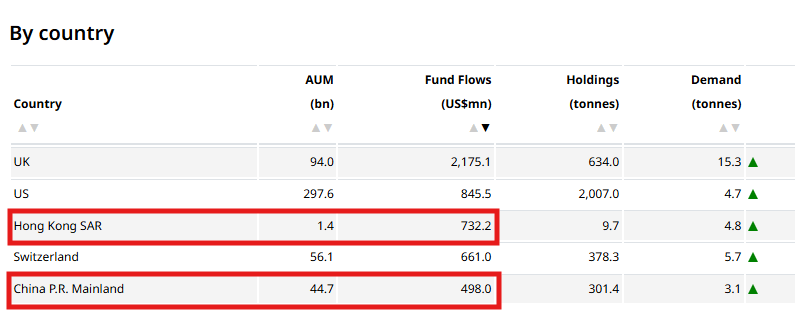
Besides the one-off from Hong Kong, “Gold ETFs in Mainland China continued to draw inflows amid elevated geopolitical tensions, falling yields, and continued official-sector gold buying announcement,” the World Gold Council said.
Looking at the broader region, Gold ETFs in Asia extended their inflow streak to eight months, adding $1.8 billion in April, with positive contributions also from India. Globally, Gold ETFs recorded inflows of $6.6 billion in the month, partly reversing March’s outflows, with the largest inflows coming from the United Kingdom (UK) with $2.1 billion.
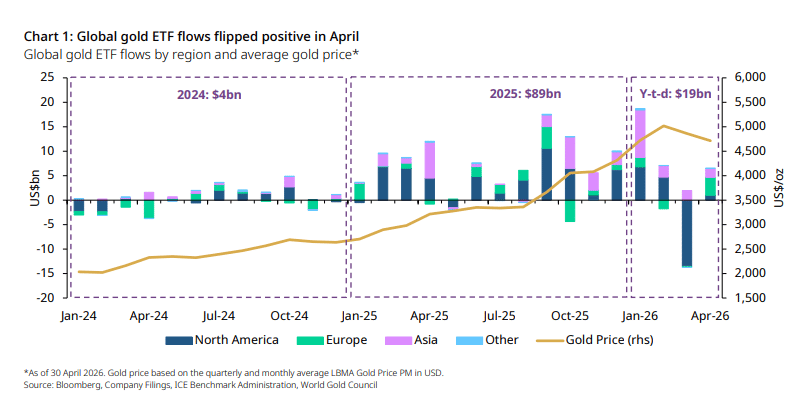
Positive flows via ETFs are a bellwether for spot prices as investor demand via ETFs tends to directly impact the physical market.
Gold prices have traded broadly rangebound since the end of March, within a band of between $4,400 and $4,900. While geopolitics keeps the precious’ metal safe-haven appeal intact, the quick hawkish repricing of global central banks’ rate outlook is also capping gains.
April’s ETF rebound shows that Gold has somewhat regained its safe-haven appeal. While investor demand through ETFs could keep providing a solid floor for the precious metal, any significant gains would need a decline in energy prices and messages from central banks that the current plans to keep interest rates at high levels are no longer on the table.
Gold FAQs
Gold has played a key role in human’s history as it has been widely used as a store of value and medium of exchange. Currently, apart from its shine and usage for jewelry, the precious metal is widely seen as a safe-haven asset, meaning that it is considered a good investment during turbulent times. Gold is also widely seen as a hedge against inflation and against depreciating currencies as it doesn’t rely on any specific issuer or government.
Central banks are the biggest Gold holders. In their aim to support their currencies in turbulent times, central banks tend to diversify their reserves and buy Gold to improve the perceived strength of the economy and the currency. High Gold reserves can be a source of trust for a country’s solvency. Central banks added 1,136 tonnes of Gold worth around $70 billion to their reserves in 2022, according to data from the World Gold Council. This is the highest yearly purchase since records began. Central banks from emerging economies such as China, India and Turkey are quickly increasing their Gold reserves.
Gold has an inverse correlation with the US Dollar and US Treasuries, which are both major reserve and safe-haven assets. When the Dollar depreciates, Gold tends to rise, enabling investors and central banks to diversify their assets in turbulent times. Gold is also inversely correlated with risk assets. A rally in the stock market tends to weaken Gold price, while sell-offs in riskier markets tend to favor the precious metal.
The price can move due to a wide range of factors. Geopolitical instability or fears of a deep recession can quickly make Gold price escalate due to its safe-haven status. As a yield-less asset, Gold tends to rise with lower interest rates, while higher cost of money usually weighs down on the yellow metal. Still, most moves depend on how the US Dollar (USD) behaves as the asset is priced in dollars (XAU/USD). A strong Dollar tends to keep the price of Gold controlled, whereas a weaker Dollar is likely to push Gold prices up.














