

Dow Jones Industrial Average shrugs off a hawkish new Fed chair to set a record
- The Dow Jones shrugged off sliding consumer sentiment, rising inflation expectations, and a Middle East peace deal that refuses to materialize.
- Kevin Warsh was sworn in with a stated wish to change how the Fed talks to markets.
- Rate markets now see ~70% odds that rates will rise by December.
There is confident, and then there is Friday. The Dow Jones Industrial Average (DJIA) ground out a fresh all-time high, up around a quarter of a percent, on a day that gave it nothing to celebrate. A famously hawkish new chief took the gavel at the Federal Reserve (Fed), consumer sentiment fell off a cliff, households said they expect more inflation, not less, and the Middle East ceasefire stayed firmly off. None of it mattered. The tape wanted a record and took one.

A hawkish handover the bulls ignored
The day's headline event ought to have given the rally pause. Kevin Warsh took the oath as the new Fed chair, a man with a hawkish track record, a declared intent to shrink the central bank's bloated balance sheet, and plans to reform how the Fed guides markets. That is a structural headwind for risk assets, not the easy-money backdrop stocks have spent two years pricing. The tape pushed to a record anyway.
Sentiment cracks, the bid does not
Friday's University of Michigan (UoM) survey was ugly in the way a record high should find uncomfortable. Sentiment and expectations both dropped sharply, well below consensus, while one-year and five-year inflation expectations rose, overshooting forecasts in both cases. That is the stagflation-lite cocktail in miniature, softer confidence and stickier prices together, and it landed just as Fed governor Christopher Waller struck a pointedly hawkish tone. Soft data is easy to wave away on any single day, but the survey and the hawk together takes nerve.
A peace premium built on rumor
Then there is Iran. The story doing the rounds is that a US-Iran deal is close, perhaps imminent, and risk assets have quietly banked a slice of that optimism. The trouble is the same story has been close for weeks. The early-April ceasefire has been called barely alive by the US president himself, Tehran's latest proposal was waved off, and fire is still being traded near the Strait of Hormuz with Oil holding above $100. Talk of a breakthrough keeps surfacing from unnamed sources, but no document has been produced, with some doubting that a draft exists at all. Leaning on a peace dividend that may never arrive is leaning on hope.
Pricing hikes, not cuts
Here is where the stock market and the rate market part company completely. Futures see effectively no chance of a move at the June meeting, a near-certain hold, and from there the curve drifts the wrong way for the bulls. By October, a hike is priced as more likely than a hold, and by December, the market puts better than 70% odds on rates sitting higher than they are today, with the probability of a cut at zero. The Fed has held its benchmark at 3.50% to 3.75% through its last two meetings. April Consumer Price Index (CPI) ran hot near 4% YoY, and the bond market has quietly decided the next move, if there is one, is up.
Even the president has softened, conceding he will let his new chair do as he sees fit, which, from a man who demanded cuts for two years, reads like a quiet admission they are not coming. Record highs are supposed to reflect a market that expects policy to ease. The curve says tightening is the bigger risk, and only one of those stories can be right.
The reckoning lands Thursday
None of this gets seriously tested until midweek. US markets are shut Monday for the holiday, thinning liquidity into the long weekend and making a low-volume melt-up easy to manufacture and hard to trust. Thursday brings the April Personal Consumption Expenditures Price Index (PCE), the Fed's preferred inflation gauge and a top-tier release. With UoM inflation expectations already creeping up and CPI still sticky, a hot PCE print would only reinforce the hawkish path the rate market is already pricing, leaving record-high equities looking ever more like the odd one out. A soft one buys the bulls another week of denial.
Trading a record into a long weekend
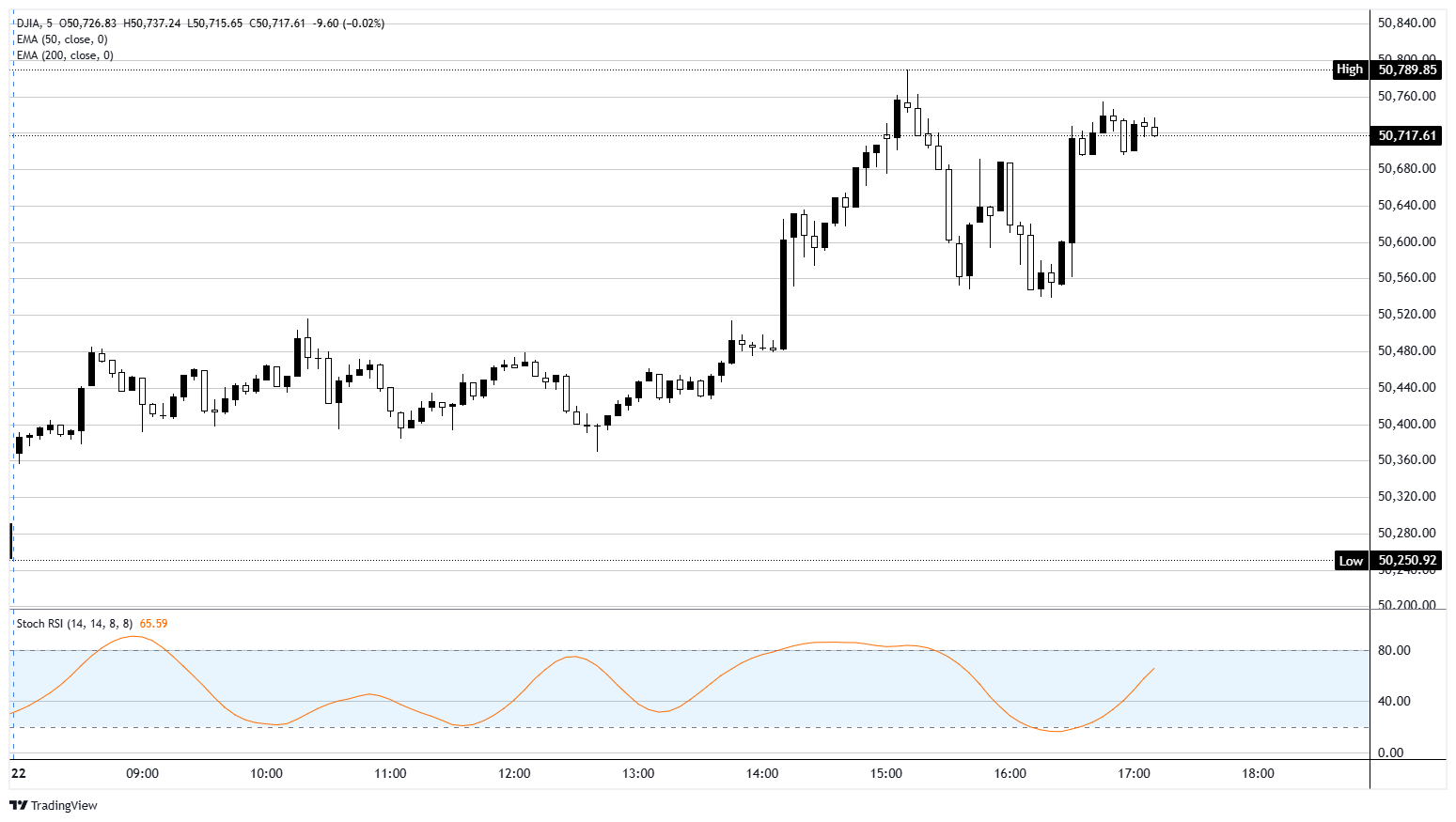
For now the trend is up. The breakout zone near the record around 50,800 is the line that matters, a hold above it keeps momentum chasers engaged. Below, the first shelf is around 50,200, Friday's low, and beneath that the round 50,000 level is the floor bulls cannot afford to lose. The honest read is a momentum tape running on thin conviction and thinner holiday liquidity. Long into strength is fine while 50,000 holds, but this is not a level to marry. If Thursday's inflation print runs hot or the Iran talks fall apart in the open, the unwind from a record tends to move far faster than the grind that produced it.
Dow Jones 5-minute chart
Dow Jones FAQs
The Dow Jones Industrial Average, one of the oldest stock market indices in the world, is compiled of the 30 most traded stocks in the US. The index is price-weighted rather than weighted by capitalization. It is calculated by summing the prices of the constituent stocks and dividing them by a factor, currently 0.152. The index was founded by Charles Dow, who also founded the Wall Street Journal. In later years it has been criticized for not being broadly representative enough because it only tracks 30 conglomerates, unlike broader indices such as the S&P 500.
Many different factors drive the Dow Jones Industrial Average (DJIA). The aggregate performance of the component companies revealed in quarterly company earnings reports is the main one. US and global macroeconomic data also contributes as it impacts on investor sentiment. The level of interest rates, set by the Federal Reserve (Fed), also influences the DJIA as it affects the cost of credit, on which many corporations are heavily reliant. Therefore, inflation can be a major driver as well as other metrics which impact the Fed decisions.
Dow Theory is a method for identifying the primary trend of the stock market developed by Charles Dow. A key step is to compare the direction of the Dow Jones Industrial Average (DJIA) and the Dow Jones Transportation Average (DJTA) and only follow trends where both are moving in the same direction. Volume is a confirmatory criteria. The theory uses elements of peak and trough analysis. Dow’s theory posits three trend phases: accumulation, when smart money starts buying or selling; public participation, when the wider public joins in; and distribution, when the smart money exits.
There are a number of ways to trade the DJIA. One is to use ETFs which allow investors to trade the DJIA as a single security, rather than having to buy shares in all 30 constituent companies. A leading example is the SPDR Dow Jones Industrial Average ETF (DIA). DJIA futures contracts enable traders to speculate on the future value of the index and Options provide the right, but not the obligation, to buy or sell the index at a predetermined price in the future. Mutual funds enable investors to buy a share of a diversified portfolio of DJIA stocks thus providing exposure to the overall index.














