

EUR/USD struggles for traction as markets remain cautious on US-Iran talks
- EUR/USD lacks upside momentum as stalled US-Iran talks keep market sentiment fragile.
- Markets await Fed and ECB monetary policy decisions amid Oil-driven inflation concerns.
- Technicals show mild bullish bias with support near the 1.1650-1.1710 zone.
The Euro (EUR) trims part of its earlier gains against the US Dollar (USD) on Monday, as stalled US-Iran peace talks keep market sentiment fragile and limit downside in the Greenback.
At the time of writing, EUR/USD is trading around 1.1723 after hitting an intraday high of 1.1755. Meanwhile, the US Dollar Index (DXY), which tracks the Greenback’s value against a basket of six major currencies, is trading around 98.47 after touching an intraday low of 98.22.

The modest downside in the US Dollar comes as US-Iran headlines continue to drive price action. Earlier in the day, a report by Axios, citing a US official and two sources familiar with the matter, said Iran has presented a new proposal to the United States to reopen the Strait of Hormuz and end the war, while leaving nuclear negotiations for a later stage.
However, uncertainty remains, as Washington has yet to respond to the proposal. The plan is unlikely to be accepted by US President Donald Trump, who has repeatedly said that curbing Iran’s nuclear program is a key condition for any deal.
Attention is also turning to upcoming central bank meetings later this week, with both the Federal Reserve (Fed) and the European Central Bank (ECB) widely expected to keep interest rates unchanged amid rising inflation risks linked to elevated Oil prices.
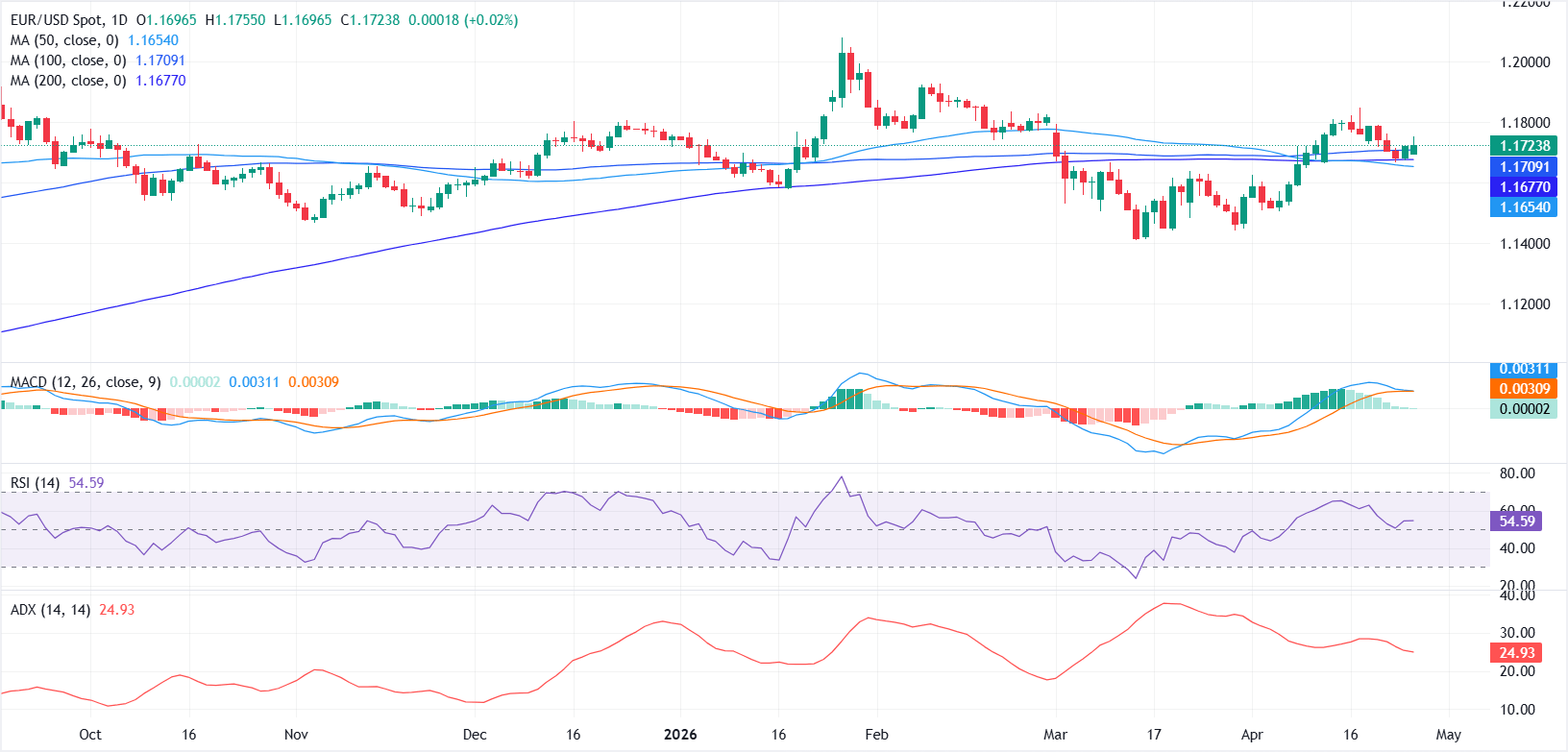
In the daily chart, EUR/USD maintains a mildly bullish near-term bias as prices show signs of stabilization above the 50-, 100-, and 200-day Simple Moving Averages (SMAs). The clustering of these SMAs between roughly 1.1650 and 1.1710 suggests a supportive base beneath the market, while the Relative Strength Index (RSI) around 55 points to constructive but not overstretched momentum.
The Moving Average Convergence Divergence (MACD) has eased back toward the zero line, hinting that upside pressure is moderating rather than reversing at this stage. The Average Directional Index (ADX) near 24 suggests a modest trend strength.
On the downside, a break below this cluster of moving averages could expose the next support near 1.1600. On the upside, resistance is seen around the 1.1800 level.
Fed FAQs
Monetary policy in the US is shaped by the Federal Reserve (Fed). The Fed has two mandates: to achieve price stability and foster full employment. Its primary tool to achieve these goals is by adjusting interest rates. When prices are rising too quickly and inflation is above the Fed’s 2% target, it raises interest rates, increasing borrowing costs throughout the economy. This results in a stronger US Dollar (USD) as it makes the US a more attractive place for international investors to park their money. When inflation falls below 2% or the Unemployment Rate is too high, the Fed may lower interest rates to encourage borrowing, which weighs on the Greenback.
The Federal Reserve (Fed) holds eight policy meetings a year, where the Federal Open Market Committee (FOMC) assesses economic conditions and makes monetary policy decisions. The FOMC is attended by twelve Fed officials – the seven members of the Board of Governors, the president of the Federal Reserve Bank of New York, and four of the remaining eleven regional Reserve Bank presidents, who serve one-year terms on a rotating basis.
In extreme situations, the Federal Reserve may resort to a policy named Quantitative Easing (QE). QE is the process by which the Fed substantially increases the flow of credit in a stuck financial system. It is a non-standard policy measure used during crises or when inflation is extremely low. It was the Fed’s weapon of choice during the Great Financial Crisis in 2008. It involves the Fed printing more Dollars and using them to buy high grade bonds from financial institutions. QE usually weakens the US Dollar.
Quantitative tightening (QT) is the reverse process of QE, whereby the Federal Reserve stops buying bonds from financial institutions and does not reinvest the principal from the bonds it holds maturing, to purchase new bonds. It is usually positive for the value of the US Dollar.














