

GBP/USD consolidates ahead of Bank of England rate decision
作者 Joshua Gibson
發布日期: 4 Feb 2026 | 修改日期: 4 Feb 2026


熱門文章

The Pound Sterling (GBP) traded in a narrow range against the US Dollar (USD) on Tuesday, edging modestly higher to near 1.3700 as markets adopted a cautious stance ahead of the Bank of England's (BoE) first policy decision of 2026.
- GBP/USD trades near 1.3700, up 0.26% on Tuesday as Sterling steadies against the Greenback.
- BoE expected to hold rates at 3.75% on Thursday, with markets pricing less than a 4% chance of a cut.
- USD softens as partial government shutdown ends and Fed Chair succession uncertainty lingers.
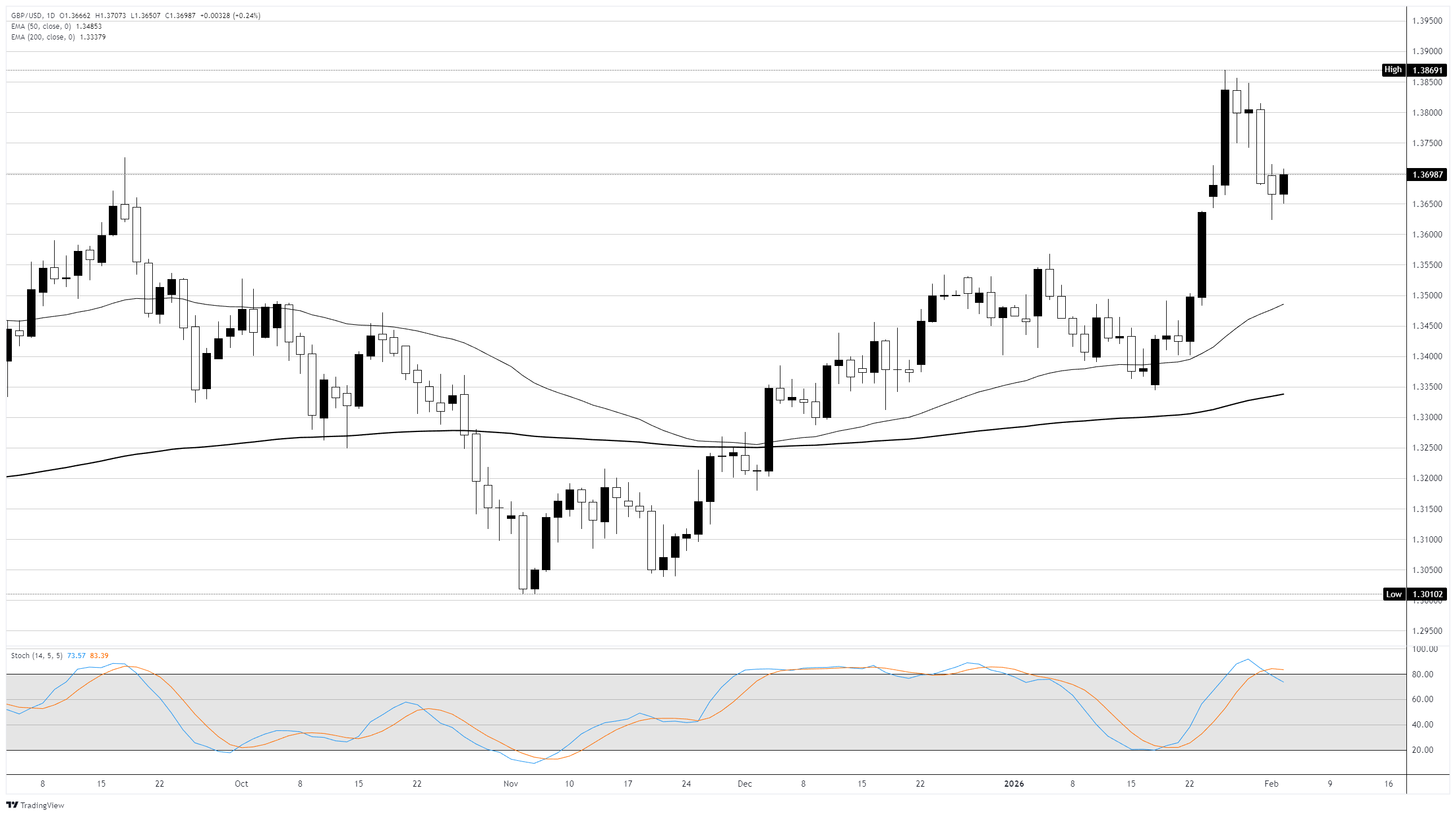
The Pound Sterling (GBP) traded in a narrow range against the US Dollar (USD) on Tuesday, edging modestly higher to near 1.3700 as markets adopted a cautious stance ahead of the Bank of England's (BoE) first policy decision of 2026. GBP/USD opened the session at 1.3665 and touched an intraday high near 1.3707, with the pair consolidating below the multi-year high of 1.3869 posted in late January.
The BoE is widely expected to leave its Bank Rate unchanged at 3.75% when the Monetary Policy Committee (MPC) delivers its verdict on Thursday. Market pricing shows only a 4% probability of a rate cut at this meeting, with the next reduction now penciled in for April at the earliest. December's decision to cut rates was narrowly split at 5-4, and Governor Andrew Bailey has cautioned that future cuts will become "a closer call" as rates approach neutral levels.
UK manufacturing data supports cautious optimism
UK economic data has provided some support for Sterling, with the S&P; Global Manufacturing PMI rising to 51.8 in January from 50.6 in December, marking a 17-month high. The reading exceeded expectations and showed the fourth consecutive month of expansion, with new export orders rising for the first time in four years. Business confidence rebounded to its highest level since before the 2024 Autumn Budget, offering a tentative positive signal for the UK economy.
However, UK inflation remains a concern, with Consumer Price Index (CPI) data for December showing a rise to 3.4% year-on-year, up from 3.2% in November. This sticky inflation picture has limited the BoE's room for maneuver on rate cuts, even as the labor market shows signs of cooling with unemployment at 5.1%.
US Dollar steadies after volatile week
The US Dollar Index (DXY) traded around 97.5 on Tuesday, easing slightly after a sharp two-day rebound earlier in the session. The Greenback found support following President Donald Trump's nomination of Kevin Warsh to succeed Jerome Powell as Federal Reserve (Fed) Chair when Powell's term expires in May. Markets have interpreted the Warsh pick as relatively hawkish, though uncertainty around Fed policy direction persists.
The partial US government shutdown, which began Saturday, came to an end on Tuesday after the House passed a funding package by a narrow 217-214 vote. President Trump signed the legislation into law, providing full-year funding for most federal agencies while extending Department of Homeland Security funding for just two weeks. The January Nonfarm Payrolls (NFP) report, originally due Friday, will be delayed due to the shutdown's impact on Bureau of Labor Statistics operations.
BoE policy outlook in focus
While the BoE is expected to stand pat this week, the policy outlook beyond February remains divided. Some economists see as many as four rate cuts in 2026, while markets are pricing in only one or two reductions. BoE policymaker Megan Greene recently noted that rate cuts may be more limited than expected due to strong UK wage growth and the potential impact of Fed policy decisions on UK inflation. The MPC's guidance on Thursday will be closely scrutinized for signals on the pace of future easing.
Pound Sterling price forecast
GBP/USD continues to trade within a bullish tilt on the daily chart, with price action holding near 1.3700 after pulling back from the January 27 high of 1.3869. The pair remains well above both the 50-day Exponential Moving Average (EMA) at 1.3485 and the 200-day EMA at 1.3338, maintaining a clear bullish bias in the medium term.
The recent pullback from multi-year highs has found support near the 1.3650 area, with buyers stepping in on dips. Immediate resistance sits at the psychological 1.3700 level, followed by the recent swing high at 1.3869. A sustained break above 1.3870 would open the door for a move toward 1.3900 and potentially 1.4000 over the coming weeks.
The Stochastic Oscillator readings at 73.67 and 83.41 indicate the pair is trading in overbought territory, suggesting short-term momentum may be stretched. This could invite profit-taking or consolidation before another leg higher. On the downside, a break below 1.3650 would expose the 1.3500 area, where the 50-day EMA could provide dynamic support. The broader uptrend remains intact while price holds above the 200-day EMA at 1.3338.
GBP/USD daily chart
GDP FAQs
A country’s Gross Domestic Product (GDP) measures the rate of growth of its economy over a given period of time, usually a quarter. The most reliable figures are those that compare GDP to the previous quarter e.g Q2 of 2023 vs Q1 of 2023, or to the same period in the previous year, e.g Q2 of 2023 vs Q2 of 2022. Annualized quarterly GDP figures extrapolate the growth rate of the quarter as if it were constant for the rest of the year. These can be misleading, however, if temporary shocks impact growth in one quarter but are unlikely to last all year – such as happened in the first quarter of 2020 at the outbreak of the covid pandemic, when growth plummeted.
A higher GDP result is generally positive for a nation’s currency as it reflects a growing economy, which is more likely to produce goods and services that can be exported, as well as attracting higher foreign investment. By the same token, when GDP falls it is usually negative for the currency. When an economy grows people tend to spend more, which leads to inflation. The country’s central bank then has to put up interest rates to combat the inflation with the side effect of attracting more capital inflows from global investors, thus helping the local currency appreciate.
When an economy grows and GDP is rising, people tend to spend more which leads to inflation. The country’s central bank then has to put up interest rates to combat the inflation. Higher interest rates are negative for Gold because they increase the opportunity-cost of holding Gold versus placing the money in a cash deposit account. Therefore, a higher GDP growth rate is usually a bearish factor for Gold price.

超過一百萬用戶依賴 FXStreet 獲取即時市場數據、圖表工具、專家洞見與外匯新聞。其全面的經濟日曆與教育網路研討會協助交易者保持資訊領先、做出審慎決策。FXStreet 擁有約 60 人的團隊,分布於巴塞隆納總部及全球各地。
閱讀更多








