

Gold holds above $4,000 as US PCE data cools near-term Fed rate-hike bets
- Gold steadies above $4,000 amid softer US Dollar, easing Treasury yields after US PCE inflation data.
- Softer-than-expected monthly inflation data cools near-term Fed rate-hike expectations.
- Technically, XAU/USD maintains a bearish bias as prices remain below the middle Bollinger Band.
Gold (XAU/USD) steadies above the $4,000 mark on Friday as a softer US Dollar (USD) and lower Treasury yields provide support after the latest US Personal Consumption Expenditures (PCE) inflation report broadly met forecasts, reducing expectations of a near-term Federal Reserve (Fed) interest rate hike.
At the time of writing, XAU/USD trades around $4,050, up 0.6% on the day.
Data released on Thursday showed the headline PCE rose 0.4% MoM in May, unchanged from April but below the 0.5% forecast. Core PCE held steady at 0.3%, matching expectations.

Following the data, traders trimmed bets on a September rate hike, with the probability falling to 61% from 70% a week ago, according to the CME FedWatch Tool.
While the softer monthly readings helped ease immediate rate-hike concerns, the annual inflation figures remained well above the Fed's 2% target, suggesting policymakers are likely to keep borrowing costs elevated for longer, even as lower Oil prices are expected to help cool inflationary pressure in the coming months.
Against this backdrop, Gold may struggle to stage a meaningful recovery and remains on track for a fourth consecutive monthly decline as prospects for higher US interest rates continue to weigh on the non-yielding metal.
At the same time, the US Dollar remains well supported despite some intraday weakness, making Gold more expensive for overseas buyers. The US Dollar Index (DXY), which tracks the Greenback's value against a basket of six major currencies, trades around 101.20 after hitting a more than one-year high near 101.80 earlier this week.
On the geopolitical front, uncertainty over a final US-Iran agreement keeps traders cautious. Iran said on Friday that the US military presence in the Gulf is fueling insecurity and division in the region. Tehran also reiterated that safe passage through the Strait of Hormuz must be coordinated with Iranian authorities.
Technical Analysis: ADX signals a strong downtrend as XAU/USD clings to $4,000
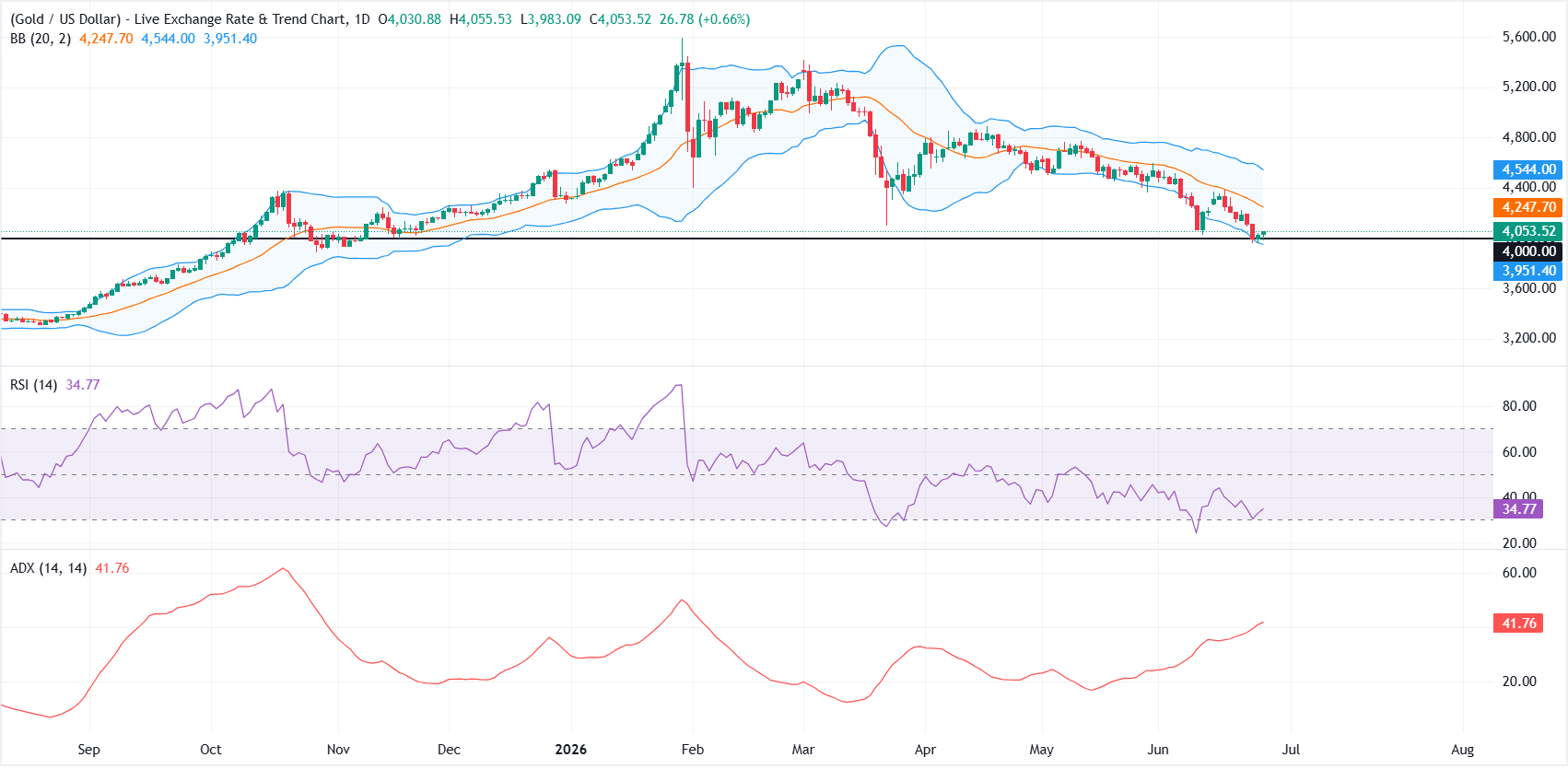
In the daily chart, XAU/USD maintains a bearish near-term bias as price holds below the 20-period Bollinger Simple Moving Average (SMA) at $4,247.
The Relative Strength Index (RSI) at 34 hovers just above oversold territory, while the Average Directional Index (ADX) at 41 signals a strong, persistent downtrend, suggesting that any bounces are likely to be capped by nearby overhead levels.
On the topside, initial resistance is located at the Bollinger middle band near $4,247, with a stronger barrier at the upper band around $4,544.
On the downside, immediate support is seen around the horizontal level at $4,000, ahead of the Bollinger lower band at $3,951, where sellers could pause before attempting another leg lower.
(The technical analysis of this story was written with the help of an AI tool.)
Gold FAQs
Gold has played a key role in human’s history as it has been widely used as a store of value and medium of exchange. Currently, apart from its shine and usage for jewelry, the precious metal is widely seen as a safe-haven asset, meaning that it is considered a good investment during turbulent times. Gold is also widely seen as a hedge against inflation and against depreciating currencies as it doesn’t rely on any specific issuer or government.
Central banks are the biggest Gold holders. In their aim to support their currencies in turbulent times, central banks tend to diversify their reserves and buy Gold to improve the perceived strength of the economy and the currency. High Gold reserves can be a source of trust for a country’s solvency. Central banks added 1,136 tonnes of Gold worth around $70 billion to their reserves in 2022, according to data from the World Gold Council. This is the highest yearly purchase since records began. Central banks from emerging economies such as China, India and Turkey are quickly increasing their Gold reserves.
Gold has an inverse correlation with the US Dollar and US Treasuries, which are both major reserve and safe-haven assets. When the Dollar depreciates, Gold tends to rise, enabling investors and central banks to diversify their assets in turbulent times. Gold is also inversely correlated with risk assets. A rally in the stock market tends to weaken Gold price, while sell-offs in riskier markets tend to favor the precious metal.
The price can move due to a wide range of factors. Geopolitical instability or fears of a deep recession can quickly make Gold price escalate due to its safe-haven status. As a yield-less asset, Gold tends to rise with lower interest rates, while higher cost of money usually weighs down on the yellow metal. Still, most moves depend on how the US Dollar (USD) behaves as the asset is priced in dollars (XAU/USD). A strong Dollar tends to keep the price of Gold controlled, whereas a weaker Dollar is likely to push Gold prices up.













