

Gold Price Forecast: XAU/USD corrects slightly to near $4,320 ahead of US inflation data
作者 Sagar Dua
發布日期: 18 Dec 2025 | 修改日期: 18 Dec 2025


熱門文章
Gold price (XAU/USD) trades 0.4% lower to near $4,320 during the European trading session on Thursday, though it remains close to its all-time high of $4,381.
- Gold price retraces to near $4,320 ahead of the US CPI data for November.
- The US Dollar trades higher in the countdown to the inflation data.
- The Fed is unlikely to cut interest rates in January, the CME FedWatch tool shows.
Gold price (XAU/USD) trades 0.4% lower to near $4,320 during the European trading session on Thursday, though it remains close to its all-time high of $4,381. The precious metal faces slight pressure as the US Dollar (USD) trades higher ahead of the United States (US) Consumer Price Index (CPI) data for November, which will be published at 13:30 GMT.
During the press time, the US Dollar Index (DXY), which tracks the Greenback’s value against six major currencies, is up 0.15% to near 98.55.
Technically, a higher US Dollar makes the Gold price an expensive bet for investors.
Market participants will closely monitor the US inflation data as it will influence market expectations for the Federal Reserve’s (Fed) monetary policy outlook. The US headline inflation is expected to have accelerated to 3.1% YoY from 3% in October, with CPI ex Food and Energy remaining steady at 3%.
Signs of price pressures remaining sticky would weigh on dovish Fed expectations, while soft figures would boost them.
Theoretically, the Gold price outperforms in a high-inflation environment, but the scenario of fading Fed dovish speculation bodes poorly for non-yielding assets.
Currently, the CME FedWatch tool shows that the probability of the Fed reducing interest rates by 25 basis points (bps) to 3.25%-3.50% in the January meeting is 24.4%.
Gold technical analysis
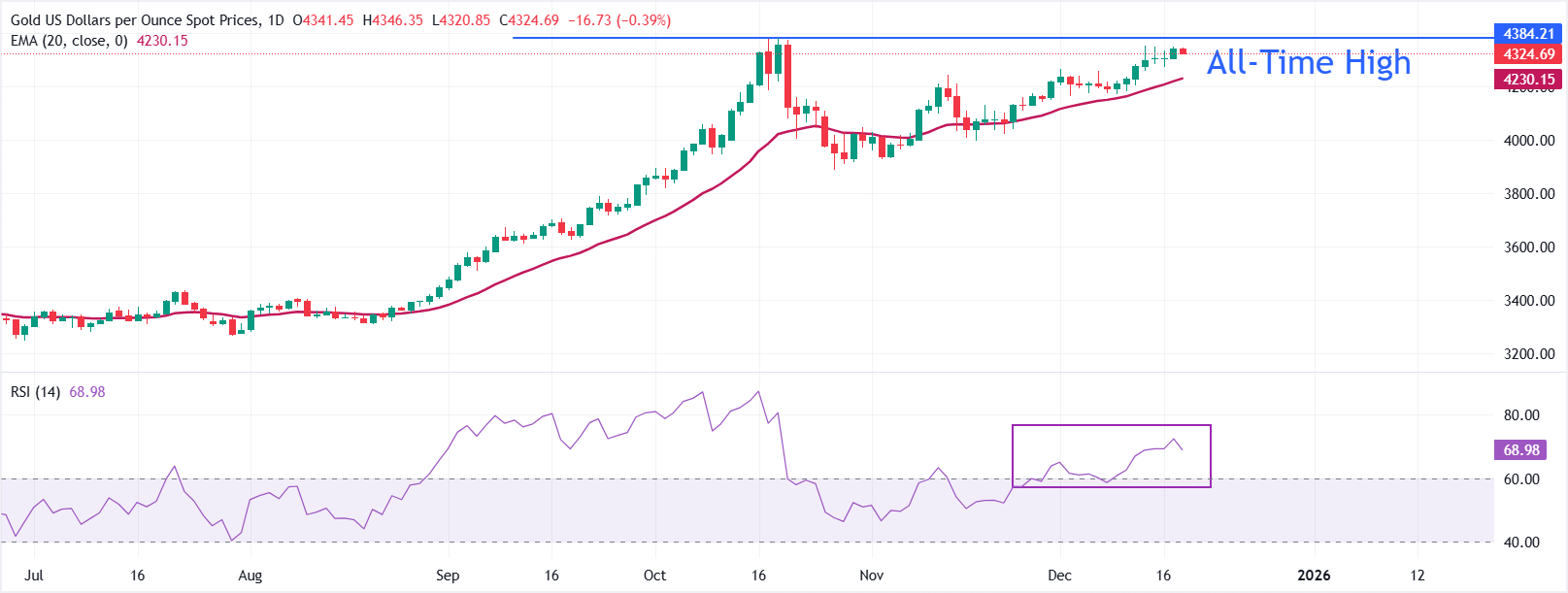
Gold price trades lower to near $4,324.56 on Thursday. The price stands firmly above the rising 20-day Exponential Moving Average (EMA), now at $4,230.13, as the average continues to advance steadily, confirming an upside bias. The widening spread between spot and the EMA underscores trend strength.
The 14-day Relative Strength Index (RSI) at 68.96 sits just below overbought after easing from 72.44, indicating robust but cooling momentum.
Should buyers keep price action anchored above the rising average, the path of least resistance would remain higher, though momentum could pause while RSI cools from the high-60s area. A pullback toward the 20-day EMA at $4,230.13 would meet initial trend support, while sustained closes above the short-term mean would preserve upside extension. RSI near 70 warns of stretched conditions, so shallow dips could emerge before trend continuation.
(The technical analysis of this story was written with the help of an AI tool.)
Gold FAQs
Gold has played a key role in human’s history as it has been widely used as a store of value and medium of exchange. Currently, apart from its shine and usage for jewelry, the precious metal is widely seen as a safe-haven asset, meaning that it is considered a good investment during turbulent times. Gold is also widely seen as a hedge against inflation and against depreciating currencies as it doesn’t rely on any specific issuer or government.
Central banks are the biggest Gold holders. In their aim to support their currencies in turbulent times, central banks tend to diversify their reserves and buy Gold to improve the perceived strength of the economy and the currency. High Gold reserves can be a source of trust for a country’s solvency. Central banks added 1,136 tonnes of Gold worth around $70 billion to their reserves in 2022, according to data from the World Gold Council. This is the highest yearly purchase since records began. Central banks from emerging economies such as China, India and Turkey are quickly increasing their Gold reserves.
Gold has an inverse correlation with the US Dollar and US Treasuries, which are both major reserve and safe-haven assets. When the Dollar depreciates, Gold tends to rise, enabling investors and central banks to diversify their assets in turbulent times. Gold is also inversely correlated with risk assets. A rally in the stock market tends to weaken Gold price, while sell-offs in riskier markets tend to favor the precious metal.
The price can move due to a wide range of factors. Geopolitical instability or fears of a deep recession can quickly make Gold price escalate due to its safe-haven status. As a yield-less asset, Gold tends to rise with lower interest rates, while higher cost of money usually weighs down on the yellow metal. Still, most moves depend on how the US Dollar (USD) behaves as the asset is priced in dollars (XAU/USD). A strong Dollar tends to keep the price of Gold controlled, whereas a weaker Dollar is likely to push Gold prices up.

超過一百萬用戶依賴 FXStreet 獲取即時市場數據、圖表工具、專家洞見與外匯新聞。其全面的經濟日曆與教育網路研討會協助交易者保持資訊領先、做出審慎決策。FXStreet 擁有約 60 人的團隊,分布於巴塞隆納總部及全球各地。
閱讀更多








