

Trade The World
Dow Jones Industrial Average rebounds as investors shrug off fresh tariff threats
作者 Joshua Gibson
發布日期: 15 Oct 2025 | 修改日期: 15 Oct 2025


POPULAR ARTICLES

The Dow Jones Industrial Average (DJIA) gained ground on Tuesday after a tumultuous late start to the new trading week for US equity markets.
- The Dow Jones reversed early losses to gain ground on Tuesday, testing back above 46,500.
- Investors are shrugging off last week’s late Trump proclamation of further tariffs on China.
- China has ramped up its trade controls, drawing ire from the Trump administration.
The Dow Jones Industrial Average (DJIA) gained ground on Tuesday after a tumultuous late start to the new trading week for US equity markets. China imposed strict licensing requirements on any foreign entity trying to export rare earth minerals out of China last week, sparking a fresh trade tariff tirade from US President Donald Trump via social media. China responded by also ramping up port fees for foreign-bound ships in Chinese ports, and investors are once again growing apprehensive of a fresh uptick in global trade tensions at a time when the US is grappling with faltering job numbers.
Stocks rebound on hope, but dark clouds continue to gather
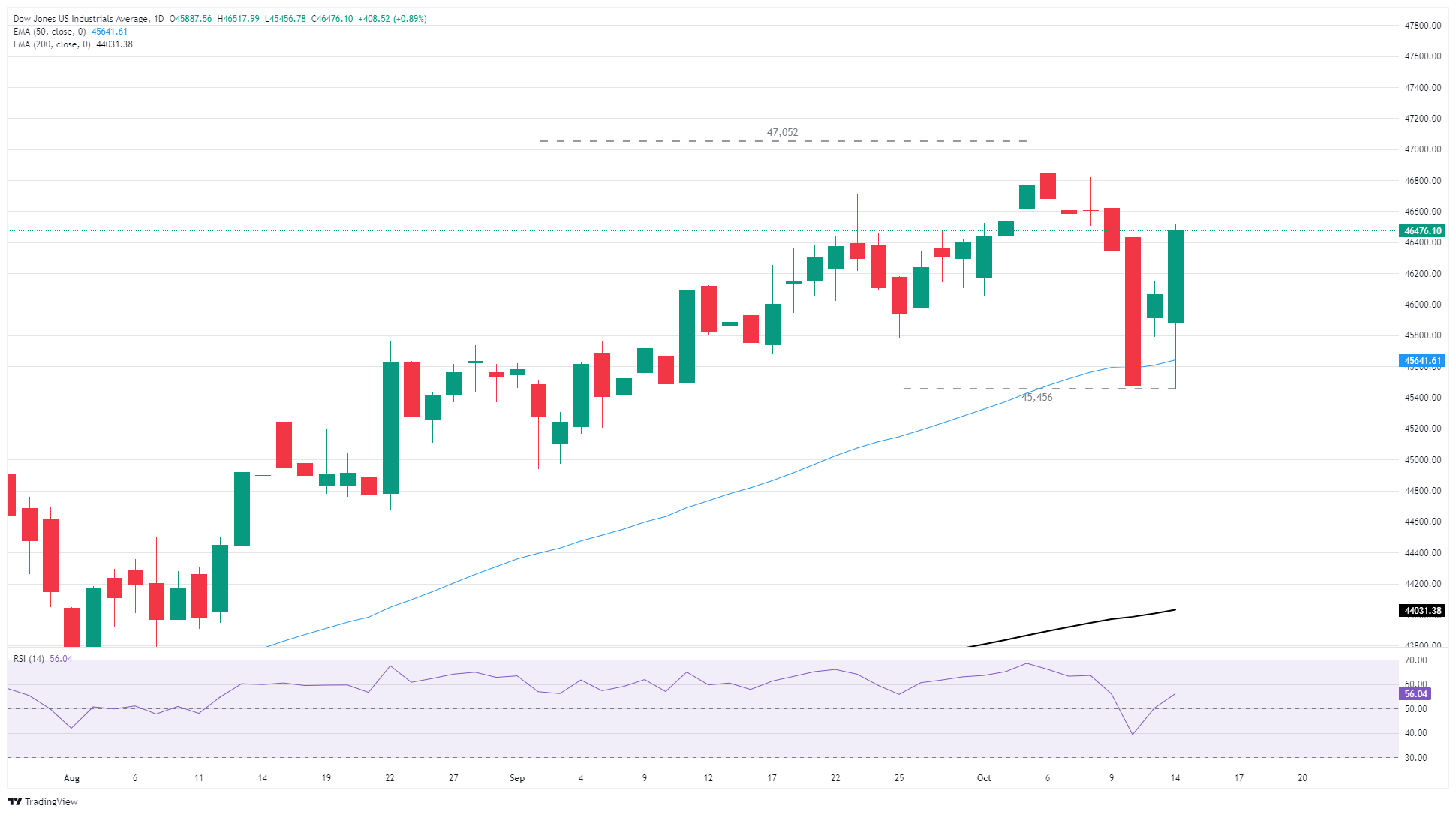
The Dow Jones fell into the 45,450 region during overnight and early trading hours before investors battled back with fresh optimism, pushing the major equity index back into the 46,500 zone as American markets piled back into the fold following a long weekend hiatus.
The Trump administration has pivoted into something approaching recalcitrance toward the latest Chinese trade controls, threatening an additional 100% tariff on Chinese imports into the US to begin on November 1 if China doesn’t reconsider its protectionist trade policies. A Chinese crackdown on rare earths exports directly threatens the stability of several key US industries, including defense, tech, energy, and health services.
Citigroup (C ) and Wells Fargo (WFC) both turned firmly bullish on Tuesday after posting better-than-expected earnings before the market open, and investors will be looking for the rest of the Q3 pack of earnings reports to keep the gravy train running.
Government shutdown continues to crimp the flow of critical market data
Key US data remains limited amongst the ongoing US government shutdown. US Producer Price Index (PPI) inflation numbers, as well as the latest Retail Sales figures, would have been due later this week, but the Bureau of Labor Statistics (BLS) remains unable to release numbers while 750,000 federal workers are facing furlough. Federal departments are coming under increasing pressure as the Trump administration begins a sweeping wave of federal terminations that could reach into the tens of thousands, ensuring that when the US government does return to work, the backlog of unperformed work will be even more difficult to work through.
Dow Jones daily chart
Tariffs FAQs
Tariffs are customs duties levied on certain merchandise imports or a category of products. Tariffs are designed to help local producers and manufacturers be more competitive in the market by providing a price advantage over similar goods that can be imported. Tariffs are widely used as tools of protectionism, along with trade barriers and import quotas.
Although tariffs and taxes both generate government revenue to fund public goods and services, they have several distinctions. Tariffs are prepaid at the port of entry, while taxes are paid at the time of purchase. Taxes are imposed on individual taxpayers and businesses, while tariffs are paid by importers.
There are two schools of thought among economists regarding the usage of tariffs. While some argue that tariffs are necessary to protect domestic industries and address trade imbalances, others see them as a harmful tool that could potentially drive prices higher over the long term and lead to a damaging trade war by encouraging tit-for-tat tariffs.
During the run-up to the presidential election in November 2024, Donald Trump made it clear that he intends to use tariffs to support the US economy and American producers. In 2024, Mexico, China and Canada accounted for 42% of total US imports. In this period, Mexico stood out as the top exporter with $466.6 billion, according to the US Census Bureau. Hence, Trump wants to focus on these three nations when imposing tariffs. He also plans to use the revenue generated through tariffs to lower personal income taxes.

FXStreet
超過一百萬用戶依賴 FXStreet 獲取即時市場數據、圖表工具、專家洞見與外匯新聞。其全面的經濟日曆與教育網路研討會協助交易者保持資訊領先、做出審慎決策。FXStreet 擁有約 60 人的團隊,分布於巴塞隆納總部及全球各地。
Read More








