

EUR/USD slips after two-day rally, Greenland headlines stir volatility
作者 Joshua Gibson
發布日期: 22 Jan 2026 | 修改日期: 22 Jan 2026


熱門文章

The Euro (EUR) traded softer on Wednesday after two days of strong gains, with price action reflecting shifting US political headlines and their impact on the US Dollar (USD) and bond yields.
- Euro snaps two-day win streak, slipping 0.2% on Wednesday
- Greenland headlines drive swings in USD, yields, and intraday FX sentiment
- Focus shifts to ECB accounts and US GDP, inflation, and jobless claims
The Euro (EUR) traded softer on Wednesday after two days of strong gains, with price action reflecting shifting US political headlines and their impact on the US Dollar (USD) and bond yields. Early in the session, comments from US President Donald Trump that the US was seeking immediate talks on Greenland briefly supported the Greenback. That move was later reversed after Trump stated that the US would not use excessive force to obtain Greenland, followed by Denmark rejecting any negotiations over a takeover. As these headlines crossed, US bond yields fell alongside the US Dollar, allowing the Euro to stabilize after an initial pullback.
European fundamentals provided a steadier backdrop. Sentiment indicators, particularly from Germany, have helped reinforce the view that eurozone growth risks may be moderating. While the macro outlook remains uneven, improved confidence data has limited downside pressure on the euro, even as geopolitical developments drove intraday volatility. This has helped the single currency consolidate rather than unwind this week’s earlier gains.
Looking ahead to Thursday, focus turns to scheduled macro catalysts that may outweigh headline risk. In the eurozone, ECB monetary policy meeting accounts will be closely watched for guidance on inflation confidence and the future rate path. In the US, GDP revisions, inflation indicators, and weekly jobless claims are expected to shape rate expectations. Any divergence between US macro momentum and ECB policy messaging could meaningfully influence near-term EUR/USD direction.
EUR/USD price forecast
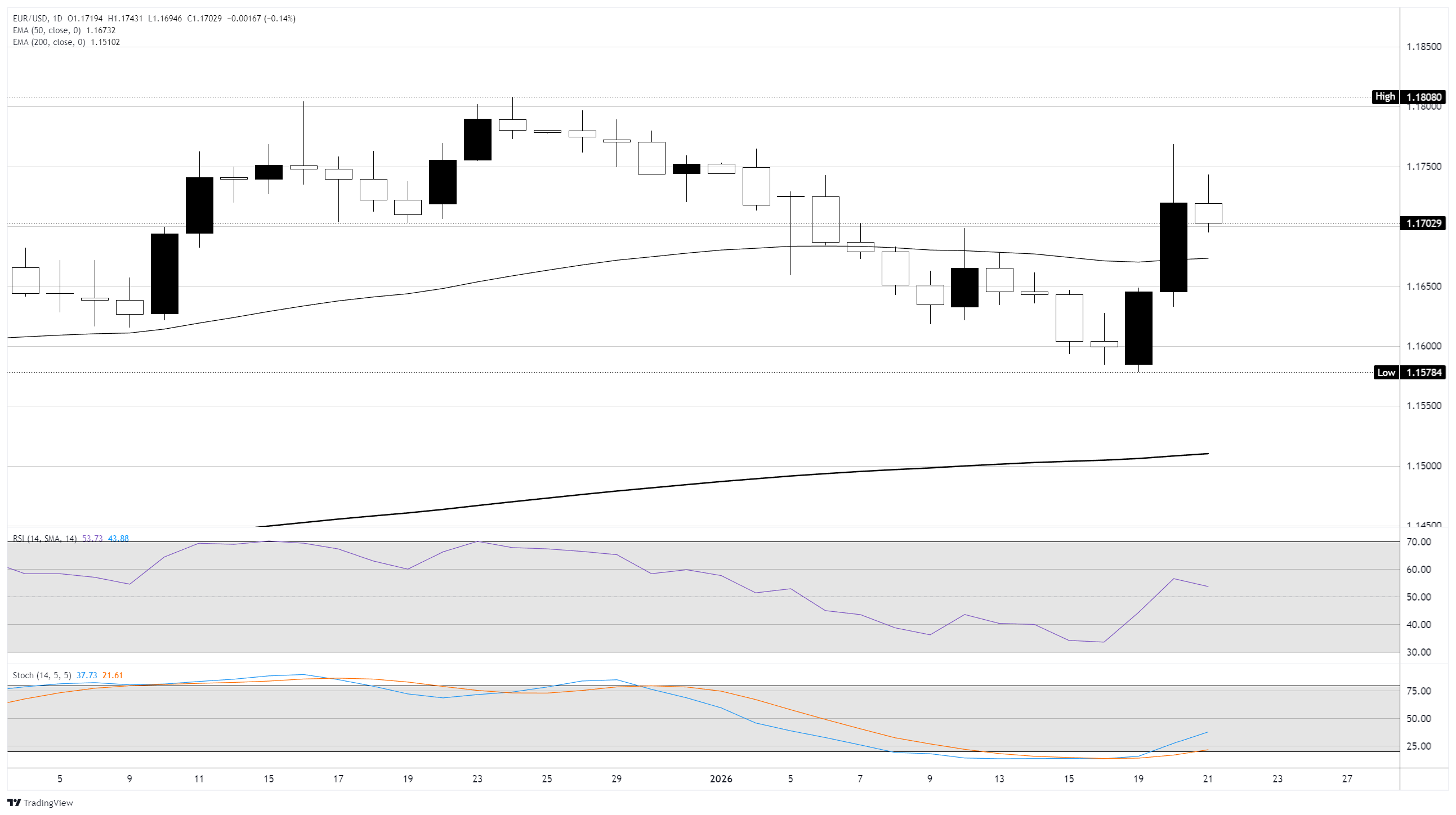
EUR/USD rallied strongly at the start of the week, gaining approximately 1.16 percent across Monday and Tuesday, before giving back around 0.2 percent on Wednesday, according to the current week’s daily candlestick structure. The mid-week pullback appears corrective rather than trend-changing, with the pair consolidating near recent highs rather than retracing the bulk of earlier gains.
From a broader perspective, the pair remains supported above key short-term levels, suggesting underlying resilience despite today’s softer close. Momentum indicators reflect cooling upside pressure rather than a reversal, consistent with a market that is pausing ahead of major data rather than aggressively re-pricing risk. Thursday’s economic releases may determine whether the euro resumes its advance or extends this consolidation phase.
EUR/USD daily chart
Euro FAQs
The Euro is the currency for the 20 European Union countries that belong to the Eurozone. It is the second most heavily traded currency in the world behind the US Dollar. In 2022, it accounted for 31% of all foreign exchange transactions, with an average daily turnover of over $2.2 trillion a day. EUR/USD is the most heavily traded currency pair in the world, accounting for an estimated 30% off all transactions, followed by EUR/JPY (4%), EUR/GBP (3%) and EUR/AUD (2%).
The European Central Bank (ECB) in Frankfurt, Germany, is the reserve bank for the Eurozone. The ECB sets interest rates and manages monetary policy. The ECB’s primary mandate is to maintain price stability, which means either controlling inflation or stimulating growth. Its primary tool is the raising or lowering of interest rates. Relatively high interest rates – or the expectation of higher rates – will usually benefit the Euro and vice versa. The ECB Governing Council makes monetary policy decisions at meetings held eight times a year. Decisions are made by heads of the Eurozone national banks and six permanent members, including the President of the ECB, Christine Lagarde.
Eurozone inflation data, measured by the Harmonized Index of Consumer Prices (HICP), is an important econometric for the Euro. If inflation rises more than expected, especially if above the ECB’s 2% target, it obliges the ECB to raise interest rates to bring it back under control. Relatively high interest rates compared to its counterparts will usually benefit the Euro, as it makes the region more attractive as a place for global investors to park their money.
Data releases gauge the health of the economy and can impact on the Euro. Indicators such as GDP, Manufacturing and Services PMIs, employment, and consumer sentiment surveys can all influence the direction of the single currency. A strong economy is good for the Euro. Not only does it attract more foreign investment but it may encourage the ECB to put up interest rates, which will directly strengthen the Euro. Otherwise, if economic data is weak, the Euro is likely to fall. Economic data for the four largest economies in the euro area (Germany, France, Italy and Spain) are especially significant, as they account for 75% of the Eurozone’s economy.
Another significant data release for the Euro is the Trade Balance. This indicator measures the difference between what a country earns from its exports and what it spends on imports over a given period. If a country produces highly sought after exports then its currency will gain in value purely from the extra demand created from foreign buyers seeking to purchase these goods. Therefore, a positive net Trade Balance strengthens a currency and vice versa for a negative balance.

超過一百萬用戶依賴 FXStreet 獲取即時市場數據、圖表工具、專家洞見與外匯新聞。其全面的經濟日曆與教育網路研討會協助交易者保持資訊領先、做出審慎決策。FXStreet 擁有約 60 人的團隊,分布於巴塞隆納總部及全球各地。
閱讀更多








