

Bank of Japan set to keep interest rates unchanged after suspected Yen intervention
- The Bank of Japan is widely expected to keep its policy rate unchanged at 1.00% after raising borrowing costs in June.
- Suspected intervention by Japanese authorities has sent the Japanese Yen sharply higher ahead of the policy decision.
- Investors will look to Governor Kazuo Ueda for clues on whether another rate hike could reinforce the Japanese Yen's rebound.
Investors are turning their attention to the Bank of Japan’s (BoJ) monetary policy announcement on Friday, after the Japanese Yen (JPY) staged a dramatic rebound during Thursday's American session. The move came amid growing speculation that Japanese authorities intervened in the foreign exchange market after USD/JPY tumbled from above 163.00 to below 158.00 within minutes.

While the BoJ is still widely expected to leave its policy rate unchanged at 1%, the sudden appreciation of the Japanese Yen has altered the market backdrop heading into the meeting. Investors will now focus on the updated economic projections and Governor Kazuo Ueda's press conference to assess whether the central bank's policy outlook could reinforce the Japanese currency's recovery.
The decision follows the BoJ's June rate hike, which gave policymakers room to assess the effects of tighter financial conditions. Although another immediate move appears unlikely, markets continue to expect additional tightening before year-end, with October and December remaining the main candidates.
What to expect from the BoJ interest rate decision?
The Bank of Japan is expected to maintain its policy rate at 1% following the conclusion of its two-day meeting. The decision is likely to be supported by a broad majority of the Policy Board, as officials assess incoming data after the June rate hike.
The central bank will also publish its quarterly Outlook Report, including updated projections for economic growth and inflation. Policymakers could revise their growth forecasts higher, supported by resilient domestic activity and strong demand linked to artificial intelligence investment. At the same time, headline inflation estimates may be adjusted slightly lower due to government subsidies and softer energy prices.
A downward revision to the inflation forecast would not necessarily imply a more dovish policy stance. The BoJ is still expected to warn that underlying price pressures could remain stronger than projected, particularly as higher import and producer costs gradually pass through to consumers.
The Japanese central bank’s latest Tankan survey also showed that companies continue to expect inflation to remain above the BoJ’s 2% target over the coming years. These expectations, combined with rising wages and persistent services inflation, strengthen policymakers’ confidence that a durable wage-price cycle is taking hold.
The weakness of the Japanese Yen remains another important consideration. A softer currency raises the cost of imported goods and energy, potentially intensifying inflationary pressures. Even though the suspected intervention by Japanese authorities has temporarily eased pressure on the Japanese Yen after months of persistent weakness, the trend could resume, as seen after the previous intervention in April. The BoJ does not directly target exchange rates, but Governor Ueda could emphasize that policymakers are closely monitoring the impact of currency movements on the inflation outlook.
The BoJ is likely to preserve a gradual tightening bias without explicitly committing to the timing of its next move. Market pricing indicates that investors expect at least one additional 25-basis-point increase before the end of the year, although expectations remain divided between the October and December meetings, according to Reuters.
Ueda’s communication will therefore be decisive. A stronger emphasis on upside inflation risks, wage growth or the economic consequences of the weak Japanese Yen could reinforce expectations of an October rate hike. Conversely, a cautious assessment of consumption and global demand could encourage investors to push those expectations towards December.
How could the Bank of Japan's monetary policy decision affect USD/JPY?
USD/JPY enters the BoJ meeting under very different conditions after plunging more than 2% on Thursday amid speculation that Japanese authorities intervened to support the Japanese Yen. With the decision to keep interest rates unchanged already largely priced in, the pair's next move will depend on whether Governor Ueda reinforces expectations for another rate hike later this year.
A hawkish outcome, including stronger warnings about inflation or a clear indication that another rate increase could come as early as October, may support the Japanese Yen and push USD/JPY lower. Markets could interpret such language as evidence that the BoJ is prepared to continue narrowing the interest-rate gap between Japan and other major economies.
By contrast, a neutral or cautious message could leave the JPY vulnerable. Should Ueda stress downside risks to growth or avoid discussing the timing of the next rate increase, USD/JPY could rebound as investors unwind expectations of near-term tightening.
Thursday's sharp decline suggests that intervention fears may already have materialized. Although Japanese authorities have yet to confirm any action, the sudden appreciation of the Japanese Yen bears the hallmarks of previous interventions, shifting investors' attention to whether the move can be sustained by a more hawkish BoJ or proves to be only temporary without additional policy support.
The Federal Reserve (Fed) also remains part of the equation after keeping interest rates unchanged on Wednesday for a fifth consecutive meeting. Although the decision matched market expectations, the US Dollar (USD) weakened as investors unwound bets on a surprise rate hike. That softer USD could offer some additional support to the Japanese Yen, meaning that any hawkish signal from the Bank of Japan may have a greater impact on USD/JPY if the Greenback remains under pressure.
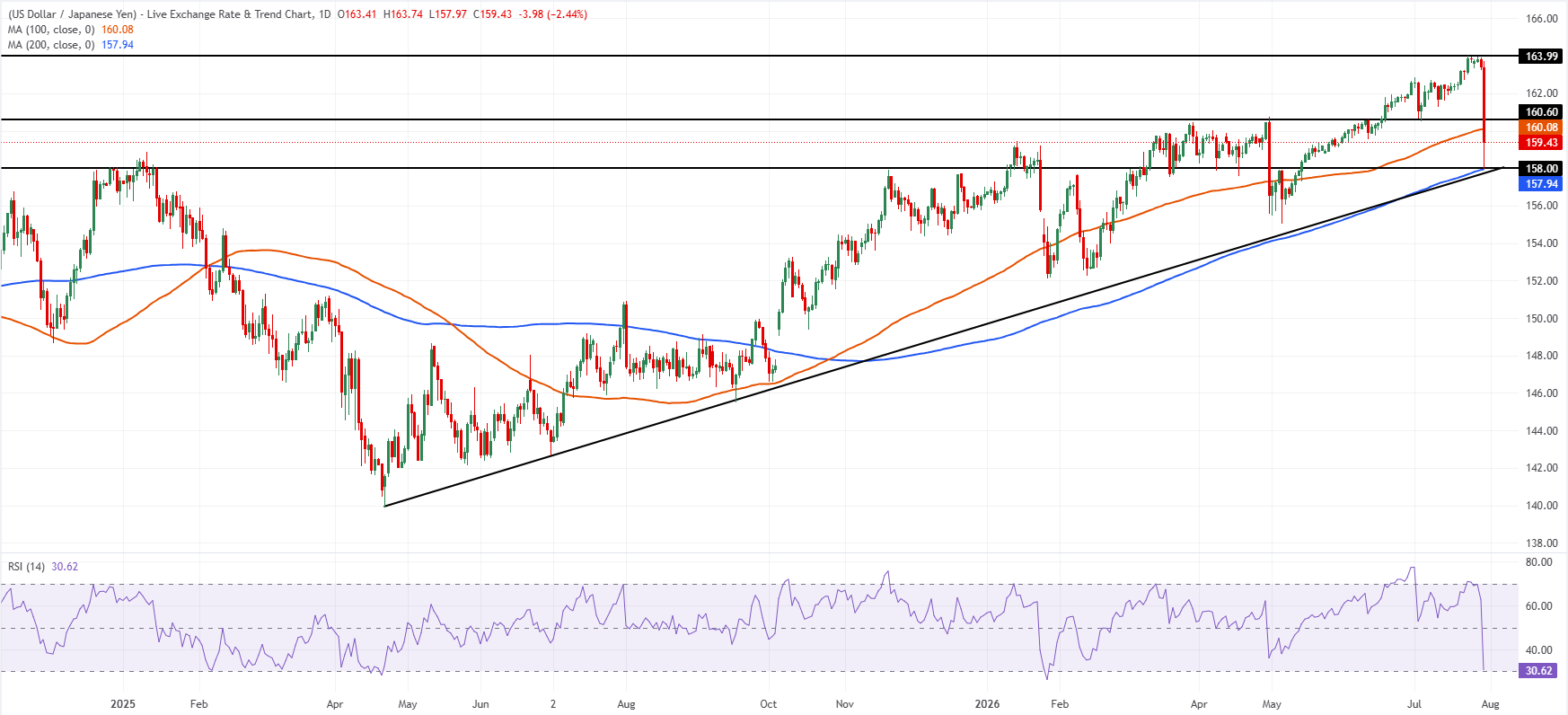
In the daily chart, USD/JPY trades just under the 100-day Simple Moving Average (SMA) at 160.08, which caps the topside and keeps the near-term bias slightly bearish despite the broader uptrend. Price holds above a dense support area defined by the horizontal floor around 158.00, the rising 200-day SMA at 157.94 and the uptrend support around 157.77, suggesting downside attempts could initially stall in this region. The Relative Strength Index (RSI) has slipped toward 30, hinting at emerging oversold conditions that may temper selling pressure but not yet imply a decisive bullish reversal while the pair trades below the 100-day SMA.
On the topside, immediate resistance is seen at the 100-day SMA at 160.08, followed by the horizontal barrier around 160.60, while a more distant hurdle emerges at the cycle high at 163.99, which would come into play on a sustained recovery. On the downside, the first area to watch is the current pivot zone around 159.43, with further support aligning at 158.00, backed by the 200-day SMA near 157.94 and the trend-line support at 157.77. A daily close below this cluster would reinforce the bearish tone and open the door to a deeper corrective phase.
Economic Indicator
BoJ Interest Rate Decision
The Bank of Japan (BoJ) announces its interest rate decision after each of the Bank’s eight scheduled annual meetings. Generally, if the BoJ is hawkish about the inflationary outlook of the economy and raises interest rates it is bullish for the Japanese Yen (JPY). Likewise, if the BoJ has a dovish view on the Japanese economy and keeps interest rates unchanged, or cuts them, it is usually bearish for JPY.
Read more.Next release: Fri Jul 31, 2026 03:00
Frequency: Irregular
Consensus: 1%
Previous: 1%
Source: Bank of Japan
Japanese Yen FAQs
The Japanese Yen (JPY) is one of the world’s most traded currencies. Its value is broadly determined by the performance of the Japanese economy, but more specifically by the Bank of Japan’s policy, the differential between Japanese and US bond yields, or risk sentiment among traders, among other factors.
One of the Bank of Japan’s mandates is currency control, so its moves are key for the Yen. The BoJ has directly intervened in currency markets sometimes, generally to lower the value of the Yen, although it refrains from doing it often due to political concerns of its main trading partners. The BoJ ultra-loose monetary policy between 2013 and 2024 caused the Yen to depreciate against its main currency peers due to an increasing policy divergence between the Bank of Japan and other main central banks. More recently, the gradually unwinding of this ultra-loose policy has given some support to the Yen.
Over the last decade, the BoJ’s stance of sticking to ultra-loose monetary policy has led to a widening policy divergence with other central banks, particularly with the US Federal Reserve. This supported a widening of the differential between the 10-year US and Japanese bonds, which favored the US Dollar against the Japanese Yen. The BoJ decision in 2024 to gradually abandon the ultra-loose policy, coupled with interest-rate cuts in other major central banks, is narrowing this differential.
The Japanese Yen is often seen as a safe-haven investment. This means that in times of market stress, investors are more likely to put their money in the Japanese currency due to its supposed reliability and stability. Turbulent times are likely to strengthen the Yen’s value against other currencies seen as more risky to invest in.













