
News & AnalysisCareer

Inflation risks remain skewed to the upside, Bank of Mexico (Banxico) Deputy Governor Jonathan Heath stressed in an exclusive Reuters interview. He said the Mexican central bank’s latest interest rate cut “confuses and sends the wrong message” to financial markets.
Recent rate reductions make it more likely that inflation will fail to return to Banxico’s 3% target, Heath added. He also warned that forward guidance signalling an extended hold in rates leaves less room for manoeuvre should further tightening be required.
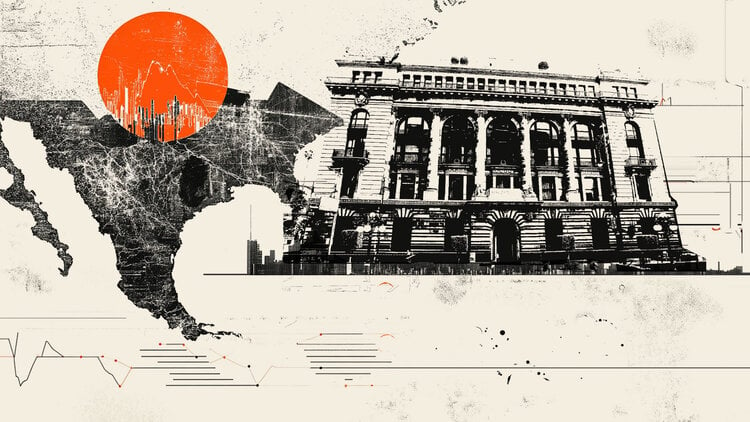
With inflation on an upward trend, he says the latest cut in the key interest rate “Confuses and sends the wrong message”.
The latest rate reduction makes a return to the 3% inflation target by end-2027 less likely.
By signalling that rates will remain unchanged for an extended period, the bank limits its room for manoeuvre, particularly for increases that may be necessary if inflation fails to ease or the US Fed continues to raise its rate.
A fall in the interest rate differential between the Fed and Banxico below 200 basis points, if the US Fed raises rates at its forthcoming meetings, would be “Dangerous and irresponsible”.
Understanding in depth why the bank has failed to bring inflation back to 3% and keep it there remains the most important outstanding task.
As Mexico’s central bank, the Bank of Mexico, or Banxico, sets monetary policy and is tasked with safeguarding the value of the national currency, the Mexican Peso (MXN). Its principal aim is therefore to keep inflation low and stable within its target range. The bank targets inflation at or near 3%, the midpoint of a tolerance band running from 2% to 4%.
Setting interest rates is Banxico’s primary monetary policy tool. To curb above-target inflation, the bank raises rates, increasing borrowing costs for households and businesses and thereby slowing economic activity. By lifting yields, higher rates generally support the Mexican Peso (MXN) and make Mexico more attractive to investors. Lower rates, by contrast, tend to put pressure on MXN. A crucial consideration is the interest rate differential with the USD, including expectations for Banxico’s rate decisions relative to those of the US Federal Reserve (Fed).
Decisions by the US Federal Reserve (Fed) have a strong influence on Banxico’s monetary policy. The Mexican central bank holds eight meetings each year, with its policy committee usually convening a week after the Fed. This allows Banxico to respond to Federal Reserve policy measures and, at times, anticipate them. Following the Covid-19 pandemic, for instance, Banxico began raising rates ahead of the Fed. Its aim was to reduce the risk of a sharp depreciation in the Mexican Peso (MXN) and avert capital outflows that could destabilise the country.










The information provided on this website is of a general nature only and does not constitute personal financial advice. Before acting on any information on this website, you should consider the suitability of the information in relation to your objectives, financial situation and needs. Investing in CFDs and FX Margin Contracts carries significant risks and is not suitable for all investors. You may lose more than your initial deposit. You do not own, or have, any interest in the underlying asset. We recommend that you seek independent advice and ensure you fully understand the risks involved before trading. It is important that you read and consider the disclosure document before you acquire any product listed on the website. The information and advertisements offered on this website are not intended for use by any person in any country or jurisdiction where such use would be contrary to local laws and regulations. The Products and Services offered on this website are not intended for residents of the United States, Malaysia and Thailand.
TMGM is authorized and regulated in various jurisdictions.
Trademax Australia Limited, trading as TMGM, is regulated by the Australian Securities and Investments Commission (ASIC), AFSL no. 436416 and is located at Level 28, One International Tower, 100 Barangaroo Avenue, 2000 Sydney, NSW Australia.
Email: support@tmgm.com.au
Trademax Global Limited, trading as TMGM, is authorized and regulated by the Vanuatu Financial Services Commission (VFSC), registration number 40356 and registered at 1276, Kumul Highway, Port Vila, Vanuatu, Republic of Vanuatu.
Email: support@tmgm.com
Trademax Global Markets (SE) Limited, trading as TMGM, is authorized and regulated by the Financial Services Authority (FSA) of Seychelles, with license number SD224. The company is registered at Office No 13, Providence Estate ABIS Centre, Mahe, Seychelles.
Email: support@tmgm.com
Trademax Global Markets (International) Pty Ltd, trading as TMGM, is authorized and regulated by the Financial Services Commission, Mauritius (FSC) with license no. GB22201012, and registered at 33, Edith Cavell Street C/o IQ EQ Fund Services (Mauritius) Ltd Port Louis, 11324 Mauritius.
Email: support@tmgm.com
Copyright © TMGM. All rights reserved


