
News & AnalysisCareer

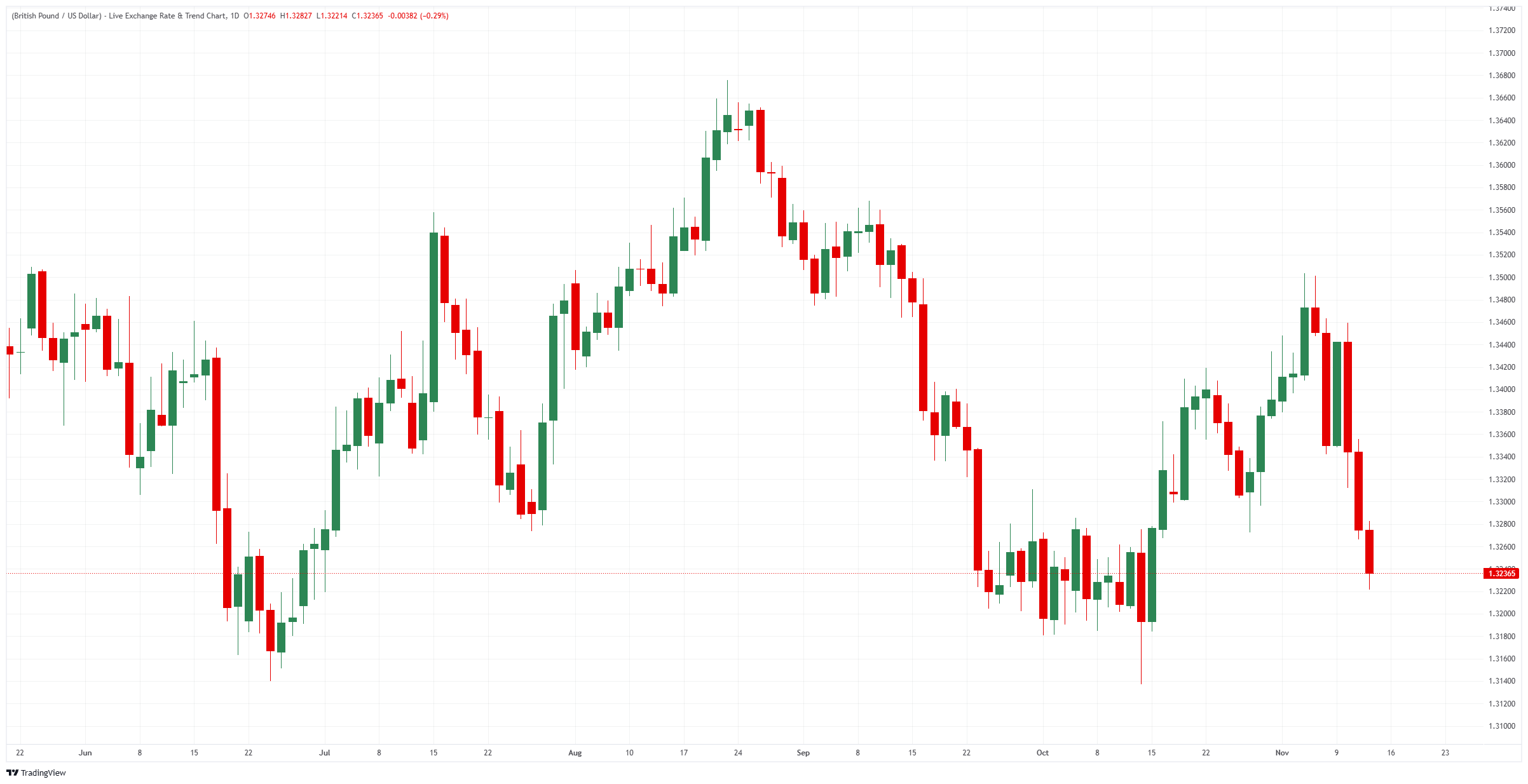
Stronger UK growth has failed to prevent a third consecutive daily decline in the Pound against the Dollar, with markets fully pricing in a December Fed rate rise. From a close just below 1.3450 on Monday, GBP/USD has retreated to around 1.3250. The low reached on Thursday marks the pair’s weakest level since 15 October.

Released on 10 November, October’s US inflation figures exceeded expectations. Futures now assign roughly a 90% probability to a quarter-point Fed rate rise on 9 December, with the remaining probability attached to a half-point increase. Speaking on Thursday, Cleveland Fed President Hammack said monetary policy needed to become restrictive, while opposing a half-point rise. At 4.00%, UK Bank Rate matches the upper end of the Fed’s 3.75%-4.00% range. A Fed increase without a corresponding move from the Bank of England (BoE) would therefore take US rates above those in the UK.
Third-quarter UK Gross Domestic Product (GDP) growth accelerated from 0.5% to 0.7%, in line with expectations, while September’s 0.2% increase surpassed a forecast for no growth. Of the five UK releases on Thursday, three exceeded forecasts and two met them, yet GBP/USD subsequently reached a four-week low. An 8-1 vote on 5 November took the BoE’s rate to 4.00%, with the sole dissenter favouring a half-point increase. Markets price in a probability of nearly 80% for a second rise on 17 December.
At 07:00 GMT on Tuesday, 17 November, the UK releases employment figures, following previous readings of 4.7% for unemployment and 3.7% for pay growth excluding bonuses. The next day, Wednesday, 18 November, October inflation is due at 07:00 GMT, following September’s 3.5% reading. Both releases precede the BoE’s decision on 17 December.
Friday’s US producer price figures for October are scheduled for 13:30 GMT. The core monthly increase is forecast at 0.3%, down from 0.7%. At 19:00 GMT on Wednesday, 18 November, minutes from the Fed’s October meeting will provide further insight into whether the 9 December rate rise will be a quarter-point or a half-point.
Around three-quarters of the advance from the 14 October low near 1.3150 to the 1.3500 highs on 4 and 5 November has been erased by the three-day decline. GBP/USD is also back within the 1.3200-1.3300 range that contained trading from late September to mid-October. Over the past six sessions, Monday’s rebound was the sole daily gain.
Dating back to 886 AD, the Pound Sterling (GBP) is the world’s oldest currency and serves as the official currency of the United Kingdom. According to 2022 figures, it ranks fourth globally in foreign exchange (FX) trading, representing 12% of all transactions and an average daily turnover of $630 billion. Among its principal pairs, GBP/USD, also called ‘Cable’, represents 11% of FX trading. GBP/JPY, known to traders as the ‘Dragon’, accounts for 3%, while EUR/GBP accounts for 2%. The Bank of England (BoE) issues the Pound Sterling.
Monetary policy set by the Bank of England is the most important influence on the Pound Sterling’s value. Decisions hinge on whether the BoE has met its central objective of “price stability”, meaning inflation holding at around 2%. Changes to interest rates are its main means of achieving that objective. To curb excessive inflation, the BoE seeks to raise borrowing costs for households and businesses by increasing interest rates. GBP generally benefits because higher rates make the UK a more appealing destination for international investors’ funds. By contrast, inflation that falls too low signals a slowdown in economic growth. The BoE will then consider cutting interest rates to reduce the cost of credit, encouraging businesses to borrow more and invest in projects that generate growth.
The economy’s health is reflected in data releases, which can affect the Pound Sterling’s value. GDP, Manufacturing and Services PMIs, and employment figures are among the indicators capable of moving GBP. Sterling benefits from economic strength, which attracts additional overseas investment and may prompt the BoE to raise interest rates, directly strengthening GBP. Weak economic figures, by contrast, are likely to weigh on the Pound Sterling.
For the Pound Sterling, the Trade Balance is another important economic release. It records the gap between a country’s export earnings and its expenditure on imports during a specified period. Strong overseas demand for a country’s exports creates additional demand for its currency as foreign buyers seek to purchase those goods. A positive net Trade Balance consequently supports the currency, while a negative balance has the opposite effect.










The information provided on this website is of a general nature only and does not constitute personal financial advice. Before acting on any information on this website, you should consider the suitability of the information in relation to your objectives, financial situation and needs. Investing in CFDs and FX Margin Contracts carries significant risks and is not suitable for all investors. You may lose more than your initial deposit. You do not own, or have, any interest in the underlying asset. We recommend that you seek independent advice and ensure you fully understand the risks involved before trading. It is important that you read and consider the disclosure document before you acquire any product listed on the website. The information and advertisements offered on this website are not intended for use by any person in any country or jurisdiction where such use would be contrary to local laws and regulations. The Products and Services offered on this website are not intended for residents of the United States, Malaysia and Thailand.
TMGM is authorized and regulated in various jurisdictions.
Trademax Australia Limited, trading as TMGM, is regulated by the Australian Securities and Investments Commission (ASIC), AFSL no. 436416 and is located at Level 28, One International Tower, 100 Barangaroo Avenue, 2000 Sydney, NSW Australia.
Email: support@tmgm.com.au
Trademax Global Limited, trading as TMGM, is authorized and regulated by the Vanuatu Financial Services Commission (VFSC), registration number 40356 and registered at 1276, Kumul Highway, Port Vila, Vanuatu, Republic of Vanuatu.
Email: support@tmgm.com
Trademax Global Markets (SE) Limited, trading as TMGM, is authorized and regulated by the Financial Services Authority (FSA) of Seychelles, with license number SD224. The company is registered at Office No 13, Providence Estate ABIS Centre, Mahe, Seychelles.
Email: support@tmgm.com
Trademax Global Markets (International) Pty Ltd, trading as TMGM, is authorized and regulated by the Financial Services Commission, Mauritius (FSC) with license no. GB22201012, and registered at 33, Edith Cavell Street C/o IQ EQ Fund Services (Mauritius) Ltd Port Louis, 11324 Mauritius.
Email: support@tmgm.com
Copyright © TMGM. All rights reserved


