
News & AnalysisCareer

At around $0.0650 on Thursday, Dogecoin (DOGE) is trading lower as sellers strengthen their hold. Further losses remain the path of least resistance for the largest meme coin by market capitalisation, as well as for leading cryptocurrencies Bitcoin (BTC), Ethereum (ETH) and Ripple (XRP).
A daily fall of about 2.6% has brought DOGE back to levels last recorded in October 2023. Behind the bearish outlook is a sustained deterioration in technical conditions, with subdued momentum indicators and falling moving averages.
Across the wider market, the $6.3 billion Binance hack has weighed on prices as interest in crypto-related investment products has suffered a sharp setback recently. Thursday's crypto Fear and Greed Index reading of 28 remained in Fear territory, only marginally below the previous day's 29, dampening appetite for risk.
Average perpetual futures Open Interest (OI) fell to $888 million on Thursday from $923 million the previous day, highlighting a marked deterioration in Dogecoin's derivatives market.
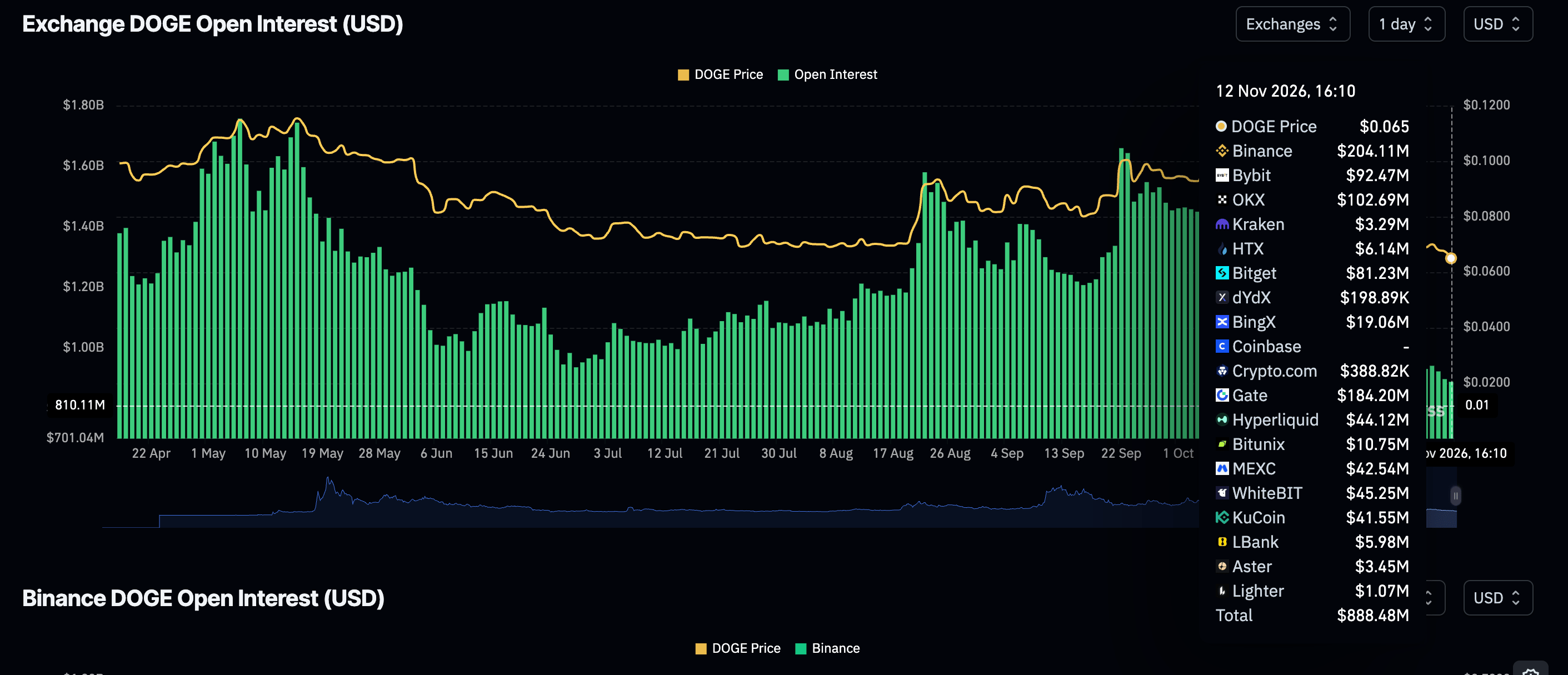
Measured by the notional value of unsettled futures contracts, OI had reached $1 billion on 1 November and $1.5 billion on 1 October. Its decline alongside Dogecoin's price suggests a sustained loss of investor interest.
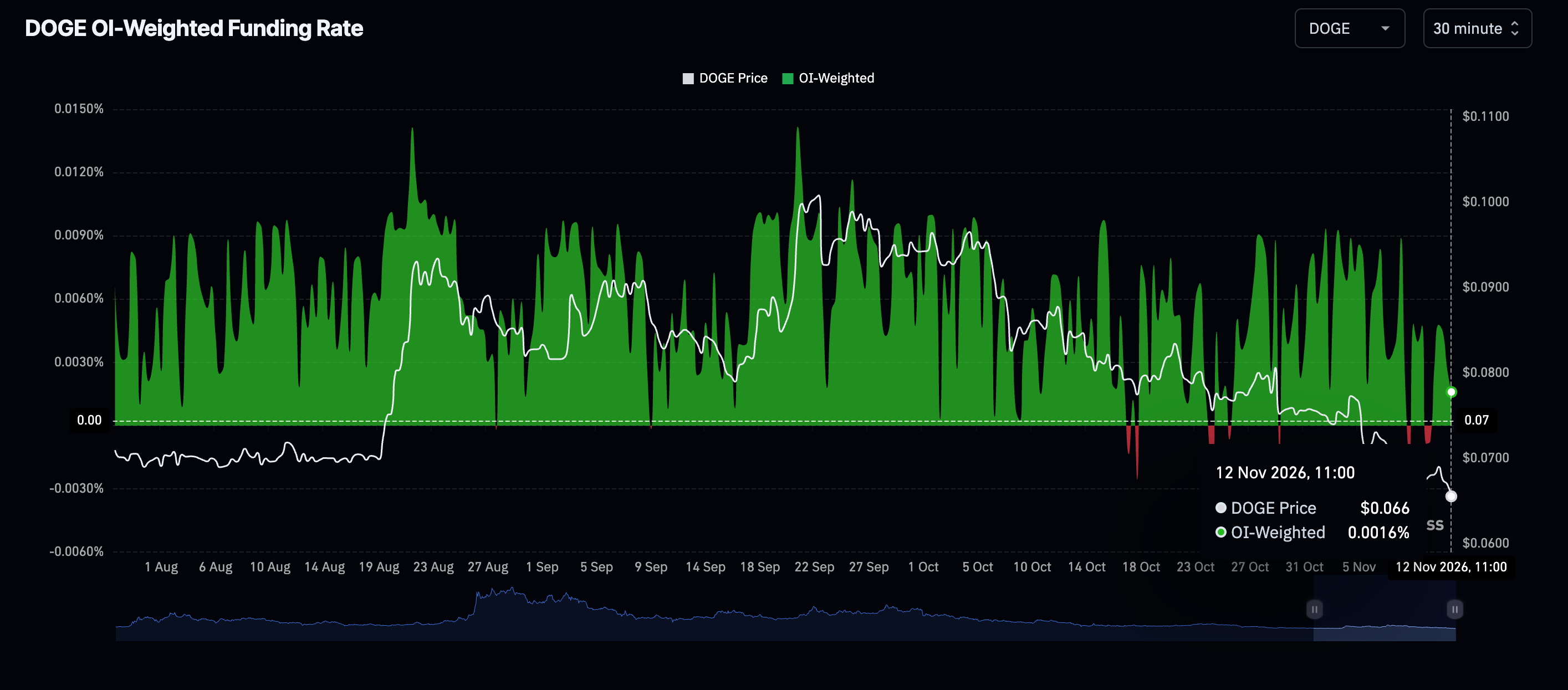
In contrast, a positive OI-weighted funding rate of 0.0016% indicates that Dogecoin traders holding long positions remain prepared to pay a premium to maintain them. Should DOGE stay above short-term support at $0.0640, traders may therefore add to their exposure, improving the prospects for a recovery.
At $0.0648, Dogecoin remains well beneath all its key Exponential Moving Averages (EMAs) as its decline continues, strengthening the near-term bearish outlook. Successive layers of trend resistance sit at the 50-day EMA of $0.0784, the 100-day EMA of $0.0812 and the 200-day EMA of $0.0885. Meanwhile, the SuperTrend level of $0.0769 constrains attempts to recover.
An oversold Relative Strength Index (RSI) reading of 27 underscores the weak momentum. The Moving Average Convergence Divergence (MACD) is also below zero and showing a bearish crossover, pointing to continued selling pressure, although brief corrective rebounds remain possible for the pair.
Any rebound would first encounter the SuperTrend resistance around $0.0769, before reaching the 50-day EMA at $0.0784 and the 100-day EMA at $0.0812, where further gains would likely prove difficult. Beyond those levels, the 200-day EMA near $0.0885 presents a more substantial obstacle. A move back above it would be needed to ease the broader bearish structure.
Immediate structural support sits around the current price of $0.0648, with a decisive break below this zone opening the way to further losses. While the price remains beneath the cluster of EMA and SuperTrend resistance levels, the oversold RSI and negative MACD suggest that any relief rally from this area could be limited.
(The technical analysis of this story was written with the help of an AI tool. Know more.)
An increase in Open Interest is linked to greater liquidity and fresh capital entering the market. This is viewed as an improvement in efficiency that supports the continuation of the prevailing trend. By contrast, falling Open Interest is regarded as evidence of liquidation: investors are exiting the market and overall demand for the asset is declining, encouraging bearish sentiment.
By increasing traders' liquidation risk, funding fees help close the gap between an asset's spot price and its futures contract prices. When the funding rate remains high and positive, it signals bullish sentiment among market participants and expectations of a price rise. A persistently negative funding rate, on the other hand, points to bearish sentiment: traders anticipate a fall in the cryptocurrency's price, and a bearish trend reversal is likely.










The information provided on this website is of a general nature only and does not constitute personal financial advice. Before acting on any information on this website, you should consider the suitability of the information in relation to your objectives, financial situation and needs. Investing in CFDs and FX Margin Contracts carries significant risks and is not suitable for all investors. You may lose more than your initial deposit. You do not own, or have, any interest in the underlying asset. We recommend that you seek independent advice and ensure you fully understand the risks involved before trading. It is important that you read and consider the disclosure document before you acquire any product listed on the website. The information and advertisements offered on this website are not intended for use by any person in any country or jurisdiction where such use would be contrary to local laws and regulations. The Products and Services offered on this website are not intended for residents of the United States, Malaysia and Thailand.
TMGM is authorized and regulated in various jurisdictions.
Trademax Australia Limited, trading as TMGM, is regulated by the Australian Securities and Investments Commission (ASIC), AFSL no. 436416 and is located at Level 28, One International Tower, 100 Barangaroo Avenue, 2000 Sydney, NSW Australia.
Email: support@tmgm.com.au
Trademax Global Limited, trading as TMGM, is authorized and regulated by the Vanuatu Financial Services Commission (VFSC), registration number 40356 and registered at 1276, Kumul Highway, Port Vila, Vanuatu, Republic of Vanuatu.
Email: support@tmgm.com
Trademax Global Markets (SE) Limited, trading as TMGM, is authorized and regulated by the Financial Services Authority (FSA) of Seychelles, with license number SD224. The company is registered at Office No 13, Providence Estate ABIS Centre, Mahe, Seychelles.
Email: support@tmgm.com
Trademax Global Markets (International) Pty Ltd, trading as TMGM, is authorized and regulated by the Financial Services Commission, Mauritius (FSC) with license no. GB22201012, and registered at 33, Edith Cavell Street C/o IQ EQ Fund Services (Mauritius) Ltd Port Louis, 11324 Mauritius.
Email: support@tmgm.com
Copyright © TMGM. All rights reserved


