
News & AnalysisCareer

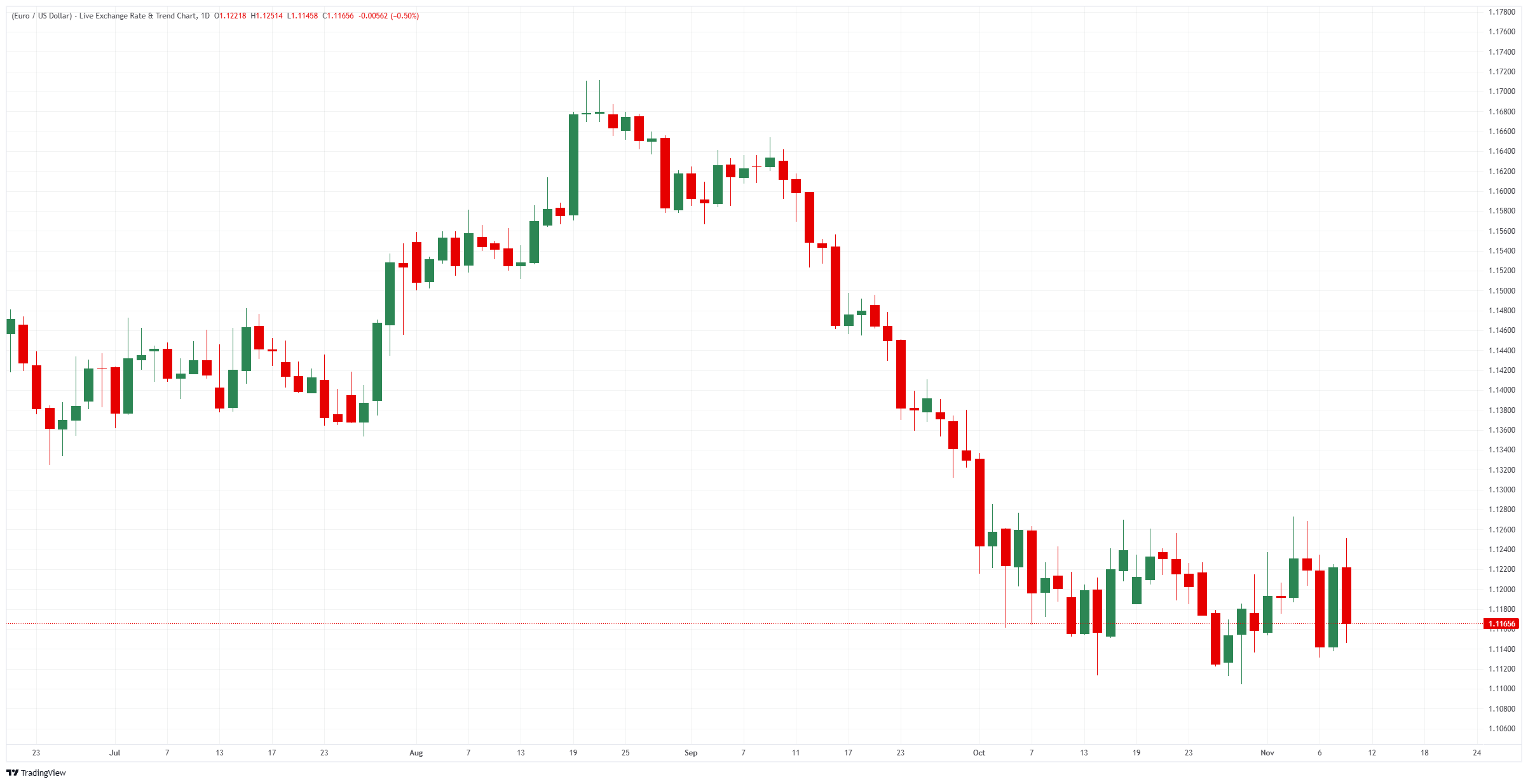
Stronger-than-forecast US consumer prices have left the Euro in the lower half of the 1.1100-1.1300 trading range it has occupied for five weeks. After slipping just below 1.1150 and surrendering almost all of Monday’s advance, the currency has edged back above that level.
October’s core US consumer prices increased by 0.3%, exceeding the 0.2% forecast. With Dallas Fed President Logan calling for two further quarter-point rate rises before a pause, traders assign roughly a 74% probability to a second increase by January. Unless the European Central Bank (ECB) also raises rates, those two moves would leave US rates 1.75-2.00 percentage points above its 2.50% deposit rate.

While two Fed officials specified the size of their prospective rate moves, ECB Chief Economist Lane said he would require a high threshold to be met before signalling the next direction for ECB rates. Following a three-year high of 4% for Eurozone inflation in October, money markets are pricing in two ECB increases by mid-2027. Those moves would reduce the rate differential for the Euro.
Wednesday’s appearance by ECB President Lagarde is scheduled for 09:45 GMT, followed by another on Thursday at 19:30 GMT. ECB Executive Board member Schnabel is due to speak on Friday at 07:10 GMT. The updated third-quarter Eurozone Gross Domestic Product (GDP) figures follow on Friday at 10:00 GMT, with growth forecast at 0.4%, unchanged from the initial estimate. Both the GDP release and ECB President Lagarde’s comments will help shape the question of whether the ECB also raises rates in December.
Thursday’s US schedule includes a speech at 14:00 GMT by Cleveland Fed President Hammack, who holds a vote this year. Attention then turns to Friday’s core producer price release at 13:30 GMT: the annual rate is expected to remain at September’s 5%, while a Fed rate increase on 9 December is already priced in.
A decline of about 5% from the late-August peak near 1.1700 preceded the Euro’s entry into its current range. Repeated attempts to approach the upper boundary have ended in reversals, most recently on 5 November. At the lower end, the lows recorded on 14 October and 29 October stayed just above the range floor.
Used by the 20 European Union countries within the Eurozone, the Euro ranks second only to the US Dollar among the world’s most traded currencies. Its share of all foreign exchange transactions reached 31% in 2022, with average daily turnover exceeding $2.2 trillion. An estimated 30% of all transactions involve EUR/USD, making it the world’s most actively traded currency pair. Next come EUR/JPY (4%), EUR/GBP (3%) and EUR/AUD (2%).
Based in Frankfurt, Germany, the European Central Bank (ECB) acts as the Eurozone’s reserve bank, setting interest rates and overseeing monetary policy. Maintaining price stability is its principal mandate, whether through containing inflation or supporting growth. Changes to interest rates are its main policy instrument. Higher relative rates, or expectations that rates will rise, generally support the Euro; the reverse also applies. Monetary policy is decided by the ECB Governing Council at eight meetings each year. The decision-makers comprise the heads of the Eurozone’s national central banks and six permanent members, among them ECB President Christine Lagarde.
Measured by the Harmonised Index of Consumer Prices (HICP), Eurozone inflation is a key economic indicator for the Euro. An unexpectedly strong rise in inflation, particularly beyond the ECB’s 2% target, requires the central bank to increase interest rates to regain control of price pressures. When rates exceed those in comparable economies, the Euro generally benefits: higher returns make the region a more appealing destination for global investors’ funds.
By revealing the state of the economy, data releases can move the Euro. GDP, manufacturing and services PMIs, employment figures and consumer sentiment surveys are among the indicators that can steer the single currency. Economic strength supports the Euro by drawing in foreign investment and potentially prompting the ECB to raise interest rates, which directly strengthens the currency. Conversely, weak figures are likely to weigh on the Euro. Particular attention is paid to Germany, France, Italy and Spain. As the euro area’s four largest economies, they represent 75% of the Eurozone economy, making their data especially important.
The trade balance is another release of importance to the Euro, recording the difference between a country’s export earnings and its import expenditure over a specified period. Strong overseas demand for a country’s exports generates additional demand for its currency as foreign buyers seek to purchase those goods, lifting the currency’s value. A positive net trade balance therefore supports a currency, whereas a negative balance has the opposite effect.










The information provided on this website is of a general nature only and does not constitute personal financial advice. Before acting on any information on this website, you should consider the suitability of the information in relation to your objectives, financial situation and needs. Investing in CFDs and FX Margin Contracts carries significant risks and is not suitable for all investors. You may lose more than your initial deposit. You do not own, or have, any interest in the underlying asset. We recommend that you seek independent advice and ensure you fully understand the risks involved before trading. It is important that you read and consider the disclosure document before you acquire any product listed on the website. The information and advertisements offered on this website are not intended for use by any person in any country or jurisdiction where such use would be contrary to local laws and regulations. The Products and Services offered on this website are not intended for residents of the United States, Malaysia and Thailand.
TMGM is authorized and regulated in various jurisdictions.
Trademax Australia Limited, trading as TMGM, is regulated by the Australian Securities and Investments Commission (ASIC), AFSL no. 436416 and is located at Level 28, One International Tower, 100 Barangaroo Avenue, 2000 Sydney, NSW Australia.
Email: support@tmgm.com.au
Trademax Global Limited, trading as TMGM, is authorized and regulated by the Vanuatu Financial Services Commission (VFSC), registration number 40356 and registered at 1276, Kumul Highway, Port Vila, Vanuatu, Republic of Vanuatu.
Email: support@tmgm.com
Trademax Global Markets (SE) Limited, trading as TMGM, is authorized and regulated by the Financial Services Authority (FSA) of Seychelles, with license number SD224. The company is registered at Office No 13, Providence Estate ABIS Centre, Mahe, Seychelles.
Email: support@tmgm.com
Trademax Global Markets (International) Pty Ltd, trading as TMGM, is authorized and regulated by the Financial Services Commission, Mauritius (FSC) with license no. GB22201012, and registered at 33, Edith Cavell Street C/o IQ EQ Fund Services (Mauritius) Ltd Port Louis, 11324 Mauritius.
Email: support@tmgm.com
Copyright © TMGM. All rights reserved


