
News & AnalysisCareer

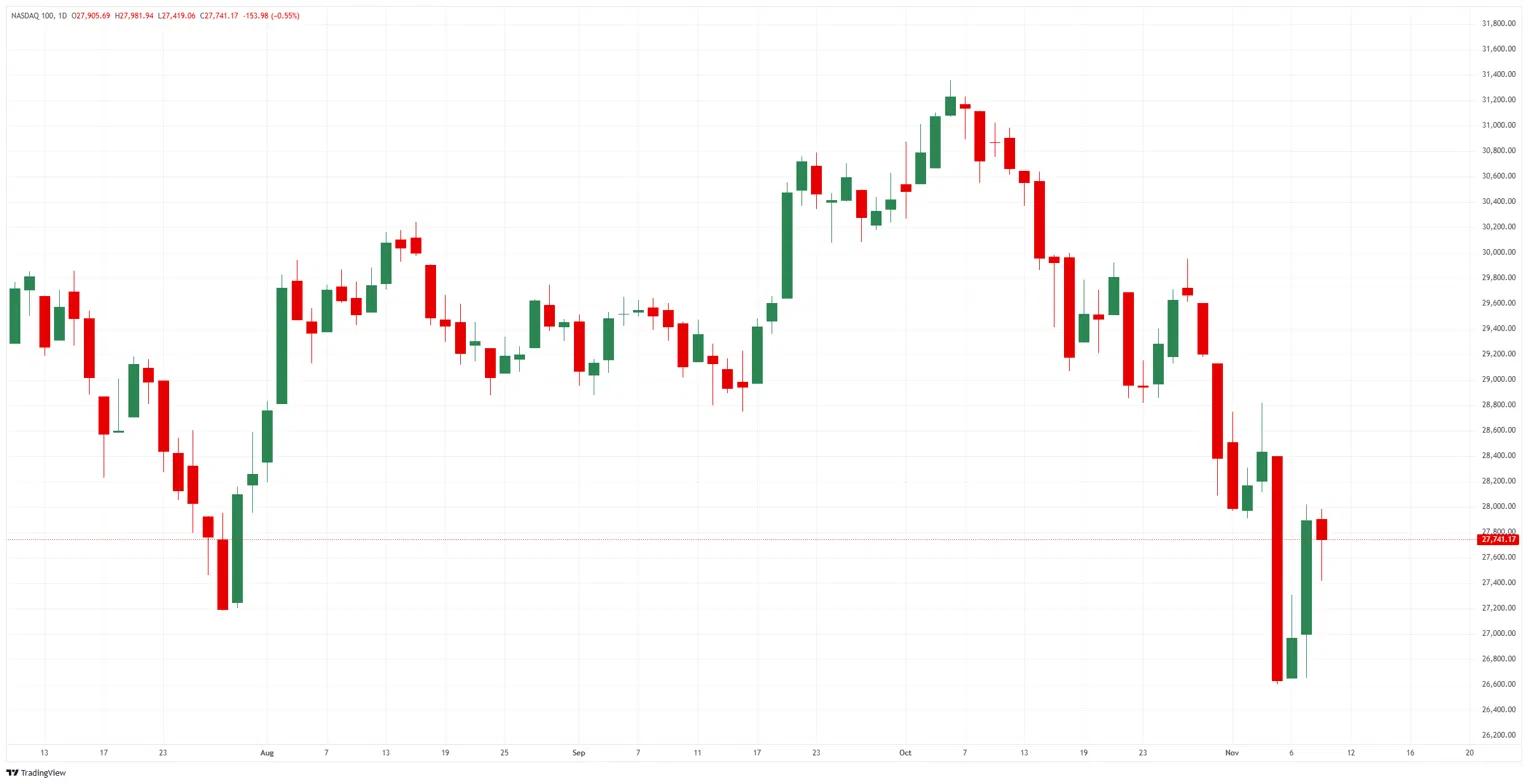
A stronger-than-expected October Consumer Price Index (CPI), alongside discussion of a half-point Fed rate rise, has erased roughly a sixth of Monday's recovery across all three US share indices. Having surrendered about half of Monday's advance and touched an intraday low just above 27,400, the Nasdaq 100 is trading near 27,750 again. Meanwhile, levels are around 7,525 for the S&P 500 and 52,250 for the Dow Jones Industrial Average.

October's 0.4% increase in consumer prices exceeded the 0.3% forecast. Fed Governor Waller had previously suggested that an overshoot of this kind could warrant a half-point rate rise in December. No annual inflation rate accompanied the figures because the 2025 government shutdown left October 2025 without a reading. The annual measure returns on December 10, the day after the Fed's decision. With the 10-year Treasury yield once again above 5%, equity buyers are paying less for future earnings as yields rise.
Having trailed Monday's rally, Nvidia (NVDA), the world's most valuable company, is now declining and weighing on all three indices. Its retreat comes after Chief Executive Jensen Huang acknowledged an affair with a woman accused of spying for China. The NASDAQ 100 is recording the largest fall of the three, reflecting its greater weighting in semiconductor shares.
Tuesday brings speeches from Fed Vice Chair for Supervision Bowman and Philadelphia Fed President Paulson at 23:30 GMT, followed by Cleveland Fed President Hammack at 14:00 GMT on Thursday. Each has a vote on the December 8-9 decision. With traders regarding a rate rise as almost certain, their remarks will help inform expectations for its size.
Thursday's weekly jobless claims release is scheduled for 13:30 GMT, with 195K expected against the previous 189K. At 13:30 GMT on Friday, October producer prices will provide the next inflation reading relevant to a half-point increase. A 0.4% rise is forecast, following September's 1.3% jump.
Roughly a quarter of the NASDAQ 100's decline from its October 6 peak near 31,350 has now been recovered. For the S&P 500, the rebound from the November 6 low around 7,325 has covered about two-fifths of the distance to October's high just below 7,850. Since mid-September, the Dow Jones Industrial Average has remained within a 50,500-53,800 range and is currently close to its midpoint.
Based in the US, the Nasdaq began as an electronic system displaying share price quotations rather than as a stock exchange. Initially, its quotations covered only over-the-counter (OTC) shares; it subsequently became an exchange as well. Its share of the total US securities market had reached 46% by 1991. In 1998, the Nasdaq became the first US stock exchange to offer online trading. It also compiles several indices, including the Nasdaq 100 and its broadest measure, the Nasdaq Composite, which represents all 2,500-plus shares listed on the Nasdaq.
Comprising 100 non-financial businesses listed on the Nasdaq stock exchange, the Nasdaq 100 is an index of large-cap companies. These constituents represent only a small proportion of the thousands of Nasdaq-listed shares, yet account for more than 90% of the movement. Each company's influence is weighted according to its market capitalisation. Technology businesses feature prominently, alongside companies in other sectors and those based outside the US. Since 1986, the Nasdaq 100 has delivered an average annual return of 17.23%.
Traders can gain exposure to the Nasdaq 100 through several instruments. Contracts for difference (CFDs) are available through most retail brokers and spread betting platforms. For investors with a longer time horizon, exchange-traded funds (ETFs) offer share-like trading while tracking the index, removing the need to purchase shares in all 100 constituent companies. The Invesco QQQ Trust (QQQ) is one such ETF. Futures contracts on the Nasdaq 100 enable speculation on the index's future direction, while options give holders the right, without an obligation, to buy or sell the Nasdaq 100 at a specified future price, known as the strike price.
Although numerous influences affect the Nasdaq 100, the combined performance of its constituents, as reported in quarterly and annual earnings releases, is the principal driver. Economic data from the US and elsewhere also shapes investor sentiment, with positive sentiment supporting gains. Interest rates set by the Federal Reserve (Fed) are another influence: they determine borrowing costs for the many corporations that depend heavily on credit. Inflation can therefore be a significant driver, alongside other indicators that shape the Fed's decisions.










The information provided on this website is of a general nature only and does not constitute personal financial advice. Before acting on any information on this website, you should consider the suitability of the information in relation to your objectives, financial situation and needs. Investing in CFDs and FX Margin Contracts carries significant risks and is not suitable for all investors. You may lose more than your initial deposit. You do not own, or have, any interest in the underlying asset. We recommend that you seek independent advice and ensure you fully understand the risks involved before trading. It is important that you read and consider the disclosure document before you acquire any product listed on the website. The information and advertisements offered on this website are not intended for use by any person in any country or jurisdiction where such use would be contrary to local laws and regulations. The Products and Services offered on this website are not intended for residents of the United States, Malaysia and Thailand.
TMGM is authorized and regulated in various jurisdictions.
Trademax Australia Limited, trading as TMGM, is regulated by the Australian Securities and Investments Commission (ASIC), AFSL no. 436416 and is located at Level 28, One International Tower, 100 Barangaroo Avenue, 2000 Sydney, NSW Australia.
Email: support@tmgm.com.au
Trademax Global Limited, trading as TMGM, is authorized and regulated by the Vanuatu Financial Services Commission (VFSC), registration number 40356 and registered at 1276, Kumul Highway, Port Vila, Vanuatu, Republic of Vanuatu.
Email: support@tmgm.com
Trademax Global Markets (SE) Limited, trading as TMGM, is authorized and regulated by the Financial Services Authority (FSA) of Seychelles, with license number SD224. The company is registered at Office No 13, Providence Estate ABIS Centre, Mahe, Seychelles.
Email: support@tmgm.com
Trademax Global Markets (International) Pty Ltd, trading as TMGM, is authorized and regulated by the Financial Services Commission, Mauritius (FSC) with license no. GB22201012, and registered at 33, Edith Cavell Street C/o IQ EQ Fund Services (Mauritius) Ltd Port Louis, 11324 Mauritius.
Email: support@tmgm.com
Copyright © TMGM. All rights reserved


