
News & AnalysisCareer

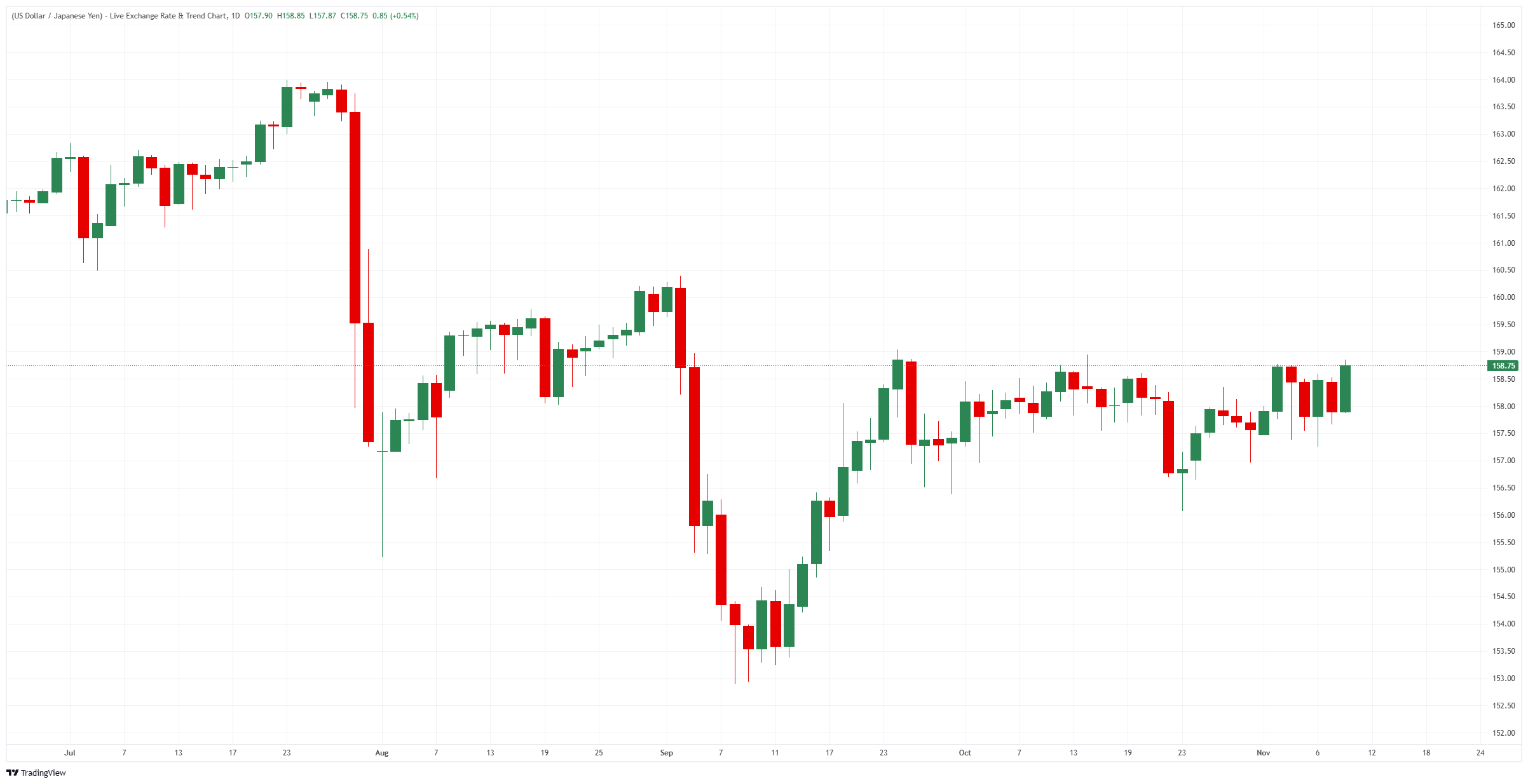
A 5% annual payment on new US 10-year notes sold on Tuesday marks the highest since 2006, while the Yen has weakened to its lowest against the Dollar since mid-October. Climbing to just below 159.00 Yen, the Dollar has more than recovered Monday’s decline and regained ground above Friday’s close.

October’s consumer price data indicate that inflationary pressures may endure and inflation is not trending downwards, according to Fed Vice Chair for Supervision Bowman. At 3.75%-4.00%, the Fed’s rate range stands 2.50-2.75 percentage points above the Bank of Japan (BoJ) rate of 1.25%. A Dollar deposit therefore offers roughly that much more than a Yen deposit.
Despite broad agreement among members that rates should rise further, as shown in Tuesday’s summary of the BoJ’s October meeting, the Yen continued to weaken. A BoJ increase to 1.50%, expected on 18 December, would follow a Fed move to 4.00%-4.25% nine days earlier. The rate differential would consequently remain unchanged.
At 13:30 GMT on Thursday, US weekly jobless claims are forecast at 195K, compared with 189K. October’s producer price release follows on Friday at 13:30 GMT, with annual growth expected to rise to 6.6% from 6.3%. Both releases have implications for how far US interest rates rise above those in Japan.
An annual increase of 6.5%, following 6.8%, is forecast for Japan’s October producer prices, due on Wednesday at 23:50 GMT. The release is among Japan’s final price reports ahead of the BoJ meeting on 17-18 December, at which most economists anticipate an increase to 1.50%.
At the upper boundary of its trading range against the Yen since 24 September, the Dollar remains well below the late-July peak near 164.00 and the 2 September high near 160.50. The range extends down to the low near 156.00 recorded on 23 October.
Among the most heavily traded currencies worldwide, the Japanese Yen (JPY) takes its broad direction from Japan’s economic performance. More specific influences include Bank of Japan policy, the gap between Japanese and US bond yields, and traders’ appetite for risk, alongside other factors.
Currency control forms part of the Bank of Japan’s mandate, making its decisions important for the Yen. Direct intervention in currency markets has occasionally been used by the BoJ, usually to weaken the currency. However, political concerns among Japan’s main trading partners discourage frequent intervention. Between 2013 and 2024, increasingly divergent policies at the Bank of Japan and other major central banks meant that the BoJ’s ultra-loose monetary stance drove the Yen lower against its main peers. More recently, a gradual withdrawal of that ultra-loose policy has provided the Yen with some support.
By maintaining ultra-loose monetary policy over the past decade, the BoJ moved increasingly out of step with other central banks, notably the US Federal Reserve. That policy divergence helped widen the gap between US and Japanese 10-year bond yields, favouring the US Dollar over the Japanese Yen. The differential is now narrowing as other major central banks cut interest rates and the BoJ implements its 2024 decision to withdraw gradually from ultra-loose policy.
Investors often regard the Japanese Yen as a safe-haven asset, making them more inclined to move funds into it during periods of market stress because of its perceived reliability and stability. During turbulence, the Yen is therefore likely to appreciate against currencies considered riskier investments.










The information provided on this website is of a general nature only and does not constitute personal financial advice. Before acting on any information on this website, you should consider the suitability of the information in relation to your objectives, financial situation and needs. Investing in CFDs and FX Margin Contracts carries significant risks and is not suitable for all investors. You may lose more than your initial deposit. You do not own, or have, any interest in the underlying asset. We recommend that you seek independent advice and ensure you fully understand the risks involved before trading. It is important that you read and consider the disclosure document before you acquire any product listed on the website. The information and advertisements offered on this website are not intended for use by any person in any country or jurisdiction where such use would be contrary to local laws and regulations. The Products and Services offered on this website are not intended for residents of the United States, Malaysia and Thailand.
TMGM is authorized and regulated in various jurisdictions.
Trademax Australia Limited, trading as TMGM, is regulated by the Australian Securities and Investments Commission (ASIC), AFSL no. 436416 and is located at Level 28, One International Tower, 100 Barangaroo Avenue, 2000 Sydney, NSW Australia.
Email: support@tmgm.com.au
Trademax Global Limited, trading as TMGM, is authorized and regulated by the Vanuatu Financial Services Commission (VFSC), registration number 40356 and registered at 1276, Kumul Highway, Port Vila, Vanuatu, Republic of Vanuatu.
Email: support@tmgm.com
Trademax Global Markets (SE) Limited, trading as TMGM, is authorized and regulated by the Financial Services Authority (FSA) of Seychelles, with license number SD224. The company is registered at Office No 13, Providence Estate ABIS Centre, Mahe, Seychelles.
Email: support@tmgm.com
Trademax Global Markets (International) Pty Ltd, trading as TMGM, is authorized and regulated by the Financial Services Commission, Mauritius (FSC) with license no. GB22201012, and registered at 33, Edith Cavell Street C/o IQ EQ Fund Services (Mauritius) Ltd Port Louis, 11324 Mauritius.
Email: support@tmgm.com
Copyright © TMGM. All rights reserved


