
News & AnalysisCareer

Stronger-than-forecast US consumer inflation and hawkish comments from Federal Reserve (Fed) officials have reinforced expectations of a more aggressive path of interest rate increases. Against that backdrop, Gold (XAU/USD) is holding steady on Wednesday following the previous day’s 2.67% fall. XAU/USD stands at around $4,050 at the time of writing, a gain of 0.47% on the day.

October’s US Consumer Price Index (CPI) increased by 0.4% MoM, exceeding the 0.3% forecast, although the rise slowed from September’s 0.6%. Excluding food and energy, core CPI advanced 0.3%, unchanged from September’s pace but above expectations of 0.2%.
Although the monthly increase moderated, Commerzbank economists warn that “prices are still rising too quickly, even though the increase was somewhat smaller than in September.” They also emphasise that “core inflation, a key gauge of the underlying trend, thus remains (too) high and is no longer trending downward,”. Their assessment is that “the strong economy and the ongoing conflict in the Middle East suggest that inflation is unlikely to ease in the near term.”
A half-point increase in December may be necessary if October core CPI is “around 0.3% or higher.” That was the message from Fed Governor Christopher Waller ahead of the release. As inflation reached that threshold, traders began to factor in the prospect of a larger increase at the December meeting.
Support for additional monetary tightening also came from other Fed officials, among them Dallas Fed President Lorie Logan and Philadelphia Fed President Anna Paulson. Fed Vice Chair for Supervision Michelle Bowman, meanwhile, underlined the need to get inflation under control.
According to the CME FedWatch Tool, markets now fully discount a December Fed rate rise, assigning an 88.5% probability to a 25-basis-point (bps) increase and an 11.5% probability to a 50 bps rise. Expectations extend to further tightening next year: three more quarter-point increases are priced in by mid-2027.
Demand for the US Dollar (USD) strengthened as interest rate expectations shifted, while US government bonds sold off sharply, most notably at the short end of the yield curve. On Tuesday, the policy-sensitive 2-year Treasury yield surged around 19 bps. The benchmark 10-year yield gained roughly 14 bps over the day and briefly pushed back above 5%.
With Veterans Day being observed on Wednesday, the US bond market is shut. The Greenback, however, continues to advance: the US Dollar Index (DXY) is trading near 102.50, closing in on October’s year-to-date peak of 102.94.
In the short term, Gold is likely to remain under pressure from the stronger US Dollar, high Treasury yields and mounting expectations of additional Fed tightening. Over a longer horizon, however, strong central bank purchases and continued inflows into Gold-backed exchange-traded funds (ETFs) could still offer a structural floor.
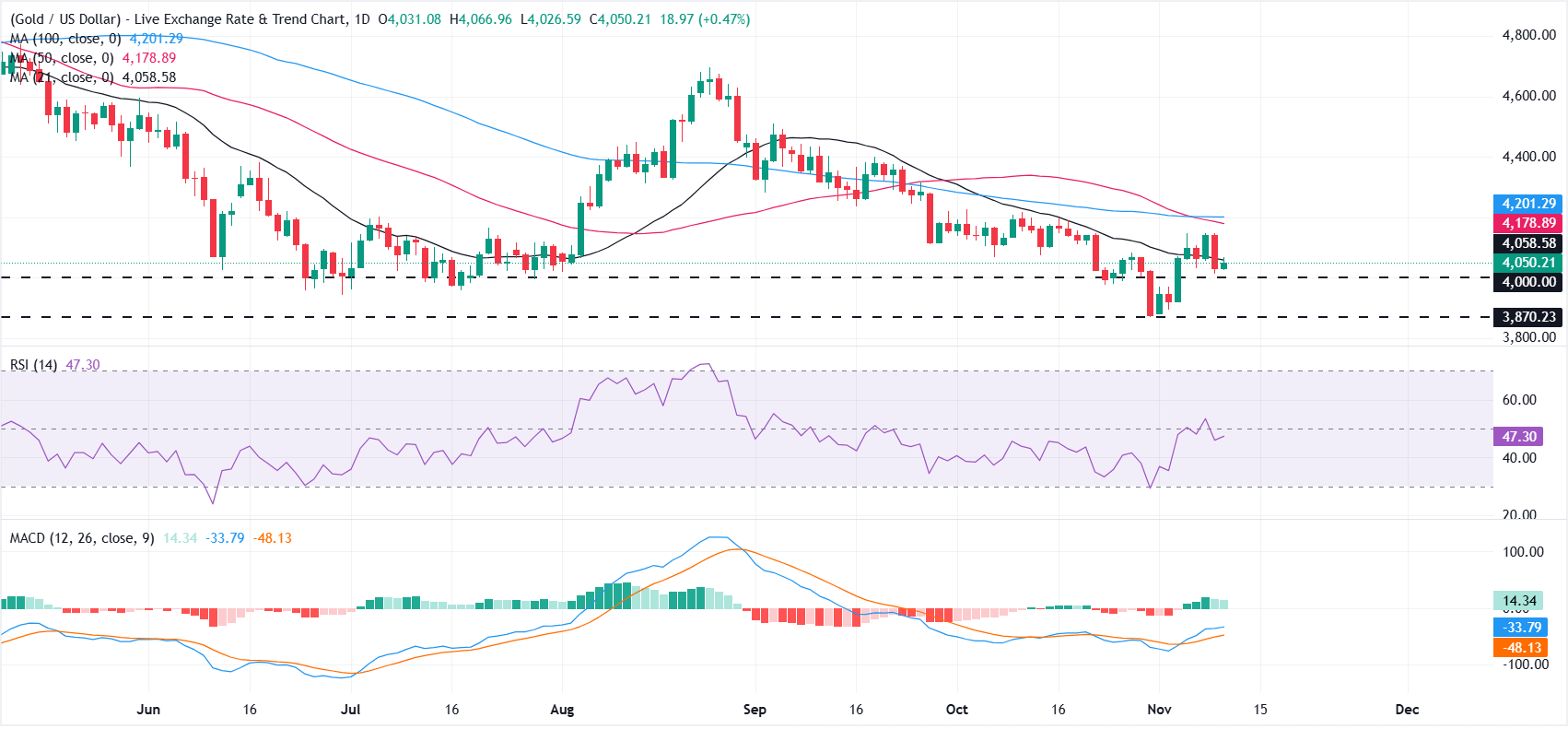
Trading beneath the 21-day Simple Moving Average (SMA) at $4,058 and the 50-day and 100-day SMAs leaves XAU/USD with a bearish daily-chart bias. Momentum is neutral according to the Relative Strength Index (RSI), which sits near 47. The Moving Average Convergence Divergence (MACD) is still positive, but shrinking green histogram bars point to a loss of bullish momentum.
Any recovery faces initial resistance at the 21-day SMA around $4,058, followed by the 50-day SMA at $4,178 and the 100-day SMA at $4,201. Sellers are likely to defend the recent range highs in that area. Initial support lies at the psychological $4,000 mark, ahead of the yearly low at $3,870.23. Should that low give way decisively, Gold could face additional selling pressure.
(The technical analysis of this story was written with the help of an AI tool. Know more.)
Throughout human history, Gold has been important as both a store of value and a means of exchange. Today, beyond its lustre and use in jewellery, the precious metal is widely regarded as a safe-haven asset: an investment considered attractive in unsettled periods. Because it is not dependent on a particular issuer or government, Gold is also commonly viewed as protection against inflation and currency depreciation.
The largest holders of Gold are central banks. Seeking to support their currencies during unsettled periods, they typically diversify reserves and purchase Gold to strengthen perceptions of their economies and currencies. Substantial Gold reserves can bolster confidence in a country’s solvency. According to World Gold Council data, central banks increased their reserves by 1,136 tonnes of Gold, valued at around $70 billion, in 2022. That was the largest annual purchase on record. Emerging-market central banks, including those in China, India and Turkey, are expanding their Gold reserves rapidly.
Both the US Dollar and US Treasuries are major reserve and safe-haven assets, and Gold is inversely correlated with them. A fall in the Dollar tends to accompany a rise in Gold, allowing investors and central banks to diversify their holdings during turbulent periods. Risk assets also have an inverse relationship with Gold: stock market gains tend to weigh on its price, whereas selling in riskier markets generally supports the precious metal.
A broad range of influences can drive Gold prices. Its safe-haven appeal means geopolitical instability or concern about a deep recession can prompt rapid price gains. Since Gold pays no yield, lower interest rates tend to support it, while a higher cost of borrowing usually weighs on the precious metal. Nevertheless, because Gold is priced in dollars (XAU/USD), most price movements hinge on the performance of the US Dollar (USD). Dollar strength generally restrains Gold prices; a weaker Dollar, by contrast, is likely to lift them.










The information provided on this website is of a general nature only and does not constitute personal financial advice. Before acting on any information on this website, you should consider the suitability of the information in relation to your objectives, financial situation and needs. Investing in CFDs and FX Margin Contracts carries significant risks and is not suitable for all investors. You may lose more than your initial deposit. You do not own, or have, any interest in the underlying asset. We recommend that you seek independent advice and ensure you fully understand the risks involved before trading. It is important that you read and consider the disclosure document before you acquire any product listed on the website. The information and advertisements offered on this website are not intended for use by any person in any country or jurisdiction where such use would be contrary to local laws and regulations. The Products and Services offered on this website are not intended for residents of the United States, Malaysia and Thailand.
TMGM is authorized and regulated in various jurisdictions.
Trademax Australia Limited, trading as TMGM, is regulated by the Australian Securities and Investments Commission (ASIC), AFSL no. 436416 and is located at Level 28, One International Tower, 100 Barangaroo Avenue, 2000 Sydney, NSW Australia.
Email: support@tmgm.com.au
Trademax Global Limited, trading as TMGM, is authorized and regulated by the Vanuatu Financial Services Commission (VFSC), registration number 40356 and registered at 1276, Kumul Highway, Port Vila, Vanuatu, Republic of Vanuatu.
Email: support@tmgm.com
Trademax Global Markets (SE) Limited, trading as TMGM, is authorized and regulated by the Financial Services Authority (FSA) of Seychelles, with license number SD224. The company is registered at Office No 13, Providence Estate ABIS Centre, Mahe, Seychelles.
Email: support@tmgm.com
Trademax Global Markets (International) Pty Ltd, trading as TMGM, is authorized and regulated by the Financial Services Commission, Mauritius (FSC) with license no. GB22201012, and registered at 33, Edith Cavell Street C/o IQ EQ Fund Services (Mauritius) Ltd Port Louis, 11324 Mauritius.
Email: support@tmgm.com
Copyright © TMGM. All rights reserved

