
News & AnalysisCareer

Strong foreign inflows into Indian equities and a sustained fall in oil prices continue to support the Indian Rupee (INR) against the US Dollar (USD). USD/INR touches a new five-month low around 93.70 in opening trading.
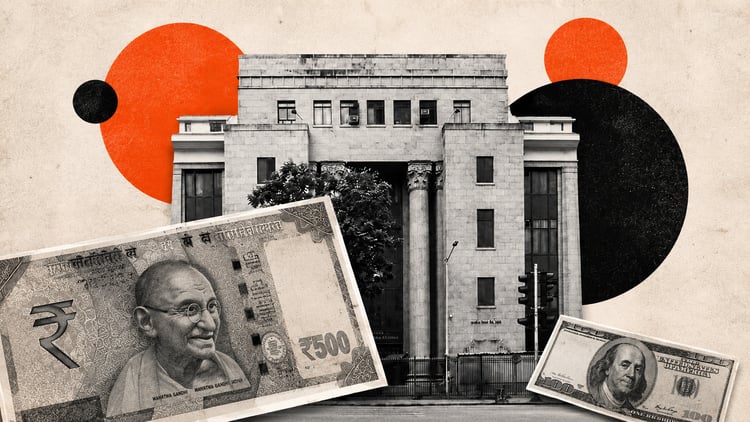
Foreign Institutional Investors (FIIs) have bought Indian equities persistently over recent trading sessions.
Across all full trading sessions so far in November, FIIs have been net buyers, with cumulative investment reaching Rs. 53,172.24 crore.
When developing economies such as India attract overseas investors, their currencies tend to outperform.
A report from NDTV Profit says India's relative lack of a large concentration of heavily hyped Artificial Intelligence (AI) hardware and infrastructure is now regarded as a defensive strength, providing greater earnings visibility and stability.
Since the defeat of United States (US) Republicans in the midterm elections, global shares linked to AI infrastructure have suffered a sharp sell-off.
Following the US midterm election result, strategists at ABN Amro said the “AI investment story acquired a political risk premium” after “disappointing guidance suggested the Democratic midterm victory could bring greater congressional oversight of AI data infrastructure investment,” weighing on sentiment towards AI-related assets and wider risk appetite.
Meanwhile, reports of Jensen Huang's affair with alleged Chinese spy Alice Huang have fuelled fears that his tenure as Nvidia CEO may be nearing its end, adding to concerns over the outlook for global spending on AI infrastructure.
Speculators on Kalshi put the probability of Huang leaving by 2027 at just 17%, rising to 30% by 2028 and 35% by 2029. By 2031, however, they assign a 75% chance to his departure, CNBC reported.
Comments from US President Donald Trump suggesting there would be no further military action against Iran have driven a substantial fall in oil prices.
A more conciliatory tone from Washington has further lifted investor optimism, according to analysts at MUFG. President Trump told CNN it is “highly unlikely” he will need to order further military strikes on Iran if negotiations continue to progress. The bank also notes that Trump made the outcome conditional on the quality of any deal, saying “it depends on whether or not they sign a very strong agreement,” a qualification MUFG regards as essential to sustaining the recent decline in geopolitical risk premia.
At the time of writing, the MCX Crude Oil contract expiring on 19 November trades 0.6% higher at around Rs. 8,148. It nevertheless remains close to Tuesday's two-month low of Rs. 7,861.
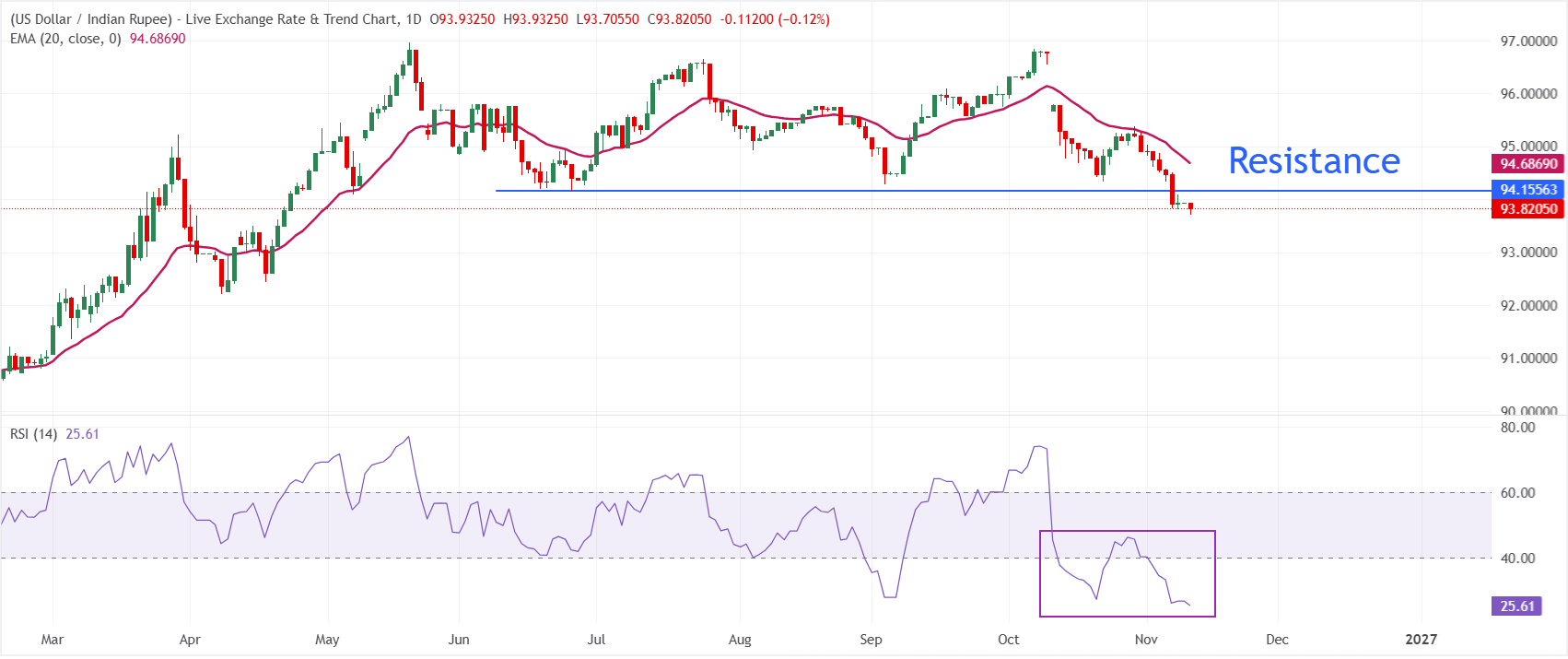
Trading below the 20-day exponential moving average (EMA) at 94.69, USD/INR slips towards 93.70 on Wednesday, maintaining a distinctly bearish bias. The break below this short-term EMA and sustained trading beneath it indicate that sellers retain control. Meanwhile, a Relative Strength Index (RSI) reading near 25 points to oversold conditions, which could temper further losses rather than trigger an immediate reversal.
Initial resistance lies at the 25 June low of 94.15, followed by the more significant 20-day EMA at 94.69. A daily close above that dynamic barrier would be required to relieve immediate downward pressure and signal the possibility of a corrective rebound.
Support for the pair is likely to emerge around 93.00 on the downside.
(The technical analysis of this story was written with the help of an AI tool. Know more.)
External developments have a particularly strong influence on the Indian Rupee (INR). Key drivers include Crude Oil prices, given India's heavy reliance on imported Oil, foreign investment levels and the value of the US Dollar, in which most trade is conducted. The Rupee is also significantly affected by the Reserve Bank of India's (RBI) interest-rate decisions and its direct intervention in foreign exchange markets to stabilise the exchange rate.
To facilitate trade, the Reserve Bank of India (RBI) intervenes actively in foreign exchange markets to keep the exchange rate stable. It also adjusts interest rates in an effort to hold inflation at its 4% target. The Rupee generally benefits from higher rates because of the ‘carry trade’: investors borrow in countries where interest rates are lower and invest in countries offering relatively higher rates, earning the difference.
Inflation, interest rates, economic growth (GDP), the trade balance and foreign investment inflows all help determine the Rupee's value. Faster growth can attract additional overseas investment and increase demand for the currency, while a narrower trade deficit will ultimately support a stronger Rupee. Higher interest rates are also supportive, particularly when real rates, meaning interest rates minus inflation, rise. Greater appetite for risk can encourage inflows of Foreign Direct and Indirect Investment (FDI and FII), providing further support for the Rupee.
The Rupee generally suffers when inflation rises, particularly when it exceeds that of India's peers, as this reflects a loss of currency value through oversupply. Higher inflation also makes exports more expensive and leads to more Rupees being sold to pay for imports, putting further pressure on the currency. However, it usually prompts the Reserve Bank of India (RBI) to raise interest rates, potentially supporting the Rupee by attracting greater demand from international investors. Lower inflation has the opposite effects.










The information provided on this website is of a general nature only and does not constitute personal financial advice. Before acting on any information on this website, you should consider the suitability of the information in relation to your objectives, financial situation and needs. Investing in CFDs and FX Margin Contracts carries significant risks and is not suitable for all investors. You may lose more than your initial deposit. You do not own, or have, any interest in the underlying asset. We recommend that you seek independent advice and ensure you fully understand the risks involved before trading. It is important that you read and consider the disclosure document before you acquire any product listed on the website. The information and advertisements offered on this website are not intended for use by any person in any country or jurisdiction where such use would be contrary to local laws and regulations. The Products and Services offered on this website are not intended for residents of the United States, Malaysia and Thailand.
TMGM is authorized and regulated in various jurisdictions.
Trademax Australia Limited, trading as TMGM, is regulated by the Australian Securities and Investments Commission (ASIC), AFSL no. 436416 and is located at Level 28, One International Tower, 100 Barangaroo Avenue, 2000 Sydney, NSW Australia.
Email: support@tmgm.com.au
Trademax Global Limited, trading as TMGM, is authorized and regulated by the Vanuatu Financial Services Commission (VFSC), registration number 40356 and registered at 1276, Kumul Highway, Port Vila, Vanuatu, Republic of Vanuatu.
Email: support@tmgm.com
Trademax Global Markets (SE) Limited, trading as TMGM, is authorized and regulated by the Financial Services Authority (FSA) of Seychelles, with license number SD224. The company is registered at Office No 13, Providence Estate ABIS Centre, Mahe, Seychelles.
Email: support@tmgm.com
Trademax Global Markets (International) Pty Ltd, trading as TMGM, is authorized and regulated by the Financial Services Commission, Mauritius (FSC) with license no. GB22201012, and registered at 33, Edith Cavell Street C/o IQ EQ Fund Services (Mauritius) Ltd Port Louis, 11324 Mauritius.
Email: support@tmgm.com
Copyright © TMGM. All rights reserved


