
News & AnalysisCareer

At around 0.5560 in Thursday’s Asian trading, the New Zealand Dollar (NZD) retains its losses of the past two days against the US Dollar (USD) and remains under pressure.
With financial markets beginning to price in the possibility of a larger interest rate increase at the Federal Reserve’s (Fed) December policy meeting, continued US Dollar outperformance leaves the Kiwi pair on a weak footing.

Up 0.18% at around 103.06 at the time of writing, the US Dollar Index (DXY) stands at its highest in over 18 months. The index measures the Greenback against six major currencies.
Waller’s remarks bring 50bp Fed hike risk back into focus
The latest reassessment in markets has been “to consider the prospect of a 50bp hike,” according to analysts at MUFG. They emphasise that the shift is “only now being considered because of Waller’s comments prior to the Consumer Price Index (CPI) report rather than the CPI report itself.” In their view, “Waller’s comment that a stronger CPI print may warrant a 50bp hike has sparked a debate over whether Waller had knowledge of the CPI print,” contributing to a rise in short-dated yields and a repricing of Fed expectations.
A 9/10 FXS Speechtracker score for Fed official Waller’s Tuesday remarks, well above the historical average of 7.3/10, reflected a notably more hawkish tone and a clear shift towards a tighter policy stance. His conditional backing for a half-point rate increase in December if October core CPI comes in at 0.3% or higher, together with support for a quarter-point rise even if inflation data improve, indicates a forceful response to any evidence of inflation moving away from target. By highlighting the breadth of price rises, the insufficiently restrictive current policy stance and the need for higher real rates, Waller reinforced upside risks to US yields and support for the Dollar. His subdued assessment of near-term productivity gains from AI also points to limited relief from supply-side disinflation.
An increase of 3.17 points took the FXS Fed Sentiment Index to 145.50, leaving it firmly in hawkish territory and in line with the high FXS Speechtracker reading. The rise confirms an increasingly forceful tilt towards further tightening in Fed communications. As markets reassess the probability of a December rate rise, that backdrop should continue to support the Dollar while putting pressure on risk-sensitive currencies.
The probability of a 50 basis points (bps) interest rate increase at the December meeting nevertheless stands at just 10%, according to the CME FedWatch tool.
For the Kiwi, expectations surrounding the Reserve Bank of New Zealand’s (RBNZ) December policy meeting would be the principal driver. After keeping its Official Cash Rate (OCR) unchanged in October, the RBNZ is likely to increase it by 25 basis points (bps) to 3%. The central bank had signalled that “tighter monetary policy probably needed” against a backdrop of upside inflation risks.
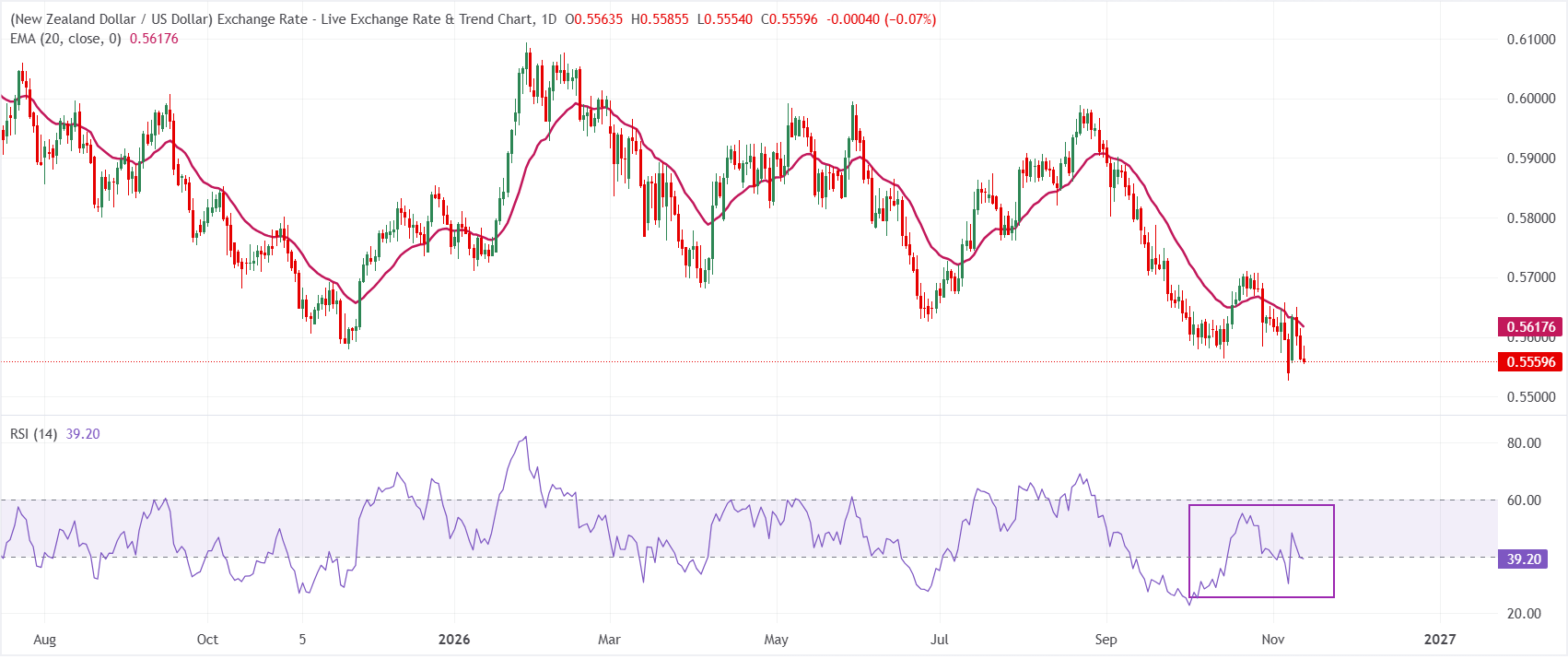
Trading at 0.5559 on the daily chart, NZD/USD has extended its retreat below the 20-period exponential moving average (EMA) at 0.5618, leaving the near-term outlook bearish. Its position beneath this short-term trend gauge suggests limited scope for rallies. Meanwhile, the Relative Strength Index (14), at around 39 following the latest fall, indicates weak conditions without extreme selling pressure.
Any corrective recovery would first encounter resistance at the 20-day EMA of 0.5618. Only a sustained move above that threshold would temper the prevailing bearish tone. Unless the pair regains it, NZD/USD remains exposed to fresh lows, with support likely only at previous price floors further down that are not identified by the current set of indicators.
(The technical analysis of this story was written with the help of an AI tool. Know more.)
As the official currency of the United States of America, the US Dollar (USD) also serves as the ‘de facto’ currency in a significant number of other countries, circulating alongside local banknotes. Data from 2022 show that it accounts for over 88% of worldwide foreign exchange turnover, equivalent to average daily transactions of $6.6 trillion, making it the world’s most actively traded currency. The USD replaced the British Pound as the world’s reserve currency after the Second World War. Gold backed the US Dollar for most of its history, until the Gold Standard ended with the Bretton Woods Agreement in 1971.
Monetary policy set by the Federal Reserve (Fed) is the single most influential factor in the US Dollar’s value. Achieving price stability, or controlling inflation, and promoting full employment are the Fed’s two mandates. Interest rate adjustments are its main means of pursuing those objectives. If prices rise too rapidly and inflation exceeds the Fed’s 2% target, the central bank raises rates, supporting the USD. Conversely, inflation below 2% or an excessively high Unemployment Rate may prompt the Fed to cut interest rates, putting pressure on the Greenback.
When conditions become extreme, the Federal Reserve can create more Dollars and introduce quantitative easing (QE), substantially expanding the flow of credit through a stalled financial system. This unconventional policy is used when credit dries up because banks, fearful of counterparty default, refuse to lend to one another. It serves as a last resort if interest rate cuts alone are unlikely to deliver the required outcome. During the Great Financial Crisis in 2008, QE was the Fed’s preferred response to the credit crunch. Under the programme, newly created Dollars are used to purchase US government bonds, mainly from financial institutions. The US Dollar generally weakens as a result of QE.
By reversing this process, quantitative tightening (QT) sees the Federal Reserve halt bond purchases from financial institutions and refrain from reinvesting the principal repaid when its existing bond holdings mature. The effect on the US Dollar is usually positive.










The information provided on this website is of a general nature only and does not constitute personal financial advice. Before acting on any information on this website, you should consider the suitability of the information in relation to your objectives, financial situation and needs. Investing in CFDs and FX Margin Contracts carries significant risks and is not suitable for all investors. You may lose more than your initial deposit. You do not own, or have, any interest in the underlying asset. We recommend that you seek independent advice and ensure you fully understand the risks involved before trading. It is important that you read and consider the disclosure document before you acquire any product listed on the website. The information and advertisements offered on this website are not intended for use by any person in any country or jurisdiction where such use would be contrary to local laws and regulations. The Products and Services offered on this website are not intended for residents of the United States, Malaysia and Thailand.
TMGM is authorized and regulated in various jurisdictions.
Trademax Australia Limited, trading as TMGM, is regulated by the Australian Securities and Investments Commission (ASIC), AFSL no. 436416 and is located at Level 28, One International Tower, 100 Barangaroo Avenue, 2000 Sydney, NSW Australia.
Email: support@tmgm.com.au
Trademax Global Limited, trading as TMGM, is authorized and regulated by the Vanuatu Financial Services Commission (VFSC), registration number 40356 and registered at 1276, Kumul Highway, Port Vila, Vanuatu, Republic of Vanuatu.
Email: support@tmgm.com
Trademax Global Markets (SE) Limited, trading as TMGM, is authorized and regulated by the Financial Services Authority (FSA) of Seychelles, with license number SD224. The company is registered at Office No 13, Providence Estate ABIS Centre, Mahe, Seychelles.
Email: support@tmgm.com
Trademax Global Markets (International) Pty Ltd, trading as TMGM, is authorized and regulated by the Financial Services Commission, Mauritius (FSC) with license no. GB22201012, and registered at 33, Edith Cavell Street C/o IQ EQ Fund Services (Mauritius) Ltd Port Louis, 11324 Mauritius.
Email: support@tmgm.com
Copyright © TMGM. All rights reserved


