
News & AnalysisCareer

Falling oil prices, driven by hopes of a United States (US)-Iran deal, have combined with renewed concerns over aggressive Federal Reserve (Fed) monetary tightening to lift USD/CAD. Against this backdrop of multiple headwinds, the Canadian Dollar (CAD) continues to lag the US Dollar (USD).
At the time of writing, a 0.17% rise has taken USD/CAD to around 1.4213, its highest point in more than three weeks. Meanwhile, the US Dollar Index (DXY), a measure of the Greenback against six major currencies, is trading near 102.37, up 0.15%.

WTI Oil has retreated almost 18% from its recent highs of 104.03 to around $85.35. Falling oil prices reduce the appeal of currencies belonging to net energy-exporting economies such as Canada.
Fed December rate rise viewed as assured, with focus turning to its size
A December rate rise is now effectively assured in the view of TD Securities, which says the “strong upside surprise in the US CPI makes a December hike all but certain,” and reiterates that “today's data certainly seals a Dec rate hike by the Fed.” Governor Waller’s remarks ahead of the CPI release have brought the possible need for a “catch-up” move into sharper focus. As strategists put it, “after Waller's speech, the debate has now shifted to whether the FOMC will go 25 or 50bps,” with TD Securities saying the discussion will centre on a “catch-up 50bps rate hike in December, or whether to maintain course with a 25bps rate increase and provide strong guidance toward a potential January follow-through.” Their current preference remains unchanged: “we still favor a 25bp hike with a rising risk of another hike in January.”
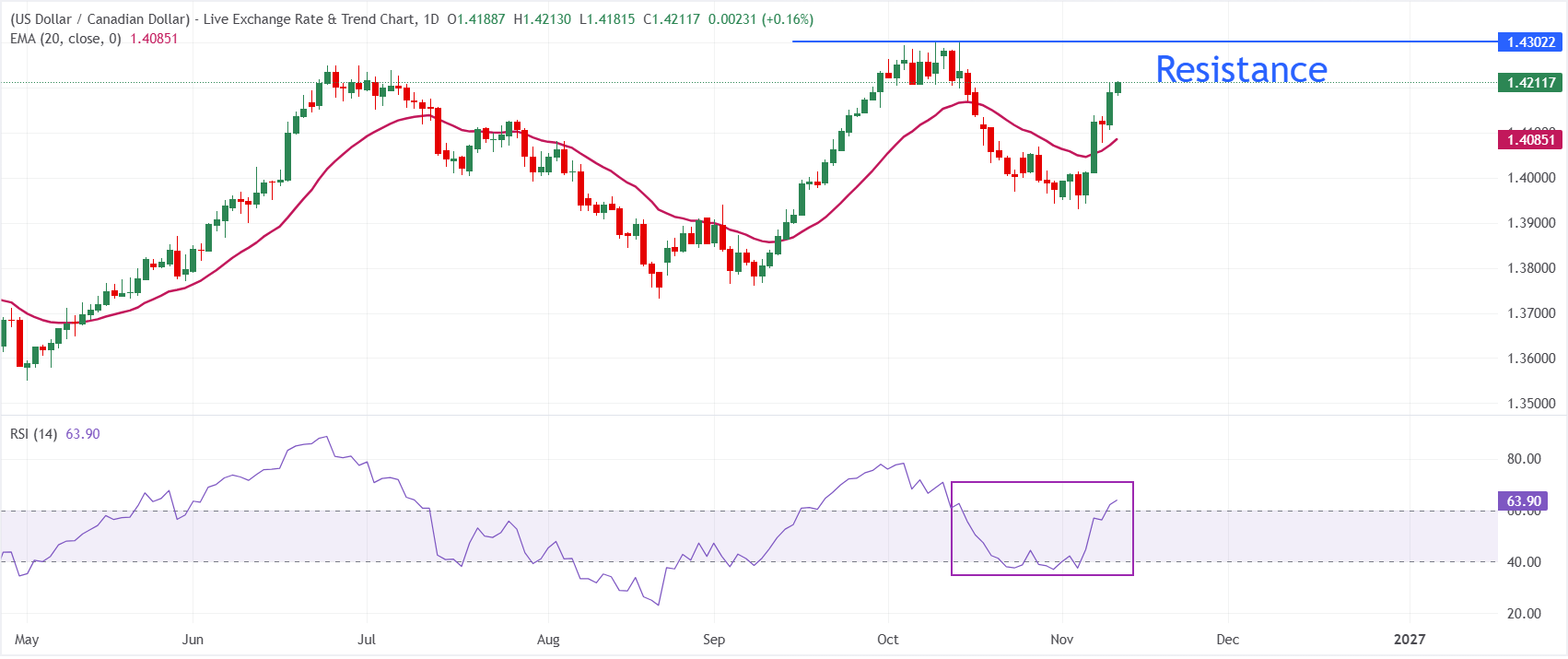
Trading at 1.4212 on the daily chart, USD/CAD retains a bullish near-term outlook after moving above its 20-day Exponential Moving Average (EMA) at 1.4085. That average now provides support for the advance. At 63.9, the Relative Strength Index (RSI) remains in positive territory without yet indicating overbought conditions. This suggests buyers remain in control, although consolidation could follow the recent recovery.
The 1.4210 area provides the nearest downside support and serves as a nearby pivot. Below that, the 20-day EMA at 1.4085 could attract renewed buying on any pullback. As this dataset shows no significant technical resistance immediately above the current price, attention centres on buyers’ ability to hold these underlying support levels and prolong the broader uptrend.
(The technical analysis of this story was written with the help of an AI tool. Know more.)
As well as being the official currency of the United States of America, the US Dollar (USD) serves as the ‘de facto’ currency in a significant number of other countries, circulating alongside local banknotes. Data from 2022 show that it accounts for over 88% of global foreign exchange turnover, equivalent to average daily transactions of $6.6 trillion, making it the world’s most heavily traded currency. The USD replaced the British Pound as the world’s reserve currency after the Second World War. Gold backed the US Dollar for most of its history, until the Gold Standard ended with the Bretton Woods Agreement in 1971.
Monetary policy, set by the Federal Reserve (Fed), is the single most important influence on the US Dollar’s value. The Fed’s dual mandate is to maintain price stability by controlling inflation and to promote full employment. Adjusting interest rates is its main means of pursuing these objectives. If prices rise too rapidly and inflation exceeds the Fed’s 2% target, the central bank will increase interest rates, supporting the USD. Conversely, inflation below 2% or an excessively high Unemployment Rate may prompt the Fed to cut rates, putting pressure on the Greenback.
When circumstances are extreme, the Federal Reserve can print additional Dollars and introduce quantitative easing (QE), substantially expanding the supply of credit within a stalled financial system. This unconventional policy is used when credit dries up because banks, fearing counterparty default, refuse to lend to one another. It is a last resort if interest rate cuts alone are unlikely to deliver the required outcome. During the Great Financial Crisis in 2008, the Fed chose QE to tackle the credit crunch. Under this policy, it prints more Dollars to purchase US government bonds, mainly from financial institutions. The US Dollar typically weakens as a result.
In the reverse process, known as quantitative tightening (QT), the Federal Reserve ceases buying bonds from financial institutions. It also stops reinvesting the principal repaid on maturing bonds in further purchases. This generally supports the US Dollar.










The information provided on this website is of a general nature only and does not constitute personal financial advice. Before acting on any information on this website, you should consider the suitability of the information in relation to your objectives, financial situation and needs. Investing in CFDs and FX Margin Contracts carries significant risks and is not suitable for all investors. You may lose more than your initial deposit. You do not own, or have, any interest in the underlying asset. We recommend that you seek independent advice and ensure you fully understand the risks involved before trading. It is important that you read and consider the disclosure document before you acquire any product listed on the website. The information and advertisements offered on this website are not intended for use by any person in any country or jurisdiction where such use would be contrary to local laws and regulations. The Products and Services offered on this website are not intended for residents of the United States, Malaysia and Thailand.
TMGM is authorized and regulated in various jurisdictions.
Trademax Australia Limited, trading as TMGM, is regulated by the Australian Securities and Investments Commission (ASIC), AFSL no. 436416 and is located at Level 28, One International Tower, 100 Barangaroo Avenue, 2000 Sydney, NSW Australia.
Email: support@tmgm.com.au
Trademax Global Limited, trading as TMGM, is authorized and regulated by the Vanuatu Financial Services Commission (VFSC), registration number 40356 and registered at 1276, Kumul Highway, Port Vila, Vanuatu, Republic of Vanuatu.
Email: support@tmgm.com
Trademax Global Markets (SE) Limited, trading as TMGM, is authorized and regulated by the Financial Services Authority (FSA) of Seychelles, with license number SD224. The company is registered at Office No 13, Providence Estate ABIS Centre, Mahe, Seychelles.
Email: support@tmgm.com
Trademax Global Markets (International) Pty Ltd, trading as TMGM, is authorized and regulated by the Financial Services Commission, Mauritius (FSC) with license no. GB22201012, and registered at 33, Edith Cavell Street C/o IQ EQ Fund Services (Mauritius) Ltd Port Louis, 11324 Mauritius.
Email: support@tmgm.com
Copyright © TMGM. All rights reserved


