

Trading
Explore a wide range of markets with competitive pricing, deep liquidity, and advanced trading tools.
Learn More 
Platform
Trade seamlessly with TMGM's powerful platform, built for speed, precision, and a superior trading experience.
Learn More Trading Platform
Academy
Learn the fundamentals of trading with beginner-friendly resources, including guides, webinars, and market insights.
Learn More News & Analysis
Get real-time market updates and expert analysis to stay ahead of trading opportunities
Learn More News & Analysis
About
Learn what sets TMGM apart — our global presence, regulatory strength, and commitment to innovation in trading.
Learn More Why Choose TMGM
Sponsorship
Will 1.3137 hold as key GBP/USD support ahead of UK CPI data?
- The British Pound gains support around 1.3169 against the US Dollar as the Greenback’s advance pauses.
- Further unwinding of AI trades could pressure the US Dollar, ING cautions.
- Investor attention centres on Wednesday's release of UK CPI figures for October.
Temporary support around 1.3169 is helping the British Pound (GBP) attempt to end a five-day decline against the US Dollar (USD) on Tuesday. The GBP/USD pair has found a cushion as the US Dollar Index (DXY) takes a breather following its rise to a fresh 19-month high near 103.70.

The prospect of an unwinding in Artificial Intelligence (AI) trades has been linked to the US Dollar’s advance by market experts. They note that additional selling in global technology shares could trigger a correction in the currency of the United States (US).
The recent “drop in US tech stocks has done little to dent the Dollar’s strong momentum.” This is the assessment of analysts at ING, who attribute much of that resilience to the fact that “the sell-off has spilled over sufficiently into broader US and global equities for the Dollar to benefit from its safe-haven role.”
Renewed pressure on the AI complex could, however, make it more difficult for the US Dollar to build on its current gains. Looking ahead, ING warns that “we still think further weakness in tech/AI stocks should make additional greenback appreciation less sustainable as it drives more dovish Federal Reserve (Fed) repricing,” pointing to limits on the sustainability of further appreciation.
Upside risks to inflation currently have financial markets anticipating successive interest rate increases by the Fed. According to analysts at MUFG/BTMU, the sharp shift towards more hawkish Fed policy expectations has passed directly into the US rates market. The market is now "assigning a higher probability to three consecutive hikes in December, January and March, which would lift the effective Fed funds rate towards 4.6%."
For the British Pound, attention is on Wednesday’s release of the United Kingdom (UK) Consumer Price Index (CPI) for October. Headline inflation is forecast at 3.7% Year-on-Year (YoY), compared with 3.5% in September. Core CPI, which strips out volatile food and energy items, is projected to hold at 2.8% over the same period.
Expectations for the Bank of England’s (BoE) interest rate path are likely to be significantly influenced by the inflation figures.
GBP/USD Technical Analysis: Can the Pair Ease Its Bearish Bias?
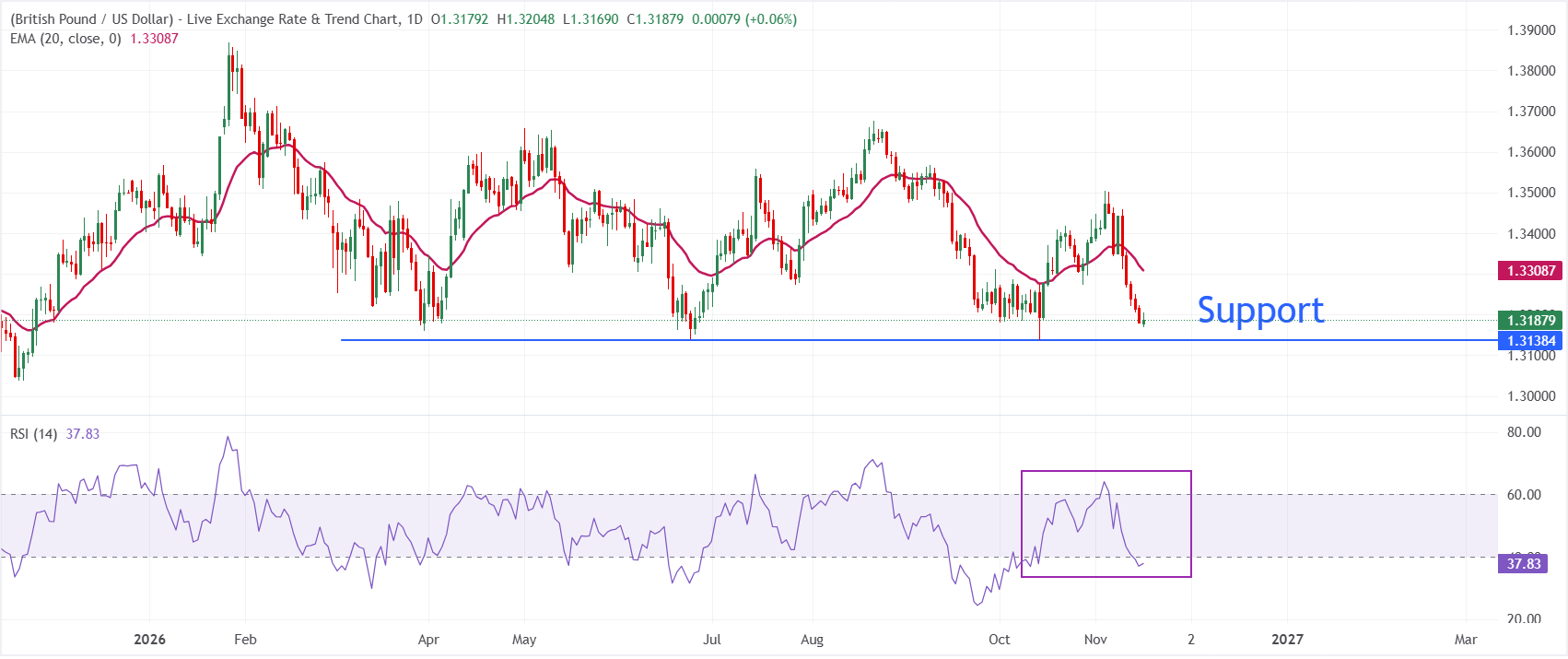
A bearish near-term outlook remains in place on the daily GBP/USD chart, with the pair trading at 1.3187 below its 20-day Exponential Moving Average (EMA) of 1.3309. Staying beneath this important dynamic resistance indicates that the latest pullback has not run its course. At 37.83, the Relative Strength Index (RSI) also remains under the neutral 50 mark, pointing to continued downside pressure rather than an imminent bullish reversal.
A recovery above the 20-day EMA at 1.3309 would be needed to temper the prevailing bearish bias; this level currently acts as the first resistance and limits rebound attempts. On the downside, key support lies at the 14 October low of 1.3137. A breach would leave 1.3100 exposed, with 1.3000 the next level below.
(The technical analysis of this story was written with the help of an AI tool. Know more.)
Economic Data Indicator
What Does the Consumer Price Index (YoY) Measure?
Published monthly by the Office for National Statistics, the United Kingdom (UK) Consumer Price Index (CPI) tracks consumer price inflation in line with international standards. It measures the rate at which prices of goods and services purchased by households increase or decrease, and serves as the inflation gauge for the government’s target. The YoY figure compares prices for the reference month with those a year earlier. A high reading is generally considered bullish for the Pound Sterling (GBP), whereas a low reading is considered bearish.
Find out more.Next publication: Wed 18 Nov 2026 07:00
Release frequency: Every month
Consensus forecast: 3.7%
Prior reading: 3.5%
Data source: Office for National Statistics
A reading above expectations generally supports GBP. The monthly release is significant because the Bank of England has a mandate to keep inflation, measured by the headline Consumer Price Index (CPI), at around 2%. When inflation rises, it points to earlier and faster interest rate increases or a reduction in bond purchases by the BOE, tightening the supply of pounds. By contrast, slower price growth signals a looser monetary policy stance.
POPULAR ARTICLES
1British Pound rebounds after five days of losses as BoE rate hike bets build2Australian Dollar: Have RBA minutes cooled easing expectations? – BBH3Top Altcoins Forecast: Can Solana, Injective and Uniswap Sustain Their Rebound as Bulls Return?4Why is the euro struggling as robust US economic data supports a hawkish Fed outlook?5British Pound: Trades within a range against Euro amid aggressive BoE pricing – ING6US Dollar: How are rate expectations and energy moves providing support? – MUFG7October records a 0.2% MoM increase in US Retail Sales8Euro: Which lower supports are in focus as downtrend against US Dollar continues? – Societe Generale9US ADP Employment Change: 4-week average climbs to 23.75K


Get Started!
Sign up and access the Global Markets in less than 3 minutes

Connect With Us












The information provided on this website is of a general nature only and does not constitute personal financial advice. Before acting on any information on this website, you should consider the suitability of the information in relation to your objectives, financial situation and needs. Investing in CFDs and FX Margin Contracts carries significant risks and is not suitable for all investors. You may lose more than your initial deposit. You do not own, or have, any interest in the underlying asset. We recommend that you seek independent advice and ensure you fully understand the risks involved before trading. It is important that you read and consider the disclosure document before you acquire any product listed on the website. The information and advertisements offered on this website are not intended for use by any person in any country or jurisdiction where such use would be contrary to local laws and regulations. The Products and Services offered on this website are not intended for residents of the United States, Malaysia and Thailand.
TMGM is authorized and regulated in various jurisdictions.
Trademax Australia Limited, trading as TMGM, is regulated by the Australian Securities and Investments Commission (ASIC), AFSL no. 436416 and is located at Level 28, One International Tower, 100 Barangaroo Avenue, 2000 Sydney, NSW Australia.
Email: support@tmgm.com.au
Trademax Global Limited, trading as TMGM, is authorized and regulated by the Vanuatu Financial Services Commission (VFSC), registration number 40356 and registered at 1276, Kumul Highway, Port Vila, Vanuatu, Republic of Vanuatu.
Email: support@tmgm.com
Trademax Global Markets (SE) Limited, trading as TMGM, is authorized and regulated by the Financial Services Authority (FSA) of Seychelles, with license number SD224. The company is registered at Office No 13, Providence Estate ABIS Centre, Mahe, Seychelles.
Email: support@tmgm.com
Trademax Global Markets (International) Pty Ltd, trading as TMGM, is authorized and regulated by the Financial Services Commission, Mauritius (FSC) with license no. GB22201012, and registered at 33, Edith Cavell Street C/o IQ EQ Fund Services (Mauritius) Ltd Port Louis, 11324 Mauritius.
Email: support@tmgm.com
Copyright © TMGM. All rights reserved