




Gold declines as Middle East tensions and higher-for-longer Fed outlook weigh
- Gold slips on Wednesday as tensions in the Middle East keep traders cautious about a possible US-Iran deal.
- Markets price in a higher-for-longer Fed interest rate outlook as elevated Oil prices add to inflation concerns.
- Technical signals continue to point lower as XAU/USD struggles to regain momentum.
Gold (XAU/USD) trades lower on Wednesday as escalating tensions in the Middle East dampen hopes for a near-term US-Iran peace deal. At the time of writing, XAU/USD is trading around $4,455, down nearly 1.85% so far this week.

US Central Command said American forces intercepted multiple Iranian ballistic missiles and drones targeting Kuwait and Bahrain on Tuesday. In response, US forces carried out strikes on an Iranian military ground control station on Qeshm Island in the Strait of Hormuz.
Meanwhile, US President Donald Trump pushed back against reports from Iran's Fars and Tasnim news agencies that talks had stalled.
Trump said on Wednesday that Iran had agreed not to have a nuclear weapon, Reuters reported. He also said Iran’s Supreme Leader, Ayatollah Mojtaba Khamenei, is involved in talks with the United States.
Traders continue to favor the US Dollar (USD) as negotiations between Washington and Tehran remain unclear and tensions in the Middle East persist, while the blockade around the Strait of Hormuz keeps Oil prices elevated.
The current macro backdrop has put Gold’s traditional defensive appeal under pressure as markets increasingly focus on the inflationary impact of higher energy prices.
As a result, traders now expect the Federal Reserve (Fed) to keep interest rates unchanged through the rest of the year, while pricing in a roughly 40% chance of a 25-basis-point (bps) rate hike at the December meeting.
A higher-interest-rate environment tends to reduce the appeal of non-yielding assets such as Gold. The hawkish repricing is also lending additional support to the US Dollar and pushing Treasury yields higher, adding further pressure on the precious metal.
On the economic calendar front, US ADP Employment Change rose by 122K in May from 105K in April, beating market expectations of 117K. It was also the highest level since March 2025. Traders now await the US ISM Services Purchasing Managers Index (PMI) data due later in the American session.
Technical Analysis: XAU/USD trades in the lower end of its recent range
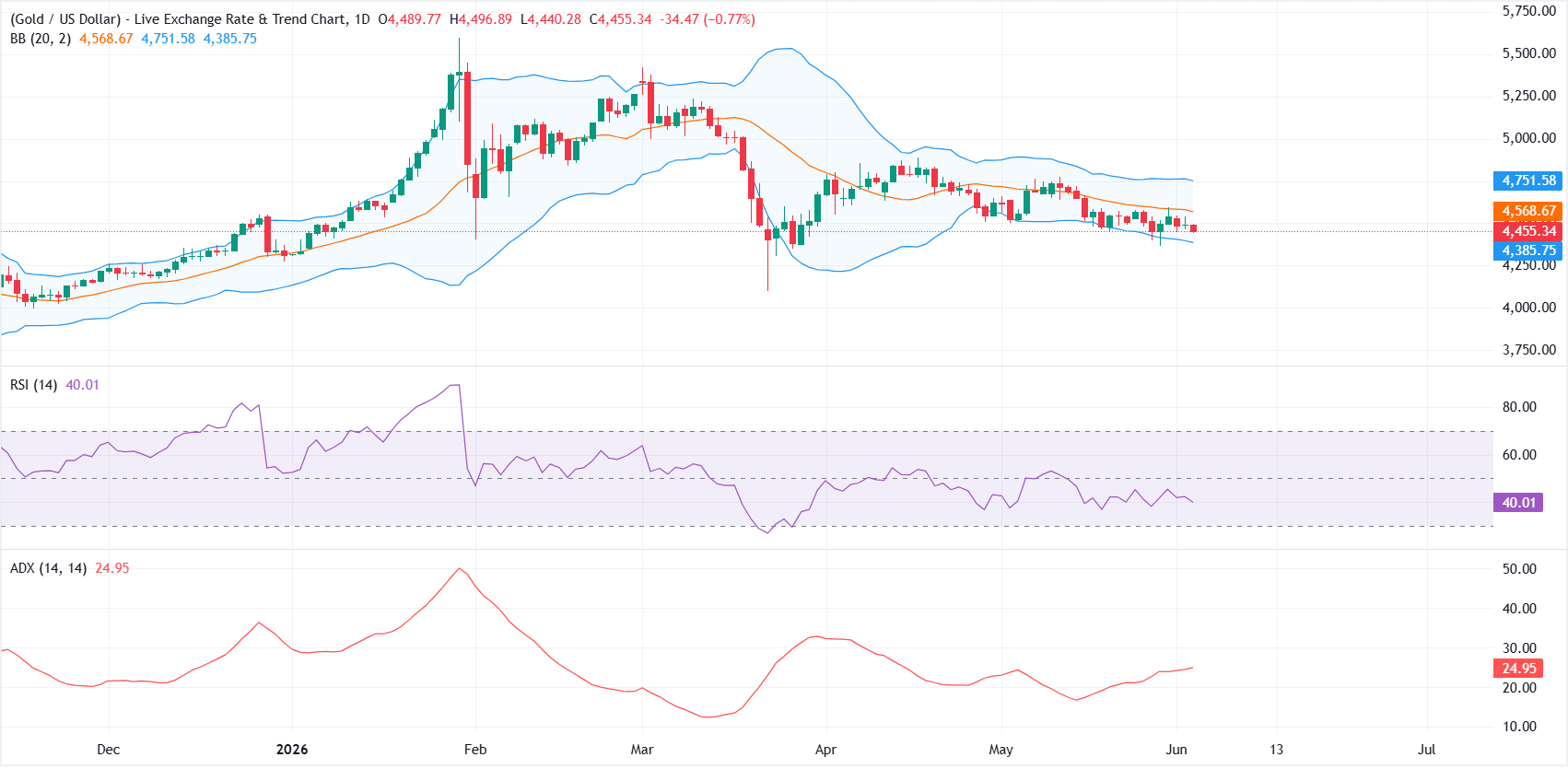
On the daily chart, XAU/USD holds below the Bollinger Bands Simple Moving Average (SMA) midpoint at roughly $4,568, keeping the near-term tone bearish as price gravitates toward the lower half of the recent volatility envelope.
The Relative Strength Index (RSI) around 40 suggests subdued bullish momentum rather than outright oversold conditions, while the Average Directional Index (ADX) near 25 hints at a trend that is gaining strength but is not yet in a strongly directional phase.
On the topside, initial resistance is aligned with the Bollinger Bands SMA center line near $4,568, with the upper band next around $4,751 acting as a secondary cap if buyers attempt a rebound.
On the downside, the lower Bollinger band near $4,385 offers the first notable support, and a clear break beneath this zone would open the door to deeper corrective losses as the broader volatility structure shifts lower.
(The technical analysis of this story was written with the help of an AI tool.)
Gold FAQs
Gold has played a key role in human’s history as it has been widely used as a store of value and medium of exchange. Currently, apart from its shine and usage for jewelry, the precious metal is widely seen as a safe-haven asset, meaning that it is considered a good investment during turbulent times. Gold is also widely seen as a hedge against inflation and against depreciating currencies as it doesn’t rely on any specific issuer or government.
Central banks are the biggest Gold holders. In their aim to support their currencies in turbulent times, central banks tend to diversify their reserves and buy Gold to improve the perceived strength of the economy and the currency. High Gold reserves can be a source of trust for a country’s solvency. Central banks added 1,136 tonnes of Gold worth around $70 billion to their reserves in 2022, according to data from the World Gold Council. This is the highest yearly purchase since records began. Central banks from emerging economies such as China, India and Turkey are quickly increasing their Gold reserves.
Gold has an inverse correlation with the US Dollar and US Treasuries, which are both major reserve and safe-haven assets. When the Dollar depreciates, Gold tends to rise, enabling investors and central banks to diversify their assets in turbulent times. Gold is also inversely correlated with risk assets. A rally in the stock market tends to weaken Gold price, while sell-offs in riskier markets tend to favor the precious metal.
The price can move due to a wide range of factors. Geopolitical instability or fears of a deep recession can quickly make Gold price escalate due to its safe-haven status. As a yield-less asset, Gold tends to rise with lower interest rates, while higher cost of money usually weighs down on the yellow metal. Still, most moves depend on how the US Dollar (USD) behaves as the asset is priced in dollars (XAU/USD). A strong Dollar tends to keep the price of Gold controlled, whereas a weaker Dollar is likely to push Gold prices up.













