

Gold rallies as Fed minutes flag hikes, US Dollar slides
- Fed minutes show officials preparing the ground for a possible rate hike.
- US Dollar slips to two-day lows, supporting non-yielding bullion demand.
- Iran warnings keep geopolitical risks elevated ahead of US PMIs.
Gold (XAU/USD) finds bids and edges higher during the North American session on Wednesday after the Federal Reserve’s (Fed) last meeting minutes showed that most officials favored laying the groundwork for a rate hike. At the time of writing, the XAU/USD pair trades at $4,530, up by 1%.

XAU/USD climbs as lower yields offset hawkish Fed minutes
The minutes of the April meeting revealed that the majority of the board supported the need for some policy tightening if inflation remains stubbornly above the 2% goal. Additionally, the minutes stated that “many participants indicated that they would have preferred removing the language from the post-meeting statement that suggested an easing bias regarding the likely direction of the Committee's future interest rate decisions.”
This is the second meeting in a row in which more Fed officials have said that increasing borrowing costs could be appropriate if prices remain high. The minutes showed that “participants generally observed Middle East conflict could have significant implications for balance of risks and appropriate policy path.”
Money markets have priced in a 50% chance that the Federal Reserve will raise rates at the December meeting, according to Prime Terminal data.
Despite this, bullion continues to rally as the Greenback slides, reaching two-day lows. The US Dollar Index (DXY), which tracks the performance of the American currency against the other six currencies, is down 0.19% at 99.11, after hitting two-day lows at 98.96.
US Treasury yields are also taking a hit, with the 10-year T-note yielding 4.576%, down 9 basis points, a tailwind for the non-yielding metal.
Geopolitics continued to drive Gold’s price action after US President Donald Trump said that negotiations with Iran are in the final stage and warned of attacks if the deal fails. The Iranian Revolutionary Guard Corps said that “if aggression against Iran is repeated, the promised regional war will extend beyond the region this time.”
Data-wise, the US economic docket remains light, with investors awaiting Initial Jobless Claims, housing data, and the S&P Global Flash PMIs.
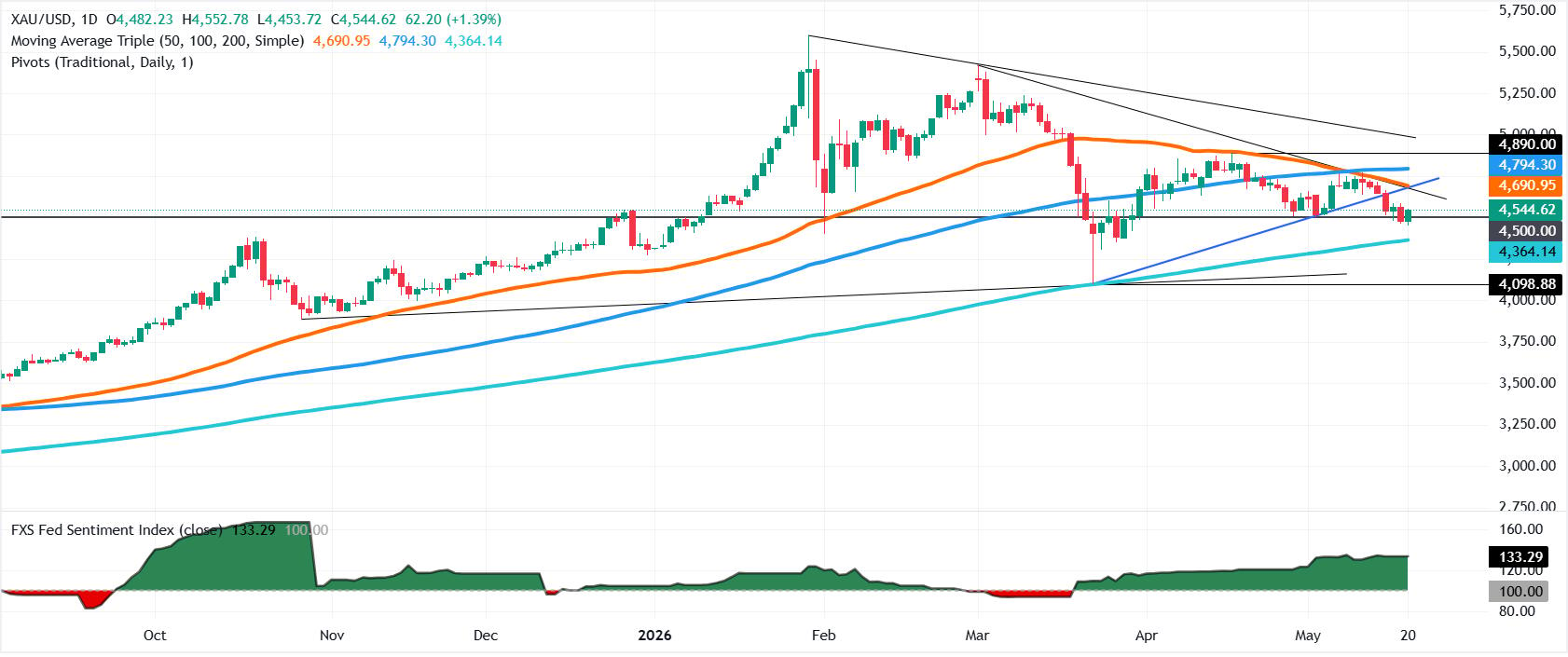
XAU/USD technical outlook: Gold jumps, poised to test stir resistance around $4,600
Gold is in consolidation mode, with a cluster of key technical resistance levels slightly above $4,600.
Momentum remains bearish, but the Relative Strength Index (RSI) suggests buyers are gaining strength, which could open the door to a test of the $4,600 mark.
A breach of $4,600 will expose the 20-day Simple Moving Average (SMA) at $4,628 and the 50-day SMA at $4,690. On further strength, the next stop would be the $4,700 figure, ahead of the 100-day SMA at $4,787.
On the downside, if XAU/USD drops below $4,500, a move towards the May 19 low at $4,464 and $4,400 is on the cards. Once hurdled, the next stop would be the 200-day SMA at $4,340.
Gold FAQs
Gold has played a key role in human’s history as it has been widely used as a store of value and medium of exchange. Currently, apart from its shine and usage for jewelry, the precious metal is widely seen as a safe-haven asset, meaning that it is considered a good investment during turbulent times. Gold is also widely seen as a hedge against inflation and against depreciating currencies as it doesn’t rely on any specific issuer or government.
Central banks are the biggest Gold holders. In their aim to support their currencies in turbulent times, central banks tend to diversify their reserves and buy Gold to improve the perceived strength of the economy and the currency. High Gold reserves can be a source of trust for a country’s solvency. Central banks added 1,136 tonnes of Gold worth around $70 billion to their reserves in 2022, according to data from the World Gold Council. This is the highest yearly purchase since records began. Central banks from emerging economies such as China, India and Turkey are quickly increasing their Gold reserves.
Gold has an inverse correlation with the US Dollar and US Treasuries, which are both major reserve and safe-haven assets. When the Dollar depreciates, Gold tends to rise, enabling investors and central banks to diversify their assets in turbulent times. Gold is also inversely correlated with risk assets. A rally in the stock market tends to weaken Gold price, while sell-offs in riskier markets tend to favor the precious metal.
The price can move due to a wide range of factors. Geopolitical instability or fears of a deep recession can quickly make Gold price escalate due to its safe-haven status. As a yield-less asset, Gold tends to rise with lower interest rates, while higher cost of money usually weighs down on the yellow metal. Still, most moves depend on how the US Dollar (USD) behaves as the asset is priced in dollars (XAU/USD). A strong Dollar tends to keep the price of Gold controlled, whereas a weaker Dollar is likely to push Gold prices up.














