

Key Takeaways:
Leverage Power: Margin trading lets you borrow from a broker to control a larger position than your cash allows.
Magnified Results: This magnifies both potential gains and losses. A 10% market move can result in a much larger percentage gain or loss on your actual capital.
Critical Risks: Key risks include amplified losses, interest costs (swaps) on borrowed funds, and margin calls that force liquidation if equity drops too low.
Risk Management: Effective traders use Stop-Loss orders and monitor "Maintenance Margin" levels to prevent liquidation.
How Margin Trading Works (Step-by-Step)
Unlike a standard cash account where you pay the full cost of a stock or asset upfront, margin trading functions as a down payment. Here is the lifecycle of a margin trade:
The Collateral (Initial Margin): You deposit a required amount of your own capital. For example, if a broker offers 10:1 leverage, you might only need to put down $1,000 to open a $10,000 position.
The Borrow: The brokerage lends you the remaining capital to complete the purchase. This "loan" is secured by the assets in your account.
The Trade: You control the full position size. If the asset price rises, you gain profit on the full value, not just your deposit.
The Interest: Since you are borrowing money, you may be charged interest (often called overnight financing or swaps) if you hold the position past a certain time (usually 5:00 PM EST).
The Exit: When you close the trade, the borrowed amount is returned to the broker. You keep the remaining profit (or cover the loss) minus any interest fees.
Real-World Example: Buying on Margin vs. Cash
To understand the power and danger of margin, look at the math. Let’s assume you have $5,000 to invest in a stock trading at $100.
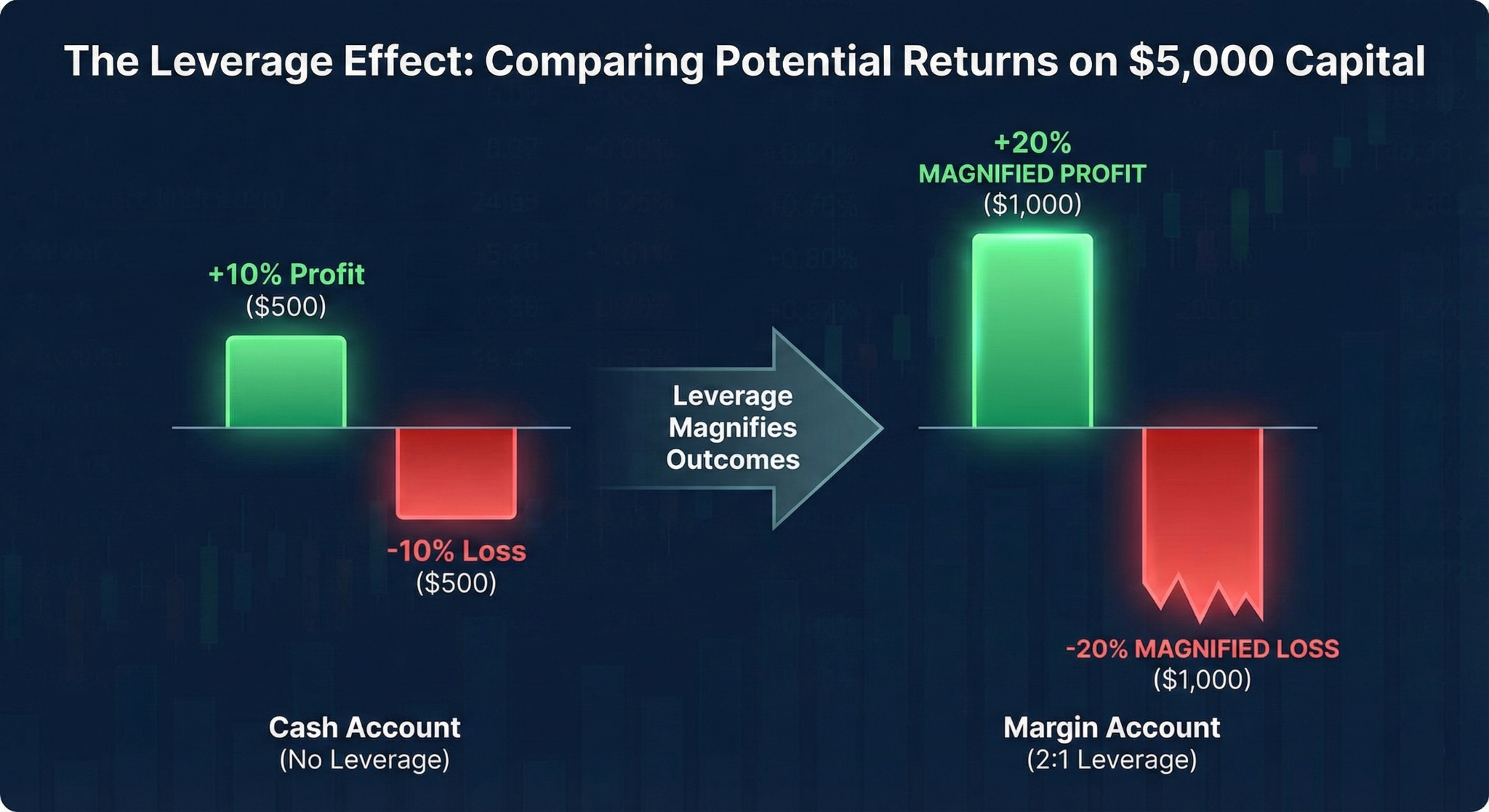
The Verdict: Margin doubled your return on investment (ROI) when the price went up, but it also doubled your loss when the price went down.
Benefits of Trading on Margin
Amplified Gains/Profits
The primary benefit of margin is capital efficiency. With big investments, traders can partake in larger movements in the market; with small investments, traders still gain access to a wider range of opportunities.
Example: In Crypto CFD trading, margin allows traders to gain exposure to Bitcoin price movements without paying the full price of a coin.
Short-Selling Opportunities
In bearish markets, short selling gives traders an edge. This process involves borrowing an asset to sell it at the current high price, planning to buy it back later at a lower price.
Note: Short selling is only possible with a margin account; you cannot short sell in a standard cash account.
Portfolio Diversification
Leveraging your capital allows you to spread investments across different assets. Instead of tying up all your cash in one trade, you can use margin to allocate smaller amounts to Forex, Gold, Crypto, and Stocks simultaneously. This diversification can serve as a risk mitigation tool if managed correctly.
What Are the Risks of Margin Trading?
1. Amplified Losses
If the trade doesn’t go as planned, losses can exceed your expectations quickly. Because you are trading with more money than you own, a small market move can wipe out a significant percentage of your account equity.
2. The Margin Call
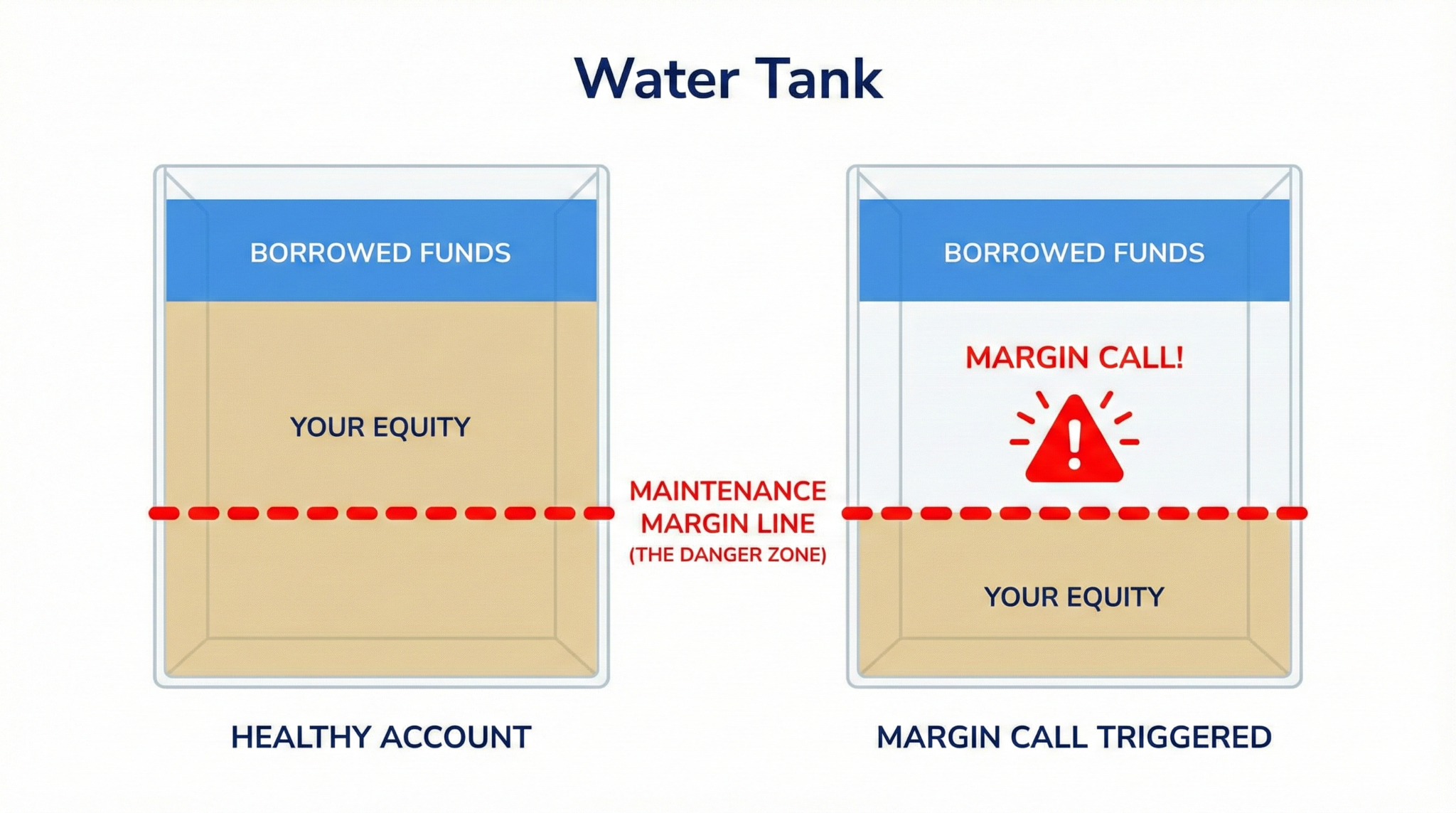
This is the most critical concept to understand. Every broker has a Maintenance Margin requirement—the minimum equity you must keep in your account.
What happens: If your trade loses money and your account equity falls below this maintenance level, the broker triggers a Margin Call.
The Consequence: You must immediately deposit more cash. If you do not, the broker will then perform a Forced Liquidation, closing your positions automatically at the current market price to cover the loan.
3. Interest Costs (Swaps)
Margin trading isn't free. Because you are borrowing money, you pay interest (called swaps). If you are a day trader closing positions before the market closes, you might avoid these fees. However, swing traders holding positions for days or weeks must calculate these costs, as they can eat into profits.
Australian Margin Rules: The ASIC Framework (Reg T vs. ASIC)
While many trading textbooks refer to Regulation T (Reg T)—the US Federal Reserve rule that limits leverage to 2:1 for stocks—Australian traders operate under a different, modernized framework enforced by the Australian Securities and Investments Commission (ASIC).
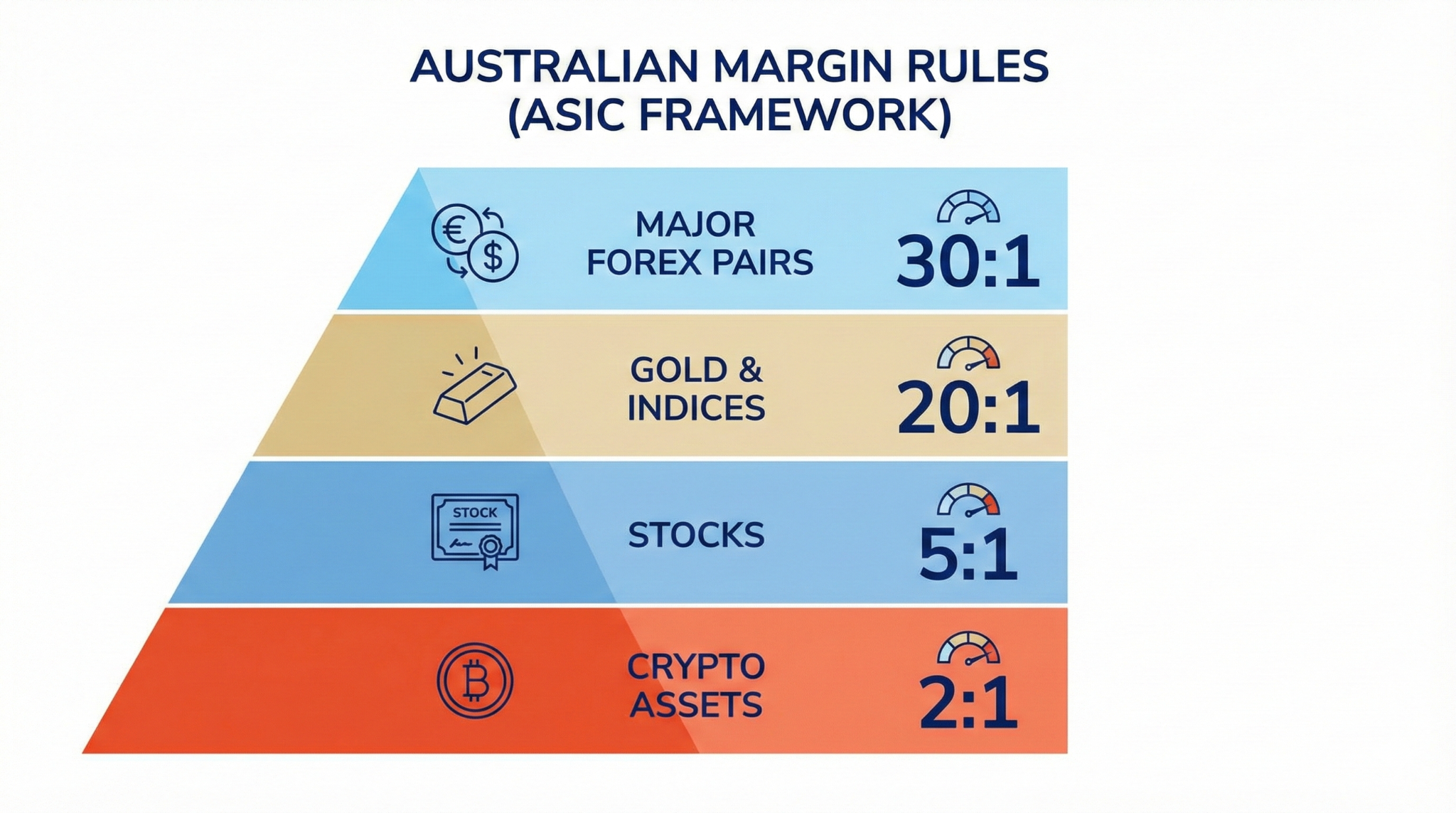
Since March 2021, ASIC has implemented strict protections for retail clients that differ significantly from the US model. If you are trading with an Australian-regulated broker like TMGM, these are the rules that apply to you:
1. Leverage Caps (The "Speed Limit")
Unlike the flat 50% margin requirement of US Reg T, ASIC scales your allowed leverage based on the volatility of the asset class. This is designed to protect retail traders from over-exposure.
2. The "50% Close-Out" Rule (Maintenance Margin)
In the US, maintenance margin rules can vary by broker. In Australia, ASIC mandates a standardized 50% Automatic Close-Out Rule.
How it works: If your account Equity (Cash + Floating Profit/Loss) falls to 50% of your total Required Margin, the broker is legally required to close your positions immediately until equity returns above 50%.
Why it matters: This acts as a hard "circuit breaker" to prevent you from losing your entire account balance in a single bad trade.
3. Negative Balance Protection (NBP)
This is a major advantage for Australian traders over US Reg T traders.
US (Reg T): In a market crash, you can lose more than your deposit and end up owing the broker money.
Australia (ASIC): Brokers must provide Negative Balance Protection. This means your losses are strictly limited to the funds in your trading account. You can never owe TMGM more than you deposited.
Tips for Managing Margin Trading Risks
Understand the "Maintenance" Level: Before you trade, ask your broker exactly what percentage of equity is required to keep the trade open.
Use Stop-Loss Orders: Never trade on margin without a hard stop-loss. This ensures you exit a losing trade before it triggers a margin call.
Start Small: Just because you can use 100:1 leverage doesn't mean you should. Experienced traders often use lower leverage (e.g., 2:1 or 5:1) to keep risks manageable.
Monitor Volatility: Indicators like the ATR (Average True Range) or RSI can help you judge if a market is too volatile for a high-leverage position.
Keep a Cash Buffer: Never use 100% of your available margin. Always leave "free margin" in your account to absorb normal market fluctuations.
Maximize Your Margin Trading Potential with TMGM
Ready to take your trading to new heights? TMGM offers the tools and resources you need to succeed in margin trading:
Explore Competitive Leverage Options: Control larger positions with confidence.
Advanced Risk Management: Protect your investments with stop-loss and trailing stop orders.
Comprehensive Support: Access expert advice and educational resources to enhance your trading strategies.