


Key Takeaways
Core Concept: Scalping prioritizes high trade volume and capturing micro-movements (pips) rather than holding for macro trends.
Prerequisites: You cannot scalp successfully without a Direct Market Access (DMA/ECN) environment, raw spreads, and low-latency execution.
Risk Warning: Transaction costs (spreads + commissions) are the silent killer; a 50% win rate is often mathematically unprofitable due to the cost of business.
Best For: Disciplined traders who can maintain intense focus for 1–2 hours during peak London/New York overlap sessions.
Why Use a Scalping Strategy? (Pros & Cons)
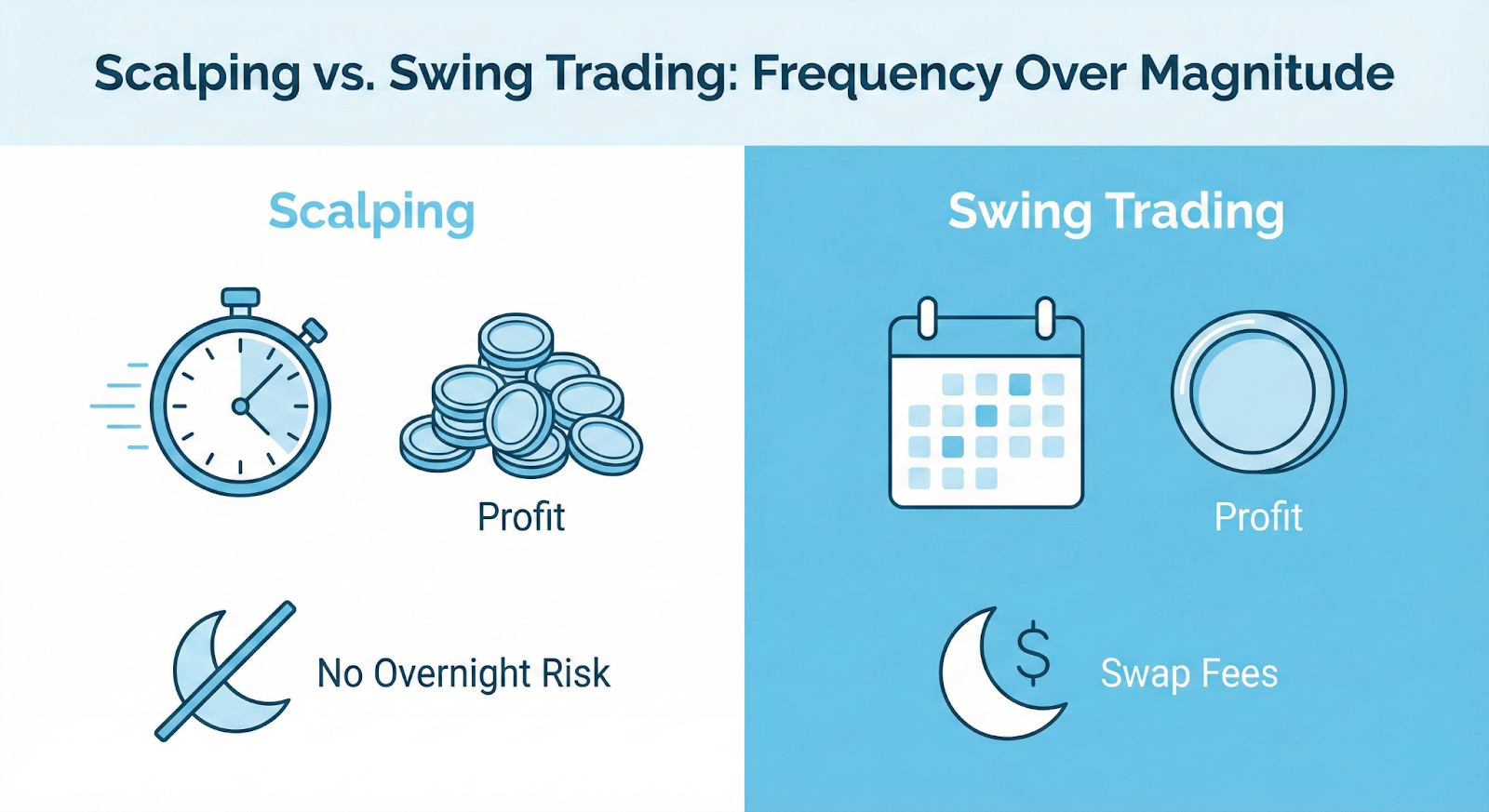
The mathematical edge of scalping lies in the Compounding Frequency. Unlike swing traders who wait days for a 100-pip move, scalpers aim to capture that same volume through 20 trades of 5 pips each. This reduces exposure to overnight financing (swaps) and major news events that occur while you sleep.
The Compounding Effect: Small vs. Large Accounts
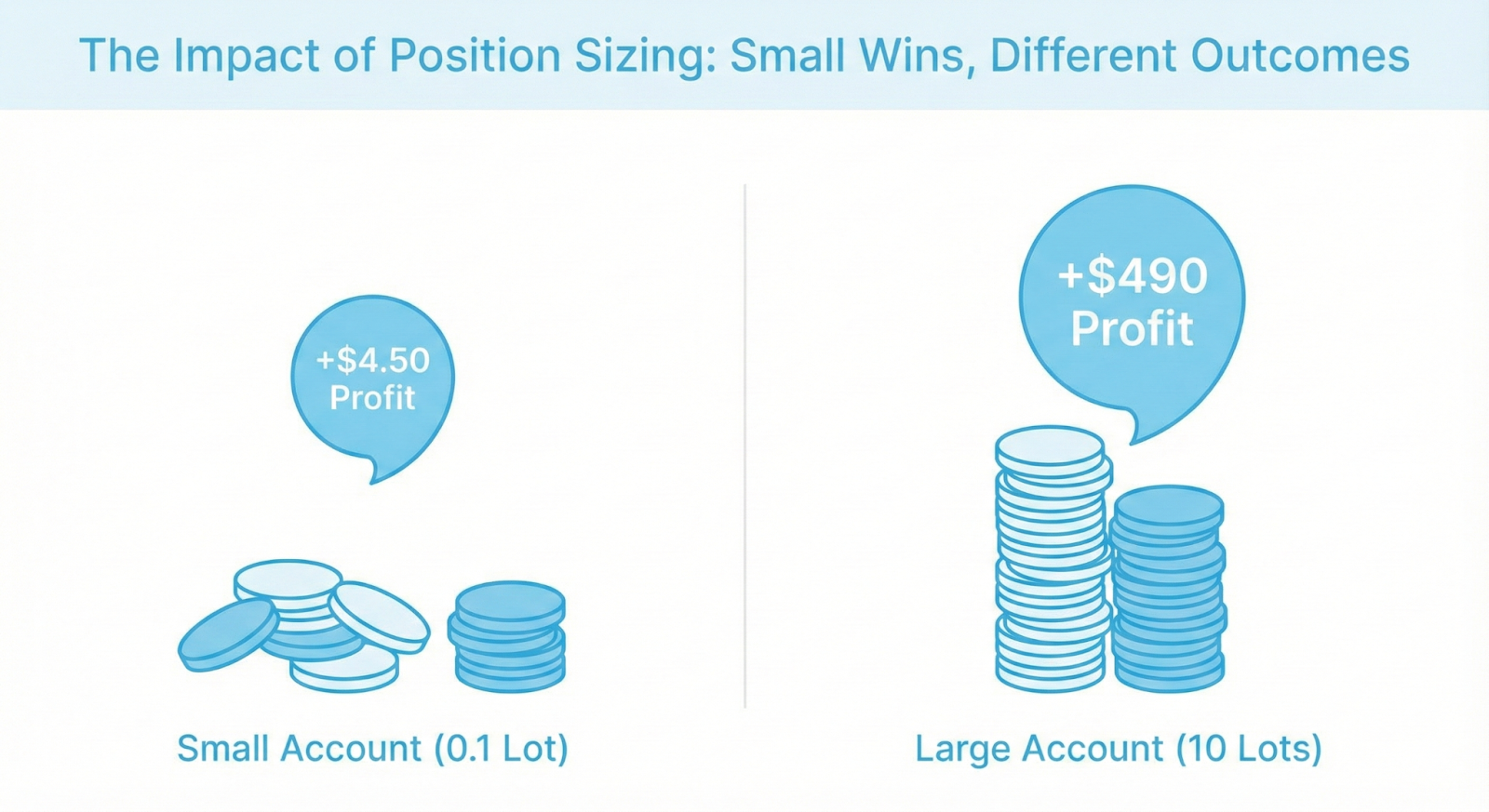
Scalping relies on frequency. Here is how the math works in practice, highlighting why position sizing matters more than the setup itself:
Small Account Scenario: Buying 0.1 Lot EUR/USD for a 5-pip move nets roughly $4.50 (after commissions). The impact is minimal.
Large Account Scenario: Buying 10 Lots EUR/USD for that same 5-pip move nets roughly $490. The strategy is identical, but the volume generates significant income from "market noise."
Pro Tip: Always calculate your "Break-Even Win Rate" before scalping. If your average win is 5 pips and your spread is 1 pip, you are starting 20% in the hole on every trade. This is why raw spreads are non-negotiable.
Top Scalping Strategies for Beginners
1. The Stochastic Oscillator Strategy
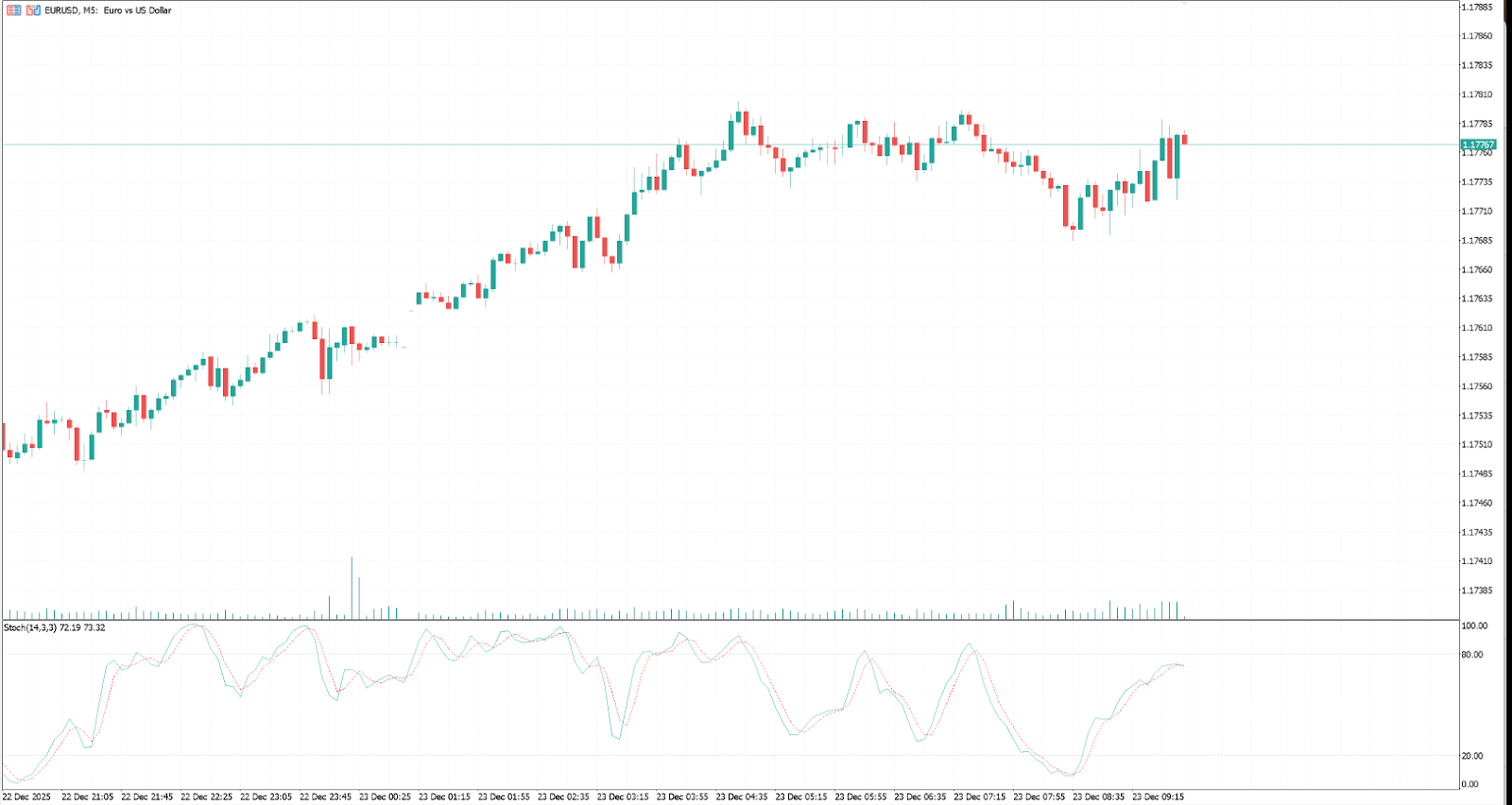
Logic: This strategy exploits Mean Reversion in ranging markets. It assumes that price will snap back to the average after a quick extension.
Trade Setup: Use a slow stochastic (e.g., 14, 3, 3) on a 1-minute or 5-minute chart.
Entry: Wait for the %K line (Fast) to cross above the %D line (Slow) in the Oversold zone (below 20) for a buy.
Exit: Close immediately when the lines cross in the opposite direction or hit the 50 level.
2. Simple Moving Averages (SMA) Ribbon
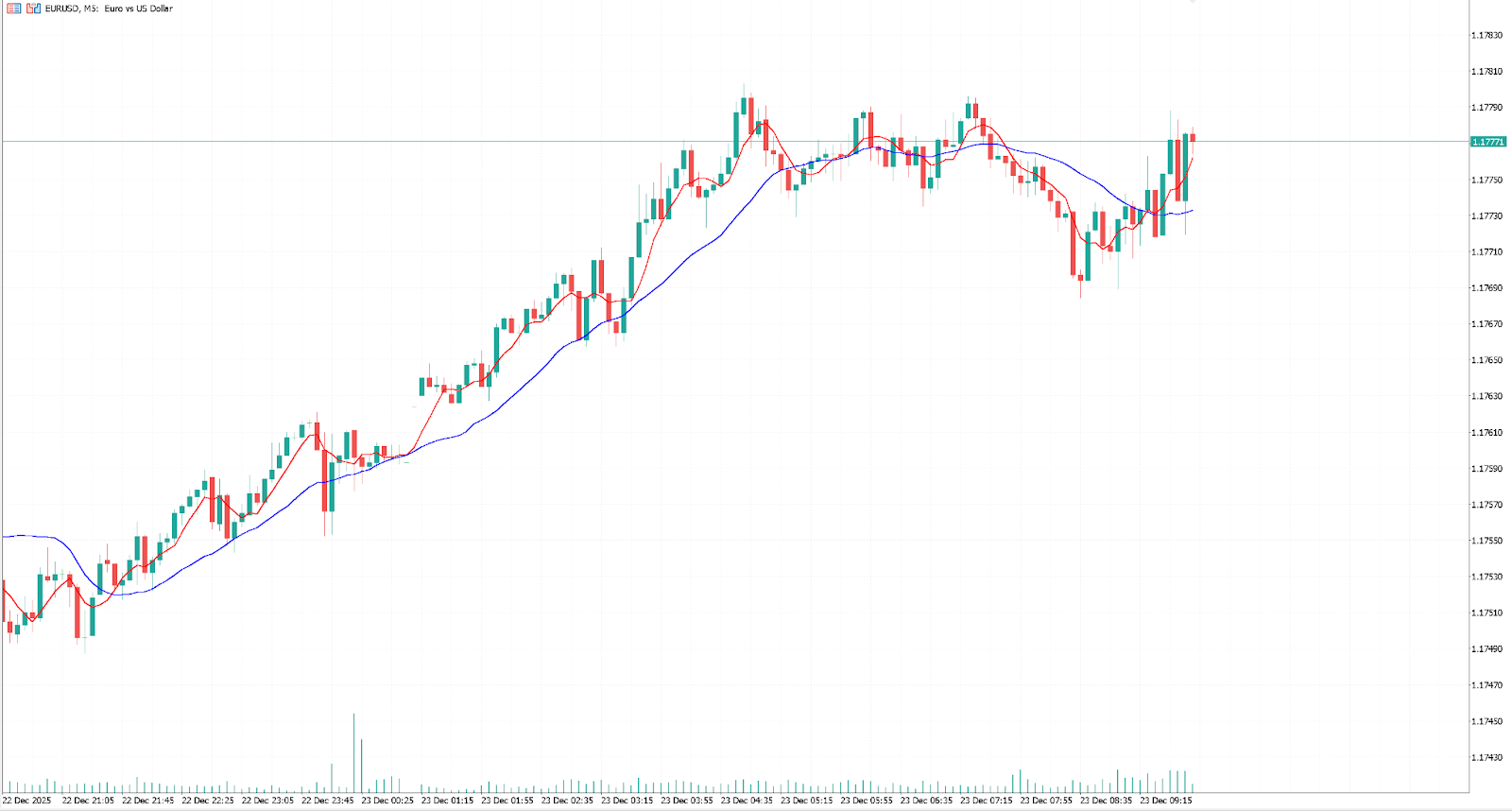
Logic: Unlike mean reversion, this captures Micro-Momentum trends.
Trade Setup: Plot a 5-period SMA and a 20-period SMA.
Signal: When the 5-SMA crosses strongly above the 20-SMA, momentum is bullish. Scalpers enter long and ride the "ribbon" until the price candles close back inside the lines.
Filter: Avoid this in choppy markets; it works best during the London Open volatility.
3. The RSI Momentum Scalp
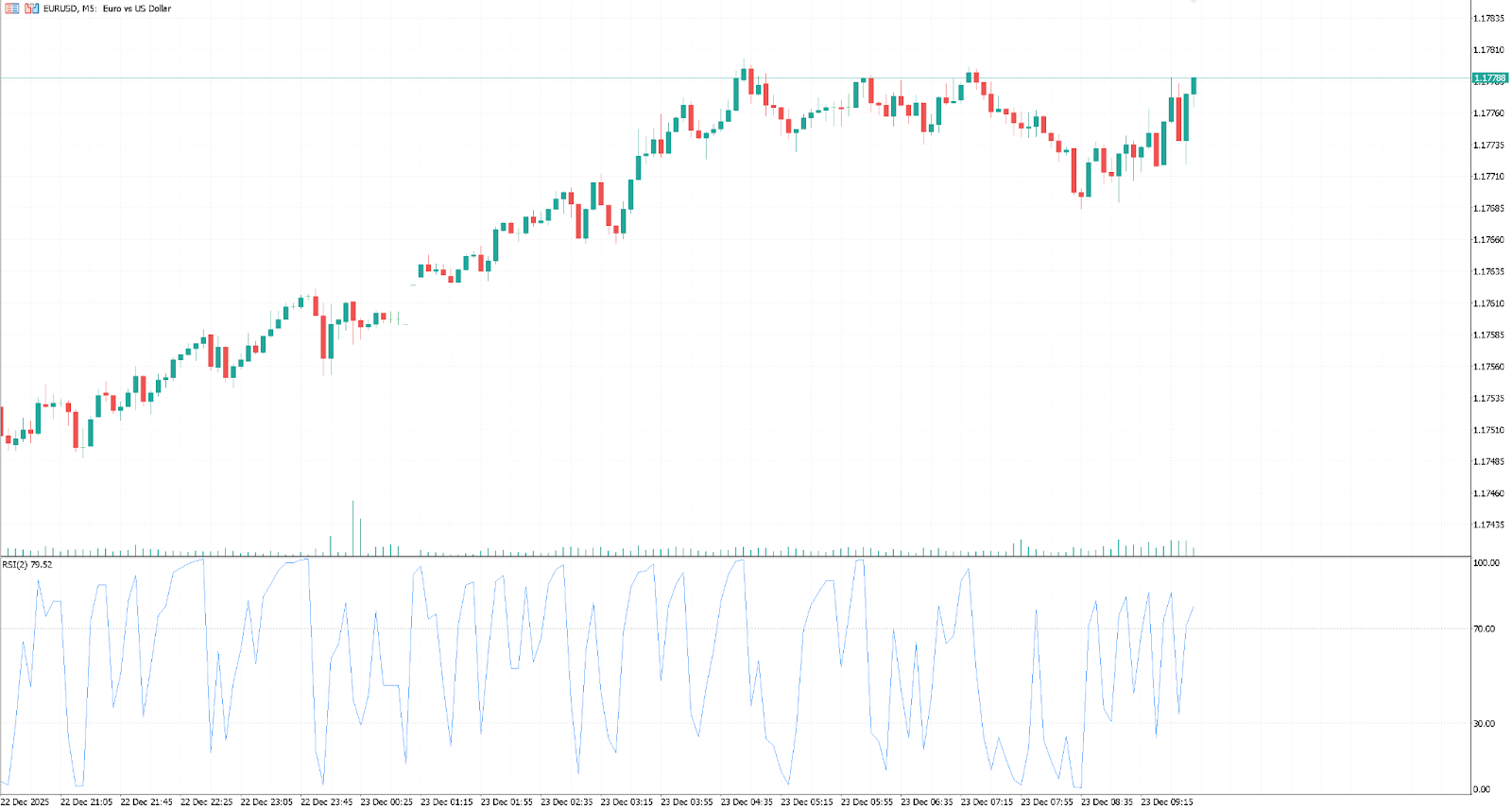
Logic: Standard RSI (14-period) is too slow for scalping. We use a modified RSI to identify Order Flow imbalances.
Trade Setup: Adjust RSI to 2-periods.
Signal: We look for extreme readings. An RSI > 90 indicates aggressive buying pressure (potential exhaustion or breakout), while < 10 indicates selling panic.
Execution: Enter counter-trend when RSI hits 95 or 5, aiming for a quick snap-back of 2–3 pips.
4. Price Action Scalping (No Indicators)
Logic: Indicators lag; price is real-time. This method reads Level II Data and pure candlestick formations at key psychological levels (e.g., 1.1000).
Trade Setup: Look for Pin Bars or Engulfing Candles that reject a Support/Resistance level.
Execution: Enter on the break of the candle wick. Stop loss goes tightly behind the wick.
Pro Tip: Watch the Order Book (Level II). If you see a massive sell wall at a resistance level, front-run it by selling just below.
Pro Tip: The indicator is not the strategy. The execution is the strategy. An indicator only tells you where to look; your discipline tells you when to click.
Essential Tools & Best Conditions
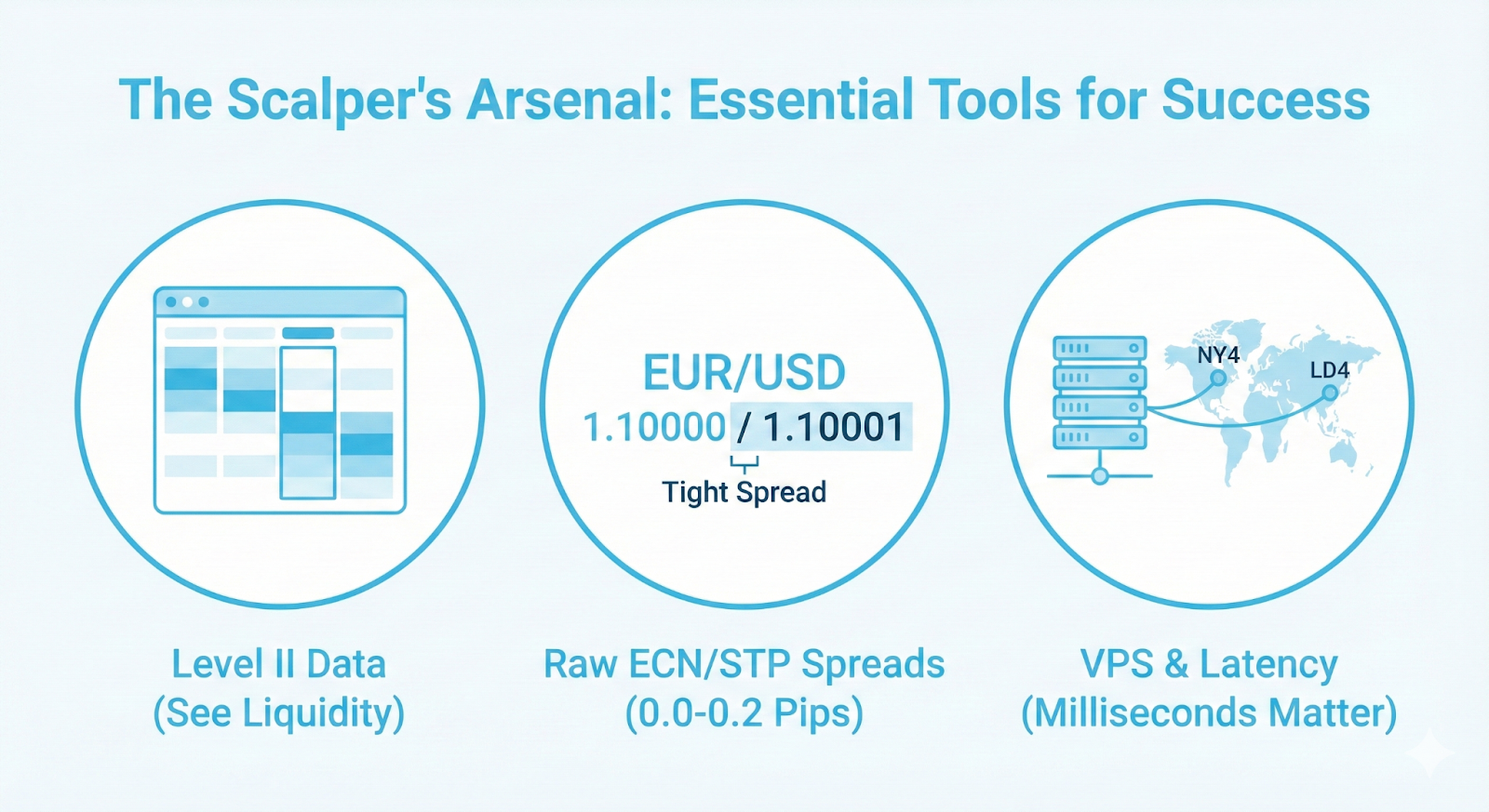
Scalping is an equipment game. You are competing against HFT algorithms; you cannot win with sub-par tools.
Technical Requirements
Level II Data (Depth of Market): You need to see the liquidity available at each price tick. A blind chart is not enough.
Raw Spreads: You must trade on an ECN/STP feed. If the spread on EURUSD is 1.5 pips, scalping is mathematically impossible. You need 0.0–0.2 pips.
VPS & Latency: Serious scalpers use a Virtual Private Server (VPS) located in the NY4 (New York) or LD4 (London) Equinix data centers to reduce execution time to milliseconds.
Hardware Setup
Forget the "6-monitor" myth. You need a Hardwired Ethernet Connection because WiFi fluctuation causes packet loss, and One-Click Trading enabled in MT4/MT5 because you do not have time to confirm order tickets manually.
Best Markets for Scalping
Forex: EURUSD and USDJPY are king due to liquidity and tightest spreads.
Indices: US30 and NAS100 offer massive volatility during the US Open (9:30 AM EST).
Stocks: CFDs are superior to physical shares for scalping. Physical shares often have the Pattern Day Trader (PDT) rule (in the US) and higher commissions. CFDs allow for high leverage and no settlement delays.
Pros vs. Cons of Scalping
Mitigating "Black Swan" Risk
By holding positions for only seconds or minutes, scalpers drastically reduce their Time at Risk. A "Black Swan" event—like a sudden central bank intervention or geopolitical crash—is statistically less likely to hit you during a 30-second trade than a 3-day swing trade.
Risk Management & The Scalper’s Mindset
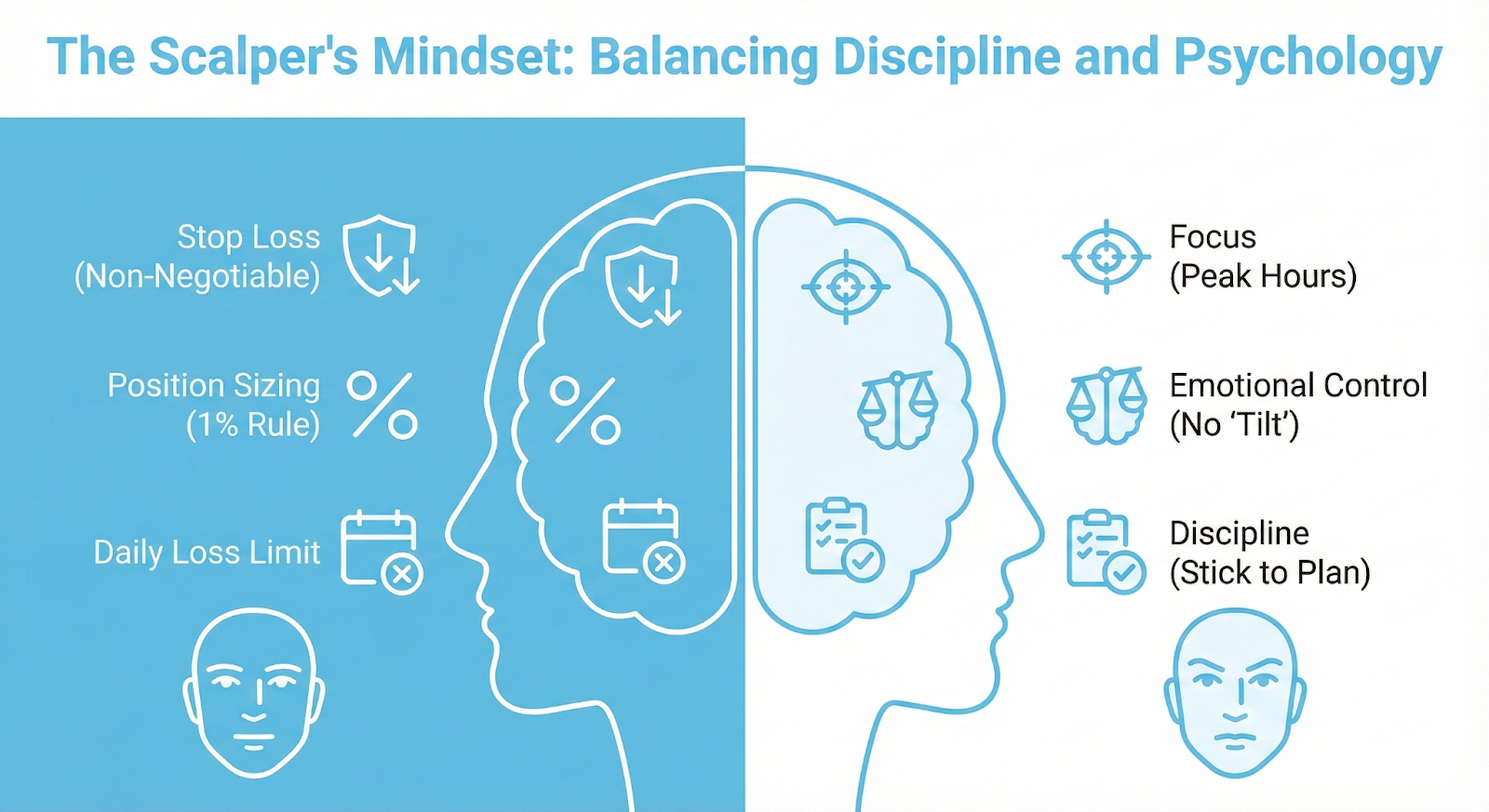
The foundation of staying in the game is the 1% Rule, which dictates that you never risk more than 1% of your total equity on a single trade. In a high-frequency environment where you might execute 50 trades in a session, a losing streak of five or ten trades is statistically inevitable. If you are risking 5% per trade, a single bad morning will lead to a 50% drawdown, a hole that is mathematically nearly impossible to dig out of without reckless gambling.
Beyond position sizing, the use of a non-negotiable hard stop loss is critical. Mental stops are ineffective in scalping because of the speed of market movement; a sudden volatility spike or "fat finger" error can cause slippage that wipes out weeks of profits in seconds. Professional scalpers place a hard stop immediately upon entry or use automated scripts to attach stops instantly. For advanced protection, utilizing Guaranteed Stop Loss Orders (GSLO), if offered by your broker, can cap your downside risk even during market gaps where liquidity disappears.
Finally, managing your psychology is as important as the strategy itself. Scalping induces high cortisol levels and rapid decision fatigue. Most traders experience a decline in cognitive function after two hours of intense focus, leading to "Tilt" or revenge trading. To combat this, strict session limits are necessary. Trade only during peak liquidity windows—such as the London/New York overlap—and walk away immediately if you hit a daily loss limit. Trying to "make back" losses quickly is the fastest path to account bankruptcy.
Important: Don't trust indicators blindly. Look left on the chart. If the stochastic signals a "buy" but price is directly underneath a major resistance level, ignore the signal. A bigger timeframe always trumps small timeframe indicators.