What is the MACD Oscillator?
The Moving Average Convergence Divergence (MACD) oscillator is a widely recognized and extensively used technical analysis tool that traders and analysts employ to assess market momentum. Developed in the late 1970s, it has become an essential instrument for technical analysts aiming to detect potential trend reversals, momentum shifts, and trading opportunities.
The MACD distinguishes itself from other technical indicators by integrating trend-following and momentum oscillation components, offering traders a flexible tool that provides insights across diverse market conditions. Unlike many indicators that generate a single type of signal, the MACD delivers multiple analytical perspectives on price action.
Traders and analysts utilize a range of technical indicators to identify market trends, anticipate potential shifts in trading dynamics, and ultimately execute successful trades or advise clients accordingly. Among these, the MACD has remained popular for decades due to its effectiveness and straightforward application.
History and Development of the MACD
Gerald Appel, a renowned technical analyst and publisher of the "Systems and Forecasts" financial newsletter, developed the Moving Average Convergence Divergence indicator in the late 1970s. His objective was to create a tool capable of identifying changes in trend strength, direction, momentum, and duration in a stock's price movement.
Initially, Appel developed only the MACD line and the signal line. It was not until 1986 that Thomas Aspray enhanced the indicator by introducing the histogram feature, which improved the MACD’s visual clarity and made it easier for traders to interpret.
Despite being over 40 years old, the MACD remains relevant in contemporary trading environments, spanning traditional equity markets, forex, commodities, and cryptocurrency trading. Its longevity underscores its utility and effectiveness across various asset classes and market cycles.
Core Components of the MACD
The MACD indicator comprises three fundamental components that collectively provide traders with critical insights into market momentum and trend conditions:
The MACD Line
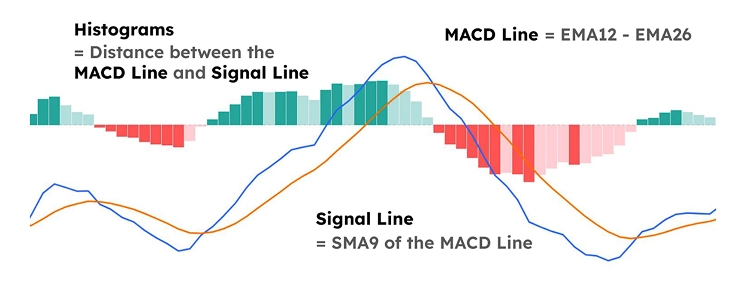
Figure 1: Explanation of the MACD Indicator
The MACD line is the primary element of the indicator and represents the difference between two exponential moving averages (EMAs), typically the 12-period EMA and the 26-period EMA. This line oscillates above and below the zero line (also known as the centerline) as the EMAs converge, cross, and diverge.
When the shorter-term EMA (12-period) rises above the longer-term EMA (26-period), the MACD line moves above zero, signaling increasing bullish momentum. Conversely, when the shorter-term EMA falls below the longer-term EMA, the MACD line dips below zero, indicating growing bearish momentum.
The Signal Line
The signal line is a 9-period EMA of the MACD line itself. It acts as a trigger for buy and sell signals when the MACD line crosses above or below it. The signal line smooths the MACD line’s fluctuations, facilitating the identification of potential entry and exit points.
When the MACD line crosses above the signal line, it generates a bullish signal, suggesting a potential buying opportunity. Conversely, crossing below the signal line produces a bearish signal, indicating a potential selling opportunity.
The MACD Histogram
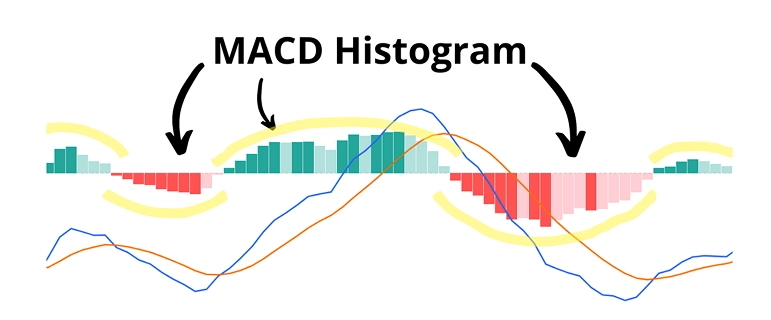
Figure 2: MACD Histogram
The MACD histogram visualizes the difference between the MACD line and the signal line. When the MACD line is above the signal line, the histogram is positive (displayed as bars above zero). When the MACD line is below the signal line, the histogram is negative (bars below zero).
The height of the histogram bars reflects the distance between the MACD line and the signal line. As this gap widens, histogram bars grow taller, indicating strengthening momentum in the trend’s direction. Conversely, shrinking bars suggest weakening momentum.
How is MACD Calculated?
The MACD captures the evolving relationship between short-term and long-term exponential moving averages. Understanding its calculation clarifies how the indicator functions and why it delivers valuable signals.
The fundamental formula for calculating the MACD is:
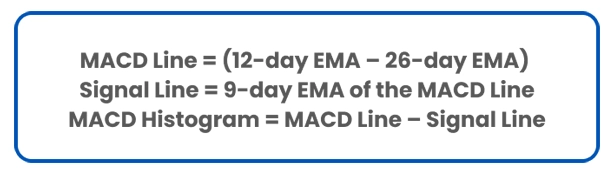
Traders typically use closing prices over 12-day and 26-day periods to compute the EMAs for the MACD calculation. Subsequently, a 9-day EMA of the MACD line itself is plotted as the signal line to help identify potential market turning points.
Step-by-Step Calculation Example
To illustrate the MACD calculation, consider this simplified example:
Calculate the 12-day EMA of the asset's price For an asset trading at various prices over 12 days, calculate the 12-day EMA, weighting recent prices more heavily.
Calculate the 26-day EMA of the asset's price Similarly, calculate the 26-day EMA, which reacts more slowly to price changes than the 12-day EMA.
Calculate the MACD Line Subtract the 26-day EMA from the 12-day EMA. MACD Line = (12-day EMA − 26-day EMA)
Calculate the Signal Line Compute the 9-day EMA of the MACD Line from step 3.
Calculate the MACD Histogram Subtract the Signal Line from the MACD Line. MACD Histogram = MACD Line − Signal Line
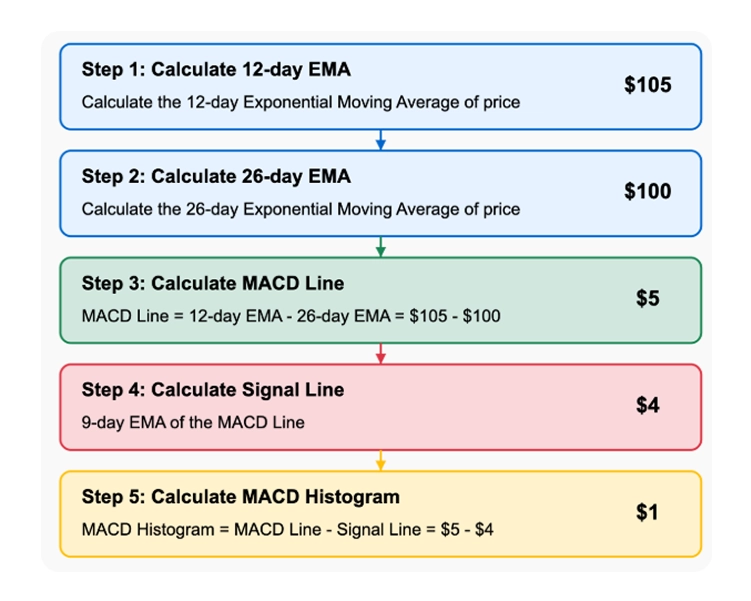
Figure 3: MACD Calculation Process
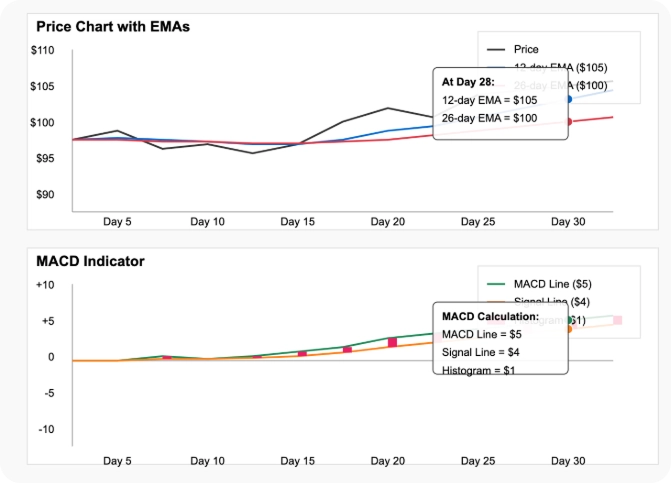
Figure 4: MACD Chart Visualization
For example, if the 12-day EMA is $105 and the 26-day EMA is $100:
MACD Line = $105 − $100 = $5
If the 9-day EMA of the MACD Line (Signal Line) is $4
MACD Histogram = $5 − $4 = $1
Customizing MACD Parameters
While the standard MACD parameters are 12, 26, and 9, traders can adjust these to align with their specific trading strategies or timeframes:
Faster MACD: Using shorter periods (e.g., 5, 13, and 4) creates a more sensitive indicator that generates more signals but may lead to increased false positives.
Slower MACD: Using longer periods (e.g., 19, 39, and 9) results in a more conservative indicator that produces fewer but potentially more reliable signals.
Experienced traders often experiment with different parameter settings to optimize the indicator for their trading style, asset class, and preferred timeframes.
How to Interpret the MACD?
The MACD is based on the movement of moving averages converging or diverging. The indicator oscillates above and below the zero line (centerline). Crossovers of this line signal that the shorter-term moving average has crossed the longer-term moving average, alerting traders to potential trend changes.
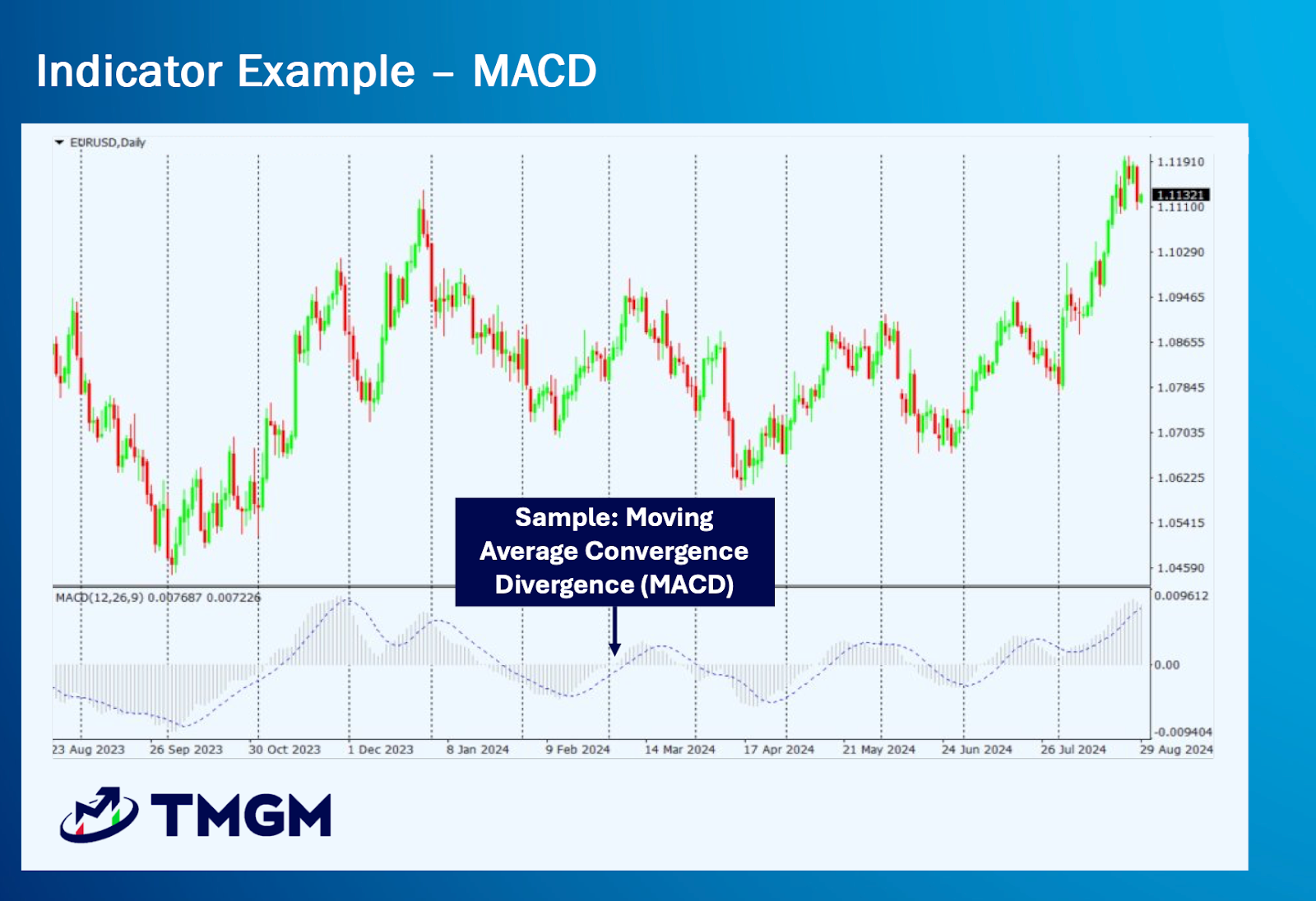
Figure 5: MACD Chart
Crossing the Zero Line
Zero line crossovers occur when the MACD line crosses the centerline, indicating shifts in trend direction:
Bullish Zero Line Crossover: When the MACD line moves from below to above zero, it signals that the 12-day EMA has crossed above the 26-day EMA, indicating a potential uptrend and a buying opportunity.
Bearish Zero Line Crossover: When the MACD line crosses from above to below zero, it indicates the 12-day EMA has fallen below the 26-day EMA, suggesting a potential downtrend and a selling opportunity.
Zero-line crossovers are commonly used to determine overall trend direction: above zero indicates bullish trends; below zero indicates bearish trends.
Crossing the Signal Line
Crossovers between the MACD line and the signal line are key trading signals. The signal line, a 9-day EMA of the MACD line, smooths the oscillator’s movements, making bullish and bearish turns easier to identify.
Bullish Signal Line Crossover: When the MACD line crosses above the signal line, it generates a bullish signal, indicating potential buying opportunities and increasing upward momentum.
Bearish Signal Line Crossover: When the MACD line crosses below the signal line, it produces a bearish signal, suggesting potential selling opportunities and increasing downward momentum.
Signal line crossovers occur more frequently than zero line crossovers, offering more trading opportunities but also a higher risk of false signals, especially in sideways markets.
Moving Average Divergence
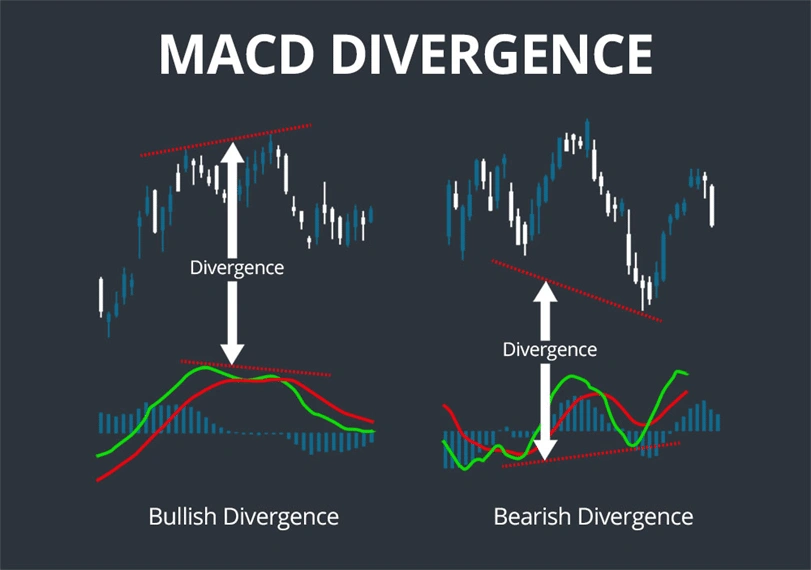
Figure 6: MACD Divergence
Analysts often monitor the MACD for divergences from price action, which can signal potential trend reversals:
Bullish Divergence: Occurs when price forms lower lows while the MACD forms higher lows, indicating weakening bearish momentum and a possible upward reversal.
Bearish Divergence: Occurs when price makes higher highs but the MACD forms lower highs, suggesting waning bullish momentum and a potential downward reversal.
Divergences are considered stronger signals when they appear after prolonged price moves and when the MACD is significantly above or below zero.
Histogram Analysis
The MACD histogram offers additional insight into momentum shifts:
Increasing Positive Histogram: Growing histogram bars above zero indicate strengthening bullish momentum.
Decreasing Positive Histogram: Shrinking bars above zero suggest weakening bullish momentum, potentially signaling an impending bearish crossover.
Increasing Negative Histogram: Expanding bars below zero indicate strengthening bearish momentum.
Decreasing Negative Histogram: Contracting bars below zero imply weakening bearish momentum, possibly preceding a bullish crossover.
Histogram analysis is valuable for detecting early momentum changes prior to actual crossovers, enabling traders to anticipate trend shifts.
Finding Entry and Exit Points with MACD
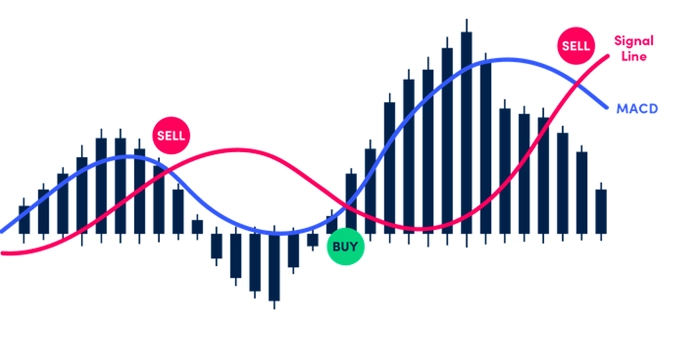 Figure 7: Entry and Exit Points
One of the MACD’s key uses is identifying potential trade entry and exit points. Proper interpretation of MACD signals can significantly improve trade timing and outcomes.
Entry Points Using MACD
The MACD generates several signals that can serve as entry points:
1. Signal Line Crossovers The most common buy signal occurs when the MACD line crosses above the signal line:
Buy Signal: MACD line crosses above the signal line
Stronger Buy Signal: When this crossover occurs below zero, it may indicate a reversal from a downtrend
2. Zero Line Crossovers When the MACD line crosses above zero, it indicates the shorter-term EMA has crossed above the longer-term EMA:
Buy Signal: MACD line crosses above zero, suggesting a new uptrend
3. Bullish Divergence A powerful MACD signal:
Buy Signal: Price makes a new low, but MACD forms a higher low
This suggests weakening bearish momentum despite falling prices
4. Histogram Reversals
Buy Signal: Histogram bars start growing from negative territory (becoming less negative)
This can signal an early momentum shift before a MACD line/signal line crossover
Exit Points Using MACD
Similarly, the MACD helps identify optimal exit points:
1. Signal Line Crossovers
Sell Signal: MACD line crosses below the signal line
Stronger Sell Signal: When this crossover occurs above zero after a prolonged uptrend
2. Zero Line Crossovers
Sell Signal: MACD line crosses below zero, indicating a shift from bullish to bearish momentum
3. Bearish Divergence
Sell Signal: Price makes a new high, but MACD forms a lower high
This suggests weakening bullish momentum despite rising prices
4. Overextended MACD
Sell Signal: MACD line extends significantly above the signal line
This often signals an overbought condition likely to correct
Practical MACD Trading Tips
Avoid False Signals: Confirm MACD signals with other technical indicators or price action before executing trades.
Consider the Trend: MACD signals are most effective when aligned with the prevailing market trend.
Timeframe Matters: Signals on higher timeframes (daily, weekly) tend to be more reliable than those on lower timeframes (1-minute, 5-minute).
Signal Strength: Stronger crossovers (wider separation between MACD and signal line) often indicate more significant moves.
Look for Confluence: The most robust trading opportunities arise when multiple MACD signals coincide.
Mind the Context: The implications of a signal line crossover vary depending on its position relative to the zero line.
Example MACD Entry and Exit Strategy
Here's a straightforward MACD trading strategy commonly used by traders:
Entry (Buy):
Wait for the MACD line to cross above the signal line
Confirm that the histogram bars are increasing in height
Ensure the crossover aligns with the overall trend
Look for supporting price action, such as a bounce off a support level
Exit (Sell):
When the MACD line crosses below the signal line
When a bearish divergence forms after a prolonged uptrend
When profit targets based on other technical analysis are met
When your predetermined stop-loss level is triggered
Remember, while the MACD is a powerful tool, no indicator is infallible. Always apply sound risk management practices regardless of the strength of a MACD signal.
MACD Trading Strategies
The MACD’s versatility makes it suitable for various trading strategies. Below are some common and effective MACD-based approaches:
MACD Crossover Strategy
The MACD crossover strategy is among the most popular MACD trading methods:
Entry Rules:
For long positions: Enter when the MACD line crosses above the signal line while both are below zero.
For short positions: Enter when the MACD line crosses below the signal line while both are above zero.
Exit Rules:
For long positions: Exit when the MACD line crosses below the signal line.
For short positions: Exit when the MACD line crosses above the signal line.
This strategy performs best in trending markets and can be improved by considering the overall trend and using additional confirmation indicators.
Zero Line Crossover Strategy
The zero-line crossover strategy targets major trend shifts:
Entry Rules:
For long positions: Enter when the MACD line crosses above zero.
For short positions: Enter when the MACD line crosses below zero.
Exit Rules:
For long positions: Exit when the MACD line crosses below zero.
For short positions: Exit when the MACD line crosses above zero.
This approach typically yields fewer signals than the MACD crossover strategy but may capture more significant trend reversals.
Divergence Trading Strategy
The divergence strategy focuses on discrepancies between price action and MACD readings:
Entry Rules:
For long positions: Enter on bullish divergence (price makes lower lows while MACD makes higher lows).
For short positions: Enter on bearish divergence (price makes higher highs while MACD makes lower highs).
Exit Rules:
For long positions: Exit at prior resistance or upon bearish divergence formation.
For short positions: Exit at prior support or upon bullish divergence formation.
Divergence strategies can provide early reversal signals but require experience to interpret accurately.
Limitations of the MACD
While the MACD is a versatile and popular indicator, it has limitations:
Lagging Indicator: Being based on moving averages, the MACD inherently lags price action. Signals often occur after a significant portion of a move has transpired.
False Signals: The MACD can produce false signals, particularly in choppy or sideways markets, leading to unprofitable trades.
No Volatility Adjustment: Unlike volatility-based indicators such as Bollinger Bands or Average True Range, the MACD does not account for market volatility, which can affect signal reliability.
Standardized Settings: The default 12, 26, and 9 settings may not suit all assets or timeframes. Customization requires experience and thorough testing.
No Support/Resistance Levels: The MACD does not identify specific support or resistance price levels, which are important for setting stop-losses and profit targets.
Awareness of these limitations enables traders to use the MACD more effectively, often by combining it with complementary indicators or adjusting their strategies accordingly.
The Bottom Line
The MACD is a flexible technical indicator that merges trend-following and momentum analysis, making it valuable across various market conditions. Its capacity to identify trend changes, momentum shifts, and potential reversals has sustained its popularity among traders for decades.
Exercise caution when the signal line crossover occurs at extreme highs or lows. Similarly, shallow or plateauing crossovers warrant vigilance. Underlying asset volatility can cause atypical MACD behavior.
For optimal use of the MACD, consider these best practices:
Use Multiple Timeframes: Analyze MACD on higher timeframes to gauge the overall trend, then use lower timeframes for precise entries.
Combine with Other Indicators: Confirm MACD signals with complementary indicators to reduce false positives.
Consider Market Context: Interpret MACD signals differently depending on whether the market is trending, ranging, or volatile.
Practice Patience: Wait for clear, strong signals rather than trading every crossover.
Implement Proper Risk Management: Always apply appropriate stop-loss orders and position sizing regardless of signal strength.
Regular practice with the MACD will enhance your understanding of its typical patterns and help you recognize significant or unusual movements. The more you incorporate this versatile indicator into your trading, the more effective it will become.
Start Trading with MACD at TMGM
Ready to integrate MACD analysis into your trading strategy? TMGM provides advanced charting platforms featuring MACD indicators, enabling traders to effectively apply this technical analysis tool.
Why Choose TMGM for Your Trading Needs:
Advanced Charting Platforms – Access professional-grade charting with customizable MACD settings and multi-timeframe analysis.
Educational Resources – Learn to trade MACD through comprehensive guides, webinars, and expert insights.
Efficient Order Execution – Execute trades with competitive speeds.
Competitive Spreads – Trade with low spreads across various instruments.
Trading Support – Receive assistance from our market analysts.
Risk-Free Practice – Test MACD strategies with virtual funds on a free demo account.
Join thousands of successful traders who rely on TMGM's powerful technical analysis tools and expert guidance. Experience the TMGM advantage in your MACD trading journey.