

Trading
Explore a wide range of markets with competitive pricing, deep liquidity, and advanced trading tools.
Learn More 
Platform
Trade seamlessly with TMGM's powerful platform, built for speed, precision, and a superior trading experience.
Learn More Trading Platform
Academy
Learn the fundamentals of trading with beginner-friendly resources, including guides, webinars, and market insights.
Learn More News & Analysis
Get real-time market updates and expert analysis to stay ahead of trading opportunities
Learn More News & Analysis
About
Learn what sets TMGM apart — our global presence, regulatory strength, and commitment to innovation in trading.
Learn More Why Choose TMGM
Sponsorship
Nasdaq 100 underperforms as hot CPI and Nvidia drag US indices lower
- About a sixth of Monday's rebound erased across NASDAQ, SPX and DJIA.
- 5% breached by the 10-year yield as Fed Governor Waller raises the prospect of a half-point December hike.
- 1.3% September surge precedes Friday's October producer price release.
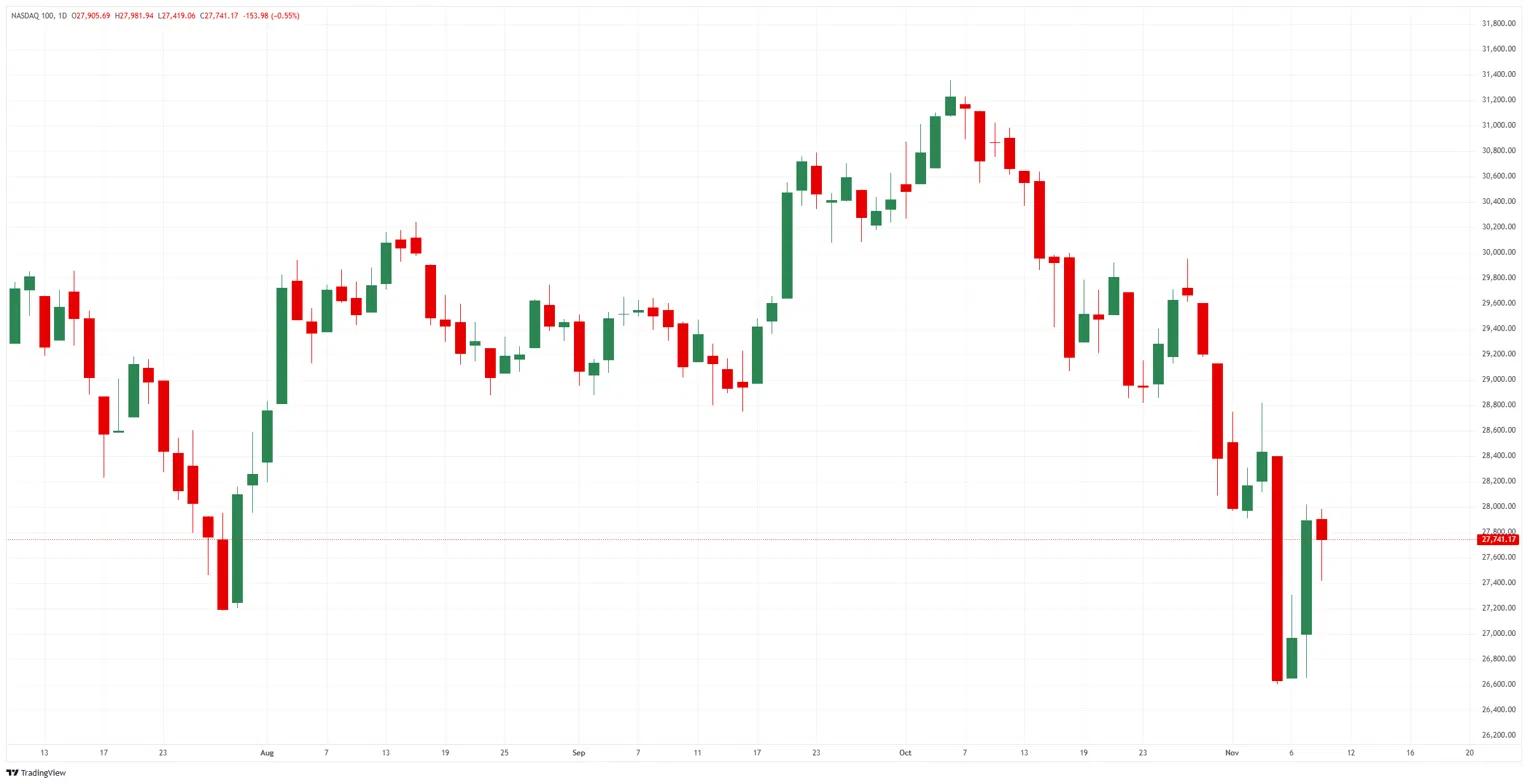
About a sixth of Monday's rebound has been erased across all three US stock indices. A strong October Consumer Price Index (CPI) reading and discussion of a half-point Fed rate increase prompted the retreat. Having surrendered about half of Monday's advance and touched a session low just above 27,400, the Nasdaq 100 now trades back near 27,750. Meanwhile, the S&P 500 stands near 7,525, with the Dow Jones Industrial Average near 52,250.

At 0.4%, October's consumer price increase exceeded the 0.3% forecast. Fed Governor Waller had indicated that an upside surprise of this kind could warrant a half-point December rate rise. No annual reading accompanied the release because the 2025 government shutdown left October 2025 without a figure. The annual rate returns on December 10, one day after the Fed's decision. Back above 5%, the 10-year Treasury yield is weighing on equity valuations: higher yields reduce what stock buyers will pay for future earnings.
After trailing Monday's rally, Nvidia (NVDA), the world's most valuable company, is declining and pulling all three indices lower. Its retreat comes after Chief Executive Jensen Huang admitted to an affair with a woman accused of spying for China. With a greater weighting in chip stocks than the other two benchmarks, the NASDAQ 100 is recording the largest fall of the three.
Key releases and Fed speakers
Tuesday's speaking schedule includes Fed Vice Chair for Supervision Bowman and Philadelphia Fed President Paulson at 23:30 GMT. Cleveland Fed President Hammack follows on Thursday at 14:00 GMT. Each has a vote on the December 8-9 decision. Traders regard a rate rise as close to certain, making their remarks relevant to the size of the increase.
A rise to 195K from 189K is forecast for weekly jobless claims, due on Thursday at 13:30 GMT. Friday brings October producer prices at 13:30 GMT, with a 0.4% increase expected following September's 1.3% surge. That release is the next inflation reading relevant to the prospect of a half-point hike.
NASDAQ 100 recovers about a quarter of its decline
About a quarter of the NASDAQ 100's decline from its October 6 peak near 31,350 has now been recovered. For the S&P 500, the recovery from the November 6 low near 7,325 towards October's peak just below 7,850 is about two-fifths complete. Since mid-September, the Dow Jones Industrial Average has stayed within a 50,500-53,800 range and now sits near its midpoint.
Daily chart: Nasdaq 100 index
Nasdaq: key questions answered
Before becoming a US stock exchange, the Nasdaq began as an electronic machine providing stock quotations. Its initial role was limited to quoting over-the-counter (OTC) stocks; it subsequently developed into an exchange. By 1991, its share of the entire US securities market had reached 46%. In 1998, it became the first US stock exchange to offer online trading. Several indices are also produced by the Nasdaq, including the Nasdaq 100 and its broadest measure, the Nasdaq Composite, which represents all 2,500-plus stocks listed on the exchange.
Comprising 100 non-financial companies listed on the Nasdaq stock exchange, the Nasdaq 100 is a large-cap index. Its constituents represent only a small proportion of the exchange's thousands of stocks, yet account for over 90% of the movement. Market capitalisation determines each company's weighting and therefore its influence on the index. Technology-focused businesses feature prominently, alongside companies in other sectors and those based outside the US. Since 1986, the Nasdaq 100 has delivered an average annual return of 17.23%.
Traders can access the Nasdaq 100 through several instruments. Contracts for Difference (CFD) are offered for bets by most retail brokers and spread betting platforms. Longer-term investors can use Exchange-Traded Funds (ETFs), which trade like shares and track the index's movements without requiring purchases of all 100 constituent companies. The Invesco QQQ Trust (QQQ) is one such ETF. Futures contracts on the Nasdaq 100 enable speculation on the index's future direction. Options, meanwhile, confer the right, without imposing an obligation, to buy or sell the Nasdaq 100 at a specified future price, known as the strike price.
The combined performance of its constituent companies, as reported in quarterly and annual earnings releases, is the principal driver of the Nasdaq 100, although many other factors play a role. Macroeconomic releases from the US and elsewhere influence investor sentiment; positive sentiment supports gains. Interest rates set by the Federal Reserve (Fed) also matter because they determine borrowing costs for the many corporations that rely heavily on credit. Inflation can therefore be a significant influence, alongside other indicators that shape the Fed's decisions.
POPULAR ARTICLES
1Nearly half of New Zealand Dollar’s election gain erased on US CPI2159.00 in sight for yen as Treasury yields return above 5%3Euro edges towards range lows as US rate bets rise41.34 gives way again as pound retreats after hot US inflation report5Nasdaq 100 underperforms as hot CPI and Nvidia drag US indices lower6CPI points to persistent US inflation pressures, Fed’s Bowman warns7Underlying inflation may rise as energy prices decline, warns ECB’s Lane8Inflation extends beyond energy as policy remains loose, Fed’s Schmid warns9$700 million in liquidations as hot US inflation drives Bitcoin, crypto market lower


Get Started!
Sign up and access the Global Markets in less than 3 minutes

Connect With Us












The information provided on this website is of a general nature only and does not constitute personal financial advice. Before acting on any information on this website, you should consider the suitability of the information in relation to your objectives, financial situation and needs. Investing in CFDs and FX Margin Contracts carries significant risks and is not suitable for all investors. You may lose more than your initial deposit. You do not own, or have, any interest in the underlying asset. We recommend that you seek independent advice and ensure you fully understand the risks involved before trading. It is important that you read and consider the disclosure document before you acquire any product listed on the website. The information and advertisements offered on this website are not intended for use by any person in any country or jurisdiction where such use would be contrary to local laws and regulations. The Products and Services offered on this website are not intended for residents of the United States, Malaysia and Thailand.
TMGM is authorized and regulated in various jurisdictions.
Trademax Australia Limited, trading as TMGM, is regulated by the Australian Securities and Investments Commission (ASIC), AFSL no. 436416 and is located at Level 28, One International Tower, 100 Barangaroo Avenue, 2000 Sydney, NSW Australia.
Email: support@tmgm.com.au
Trademax Global Limited, trading as TMGM, is authorized and regulated by the Vanuatu Financial Services Commission (VFSC), registration number 40356 and registered at 1276, Kumul Highway, Port Vila, Vanuatu, Republic of Vanuatu.
Email: support@tmgm.com
Trademax Global Markets (SE) Limited, trading as TMGM, is authorized and regulated by the Financial Services Authority (FSA) of Seychelles, with license number SD224. The company is registered at Office No 13, Providence Estate ABIS Centre, Mahe, Seychelles.
Email: support@tmgm.com
Trademax Global Markets (International) Pty Ltd, trading as TMGM, is authorized and regulated by the Financial Services Commission, Mauritius (FSC) with license no. GB22201012, and registered at 33, Edith Cavell Street C/o IQ EQ Fund Services (Mauritius) Ltd Port Louis, 11324 Mauritius.
Email: support@tmgm.com
Copyright © TMGM. All rights reserved